USCCA Free 2026 Concealed Carry Reciprocity Map: What You Need To Know
A practical, compliance-first overview of how multi-state carry recognition works, what "free map" opt-ins may involve, and how to confirm current rules through official state and federal sources.
WEST BEND, Wis., February 28, 2026 (Newswire.com) - Disclaimers: This article is for informational purposes only and does not constitute legal advice. Concealed carry and firearms laws vary significantly by state and jurisdiction and are subject to change at any time. Verify current laws in your area before carrying in any jurisdiction. Nothing in this article is intended to encourage illegal activity, illegal carry, or carrying firearms in any jurisdiction where doing so is prohibited. This article contains affiliate links. If you submit your information or make a purchase through links in this article, a commission may be earned at no additional cost to you. This compensation does not influence the accuracy or integrity of the information presented.
Free Concealed Carry Gun Laws and Reciprocity Map: 2026 Guide to Permit Reciprocity, Travel Verification, and Download Disclosures
You saw the ad. It might have been on Facebook between a recipe video and a news story. Maybe it popped up on YouTube before a hunting channel. Maybe it found you on Instagram while you were scrolling through gear reviews. Wherever it appeared, it said something that stopped you: laws do not pause during social unrest. Download your free 2026 gun law map.
And now you are here. Doing exactly what a responsible gun owner does before handing over personal information - checking whether this free concealed carry reciprocity map from the USCCA is actually worth your time, what you are agreeing to when you download it, and whether the organization behind it is one you can trust.
Good. That kind of due diligence is the difference between a responsible gun owner and someone who just owns a gun. This guide is going to give you everything you need to make that call - not just about the map itself, but about the concealed carry reciprocity landscape heading into 2026, the legal complexities most gun owners do not fully understand, and whether the broader USCCA ecosystem deserves your attention after you grab the free download.
Download the free 2026 Concealed Carry Reciprocity Map here
Disclosure: If you buy through this link, a commission may be earned at no extra cost to you.
Before Anything Else: Your Legal Responsibility as a Gun Owner
Before we talk about the map, the USCCA, reciprocity agreements, or anything else, there is something that matters more than all of it.
You are legally responsible for knowing and following the firearms laws in every single jurisdiction you enter. Not the jurisdiction you live in. Not the jurisdiction where you got your permit. Every jurisdiction you physically enter while carrying a firearm. That includes the state you are driving through on the way to your destination. That includes the county within a state that might have local ordinances beyond the state statute. That includes federal properties like post offices, courthouses, and military installations, which operate under entirely separate rules.
No map, no app, no organization, and no article - including this one - can substitute for that personal responsibility. According to the USCCA's own terms of use (effective January 29, 2026), the educational content on their websites "does not constitute legal advice" and is not intended to create an attorney-client relationship between you and the USCCA or its affiliates. They are being honest about that limitation, and you should take it seriously.
Here is what you should always do before carrying in any state or jurisdiction. Verify current reciprocity agreements directly with the destination state's attorney general office or state police. Confirm whether your specific permit type - resident versus non-resident - is honored in that jurisdiction. Review state-specific restrictions on where you can and cannot carry, because prohibited locations like schools, government buildings, houses of worship, bars, and certain businesses vary widely from state to state. Understand the difference between Shall Issue, May Issue, and Constitutional Carry designations in every state you plan to visit. Consult a licensed attorney in your jurisdiction for advice regarding your specific situation.
A concealed carry reciprocity map is a starting point. A visual reference tool. A way to orient yourself before diving into the actual statutes. It is not a legal document, it is not legal advice, and it should never be the last thing you check before crossing a state line with a firearm.
With that foundation in place, let us discuss why this resource exists, what it offers, and whether it has a place in your planning.
Why Concealed Carry Reciprocity Is One of the Most Misunderstood Topics in Gun Ownership
If you have been carrying for years, you might assume you already understand reciprocity. Most people who carry regularly think they do. And most of them are wrong about at least one critical detail.
Here is the core problem. Unlike your driver's license, which every state in the country honors, your concealed carry permit is only valid in states that have agreed to recognize it. Those agreements - called reciprocity agreements - vary dramatically depending on where your permit was issued, whether you hold a resident or non-resident permit, what training your issuing state requires, and how the destination state classifies out-of-state permits.
The result is a patchwork that changes constantly. A weekend road trip from Virginia to New England could take you through jurisdictions where your permit is fully honored, jurisdictions where it is not recognized at all, and jurisdictions with more restrictive carry and transport rules where out-of-state visitors should exercise particular caution. Travelers should always verify state statutes and official guidance before crossing borders - some states impose significant penalties for firearms violations, and "I didn't know" is generally not a legal defense.
In some jurisdictions, mistakes related to recognition status or prohibited locations can result in serious legal consequences - even for responsible, law-abiding gun owners who were just passing through. And the complexity has only increased as more states change their laws.
The Three Concealed Carry Frameworks You Need to Understand
Every state in the country falls into one of three concealed carry categories. Understanding these categories is essential before any reciprocity map makes sense.
Shall Issue states are jurisdictions where the issuing authority is required by law to grant a concealed carry permit to any applicant who meets the statutory requirements. If you meet the criteria - which typically includes age requirements, background checks, and sometimes training - the authority must issue the permit. There is no discretion involved. The majority of U.S. states operate under shall-issue frameworks.
May Issue states give the issuing authority discretion in granting permits. Even if you meet every statutory requirement, the authority can deny your application based on additional criteria, often described as "good cause" or "justifiable need" requirements. According to the USCCA's own reciprocity resources and independent references like USA Carry's state-by-state database, these jurisdictions tend to issue far fewer permits per capita. As of early 2026, states including California, Maryland, Massachusetts, and New Jersey operate under some form of May Issue framework, though the specific requirements and practical accessibility vary significantly between them.
Constitutional Carry states - also called permitless carry states - allow law-abiding adults to carry concealed firearms without obtaining a government-issued permit. As of early 2026, according to the USCCA's reciprocity resources and independent tracking references, a majority of U.S. states have adopted some form of permitless (constitutional) carry. That number has grown rapidly, with multiple states adopting permitless carry in recent years, and the most recent additions including South Carolina and Louisiana.
Here is the critical detail that catches people off guard, and it is the single most important thing to understand about constitutional carry. Constitutional carry recognition does not extend beyond that state's borders. The moment you cross a state line, permitless carry from your home state no longer applies. If you drive from a constitutional carry state into a state that requires a permit, and you do not have a recognized permit, you may be in violation of that state's law - regardless of what is permitted back home.
This is exactly why firearms training organizations, legal experts, and the USCCA itself recommend obtaining a concealed carry permit even if your home state does not require one. A permit gives you reciprocity options. Constitutional carry alone gives you nothing the moment you leave your state.
Related: Mastering Handgun Skills at Home Guide
Why Getting a Permit Still Matters Even in Permitless Carry States
If your state does not require a permit, you might wonder why you would bother getting one. The answer comes down to one word: reciprocity.
A concealed carry permit from your home state can extend your carry recognition to 35 or more other states through reciprocity agreements, depending on which state issued your permit. Without a permit, your ability to carry ends at your state border. With one, you potentially gain recognized carry status across the majority of the country.
Beyond reciprocity, there are other practical reasons. Some states that honor out-of-state permits will only honor permits that required training to obtain. A permit also serves as an additional form of identification during interactions with law enforcement. And in some jurisdictions, permit holders may skip certain background check steps when purchasing new firearms because the permit process itself includes a thorough background screening.
The combination of your home-state permit plus one or two strategically chosen non-resident permits from states like Utah or Florida - which are widely recognized - can significantly expand your reciprocity coverage. This is the kind of strategic thinking that a good reciprocity map helps you start planning.
The Reciprocity Complexity Problem: Why a Map Actually Matters
If reciprocity were as simple as "my state honors your permit, your state honors mine," you would not need a map. But the reality is layered with distinctions that trip people up.
Resident versus non-resident permits are treated differently. A state might honor your Florida resident permit but refuse to recognize a Florida non-resident permit. Another state might honor permits from any state, but only if the holder is a resident of the issuing state. This distinction alone creates confusion for millions of permit holders, especially those who hold multiple permits from different states.
Training requirements affect recognition. Some states only honor permits from states with "substantially similar" training requirements. If your home state requires a four-hour class and the state you are visiting requires an eight-hour class, your permit may not meet their standard - even if the two states have a reciprocity agreement on paper.
Reciprocity agreements change. Bilateral agreements between states are subject to legislative action. A reciprocity agreement that existed last year may have been modified, expanded, or revoked. States occasionally change their recognition lists with relatively little public notice, and the gap between a law changing and that change being reflected in online resources can leave travelers relying on outdated information.
Federal properties operate under separate rules. Federal gun-free zones apply regardless of state carry laws. U.S. Postal Service property prohibits firearms under 39 CFR 232.1. Federal courthouses and federal buildings are restricted under 18 U.S.C. 930. Air travel with firearms is governed by TSA regulations, which require firearms to be unloaded, locked in a hard-sided container, and declared at check-in - with no firearms permitted beyond TSA security checkpoints. National parks generally follow the carry laws of the state they are located in under 54 U.S.C. 104906, but buildings within national parks (visitor centers, ranger stations) may have separate federal restrictions. U.S. military installations generally maintain their own restrictions under base regulations that may differ substantially from the surrounding state's laws. Base regulations control on military property, and these restrictions apply regardless of your permit status or the state you are in.
Specific locations within states have their own prohibitions. Even in the most gun-friendly states, there are places where carrying is prohibited or restricted. Schools, government buildings, courthouses, polling places, and establishments that serve alcohol are common restricted areas, but the specific list varies from state to state. Some states prohibit carry in houses of worship unless explicitly authorized. Others restrict carry at public gatherings or sporting events. The details matter, and they are not the same anywhere.
These layers of complexity are precisely why a regularly updated, visual reference tool has value. A well-maintained reciprocity map does not replace your obligation to verify current law - but it gives you a starting framework that is far more efficient than Googling 50 individual state statutes.
What Is the USCCA Free 2026 Concealed Carry Reciprocity Map?
Now let us get specific about the resource that likely brought you here.
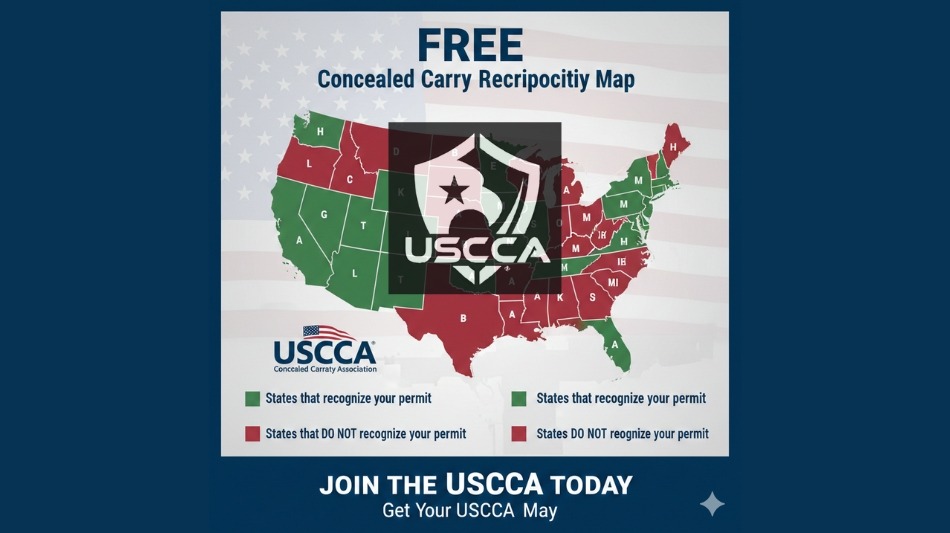
The product being promoted is a free downloadable 2026 Gun Law Map offered by the United States Concealed Carry Association, commonly known as the USCCA. According to the landing page for this offer, the map provides a state-by-state breakdown of concealed carry laws, including information about permit types, reciprocity agreements, and what the organization describes as guidance to help you "take the guesswork out of carrying."
According to the company, the map covers three primary areas.
The first is your rights by state. This includes each state's concealed carry designation - Shall Issue, May Issue, or Constitutional Carry - along with information about what it takes to obtain a concealed carry permit where you need one.
The second is how to get your permit. According to the landing page, this includes state-specific guidance on the permit application process, requirements, and what to expect when you apply.
The third is traveling with your permit. This covers whether your existing permit will be honored in the states you are passing through and traveling to - the core reciprocity question that drives most people to seek out this kind of resource in the first place.
The landing page displays a running download total at the time of access. Tim Schmidt, identified on the landing page as the USCCA's Chairman and Co-Founder, describes the map as "an important, FREE tool" that, according to the landing page, "can help you AVOID making a mistake that could land you in jail, or worse."
Who Is Behind This Map? Understanding the USCCA, Delta Defense, and the Organization's Structure
Transparency about who you are giving your contact information to matters. Especially in a space where trust is earned, not assumed. Here is what is publicly verifiable about the organization behind this resource.
The United States Concealed Carry Association is a South Carolina-incorporated organization that, according to its published materials, serves responsible gun owners who want to protect their families. The USCCA is perhaps best known for its self-defense liability protection - an insurance benefit that comes as part of paid membership - but the organization's footprint extends well beyond insurance into education, training, and community.
Delta Defense, LLC is the operational company behind the USCCA. According to the company's own disclosures, Delta Defense provides sales, marketing, operations, and administrative support services to the USCCA. Delta Defense is headquartered at 1000 Freedom Way in West Bend, Wisconsin, and according to its published information, is a licensed insurance agency in all 50 states and the District of Columbia. According to their California licensing information, Delta Defense does business as Delta Defense Insurance Services in California, holding license number 0M34093.
The relationship between these two entities matters for one practical reason. When you download the free map, you are interacting with Delta Defense's marketing infrastructure, not just downloading a standalone PDF file. The free map is an entry point into the broader USCCA membership ecosystem. That is not a criticism - it is a standard and legitimate business model for membership organizations. But it is a fact worth understanding before you submit your personal information.
According to the company's landing page, all customer-facing representatives are employed by Delta Defense, LLC.
What Happens When You Submit Your Information: Read This Section Carefully
This is the section most people skip. It is also the most important section for anyone who values knowing exactly what they are agreeing to before they agree to it.
Before submitting the download form, review the consent language on the landing page carefully. According to the form's disclosure text, by submitting your information you authorize the following. You authorize the USCCA and its affiliates to make or allow the placement of recurring marketing calls, emails, and text messages to you at the phone number you provide, including the use of automated technology, or a prerecorded or artificial voice. The disclosure further states that you are not required to provide your phone number as a condition of purchasing any property, goods, or services. According to the form, your contact information is never shared, and you can opt out at any time by texting "Stop" to 87222. The disclosure notes that message and data rates may apply.
In plain language, downloading this free map means signing up for an ongoing marketing relationship. You will likely receive calls, texts, and emails promoting USCCA membership and related products and services after you download the map. This is standard practice for lead-generation offers across many industries - the FCC provides consumer guidance on managing unwanted calls and texts at fcc.gov if you want to understand your rights regarding automated communications. The USCCA is transparent about it in their consent language - the disclosure is right there on the form - but experience suggests that many people click "submit" without reading it.
If you prefer not to enter a marketing relationship, the landing page indicates you can reach the company directly by calling 1-877-987-7443 instead of submitting the online form. According to the company, all representatives at that number are employed by Delta Defense, LLC.
Download the free 2026 Gun Law Map here
What You Get Beyond the Map: Understanding the USCCA Membership Ecosystem
The free reciprocity map is the door. What is behind the door is a full membership organization with multiple tiers, benefits, and services. Understanding what the USCCA offers beyond the map will help you evaluate whether the download - and the marketing relationship that follows - aligns with what you are looking for.
According to the USCCA's published materials, paid membership includes several categories of benefits.
Self-Defense Liability Protection. This is the flagship benefit. According to the company's disclosures, USCCA members are additional insureds under a policy issued by Universal Fire and Casualty Insurance Company, with its principal place of business in Hudsonville, Michigan. The company describes coverage as including criminal defense coverage, civil defense and damages coverage, bail bond funding, lost wages, and other incident-related expenses. According to the company, coverage and benefits are subject to the terms, conditions, and exclusions of the insurance policy. This is an important distinction - the specific coverage you receive depends on the policy terms, not just the marketing description.
Education and Training. According to the organization's published materials, members get access to the Protector Academy online training platform, Concealed Carry Magazine (described as eight issues per year), and access to a nationwide network of over 250 partner ranges and more than 3,000 certified instructors. The company describes training topics as covering concealed carry fundamentals, home defense, situational awareness, and legal considerations.
Three Membership Tiers. According to the USCCA's published pricing, membership is available at three levels. Gold membership is listed at $39 per month or $399 per year, which the company describes as a $69 savings with the annual plan. Platinum membership is listed at $49 per month or $499 per year, described as an $89 savings annually. Elite membership is listed at $59 per month or $599 per year, described as a $109 annual savings. According to the company, spouses can be added at a 50% discounted rate on any level. Always verify current pricing and terms on the official USCCA website before making any membership decisions, as pricing and promotional offers are subject to change.
Money-Back Guarantee. According to the company, membership is backed by what they call a "30-day, 100% Money-Back Bulletproof Guarantee." The company states that if you are not fully satisfied within 30 days, you can call 800-674-9779 to request a refund. Review the latest guarantee terms and conditions directly with the USCCA, as guarantee policies are subject to the company's current terms.
Auto-Renewal. According to the USCCA's terms of use, membership automatically renews at the end of each billing period - monthly or annually depending on your plan - unless you cancel before the renewal date. The terms state that you may cancel at any time by calling 800-674-9779 or through your online account, and that cancellation takes effect at the end of your current billing period. To avoid a renewal charge, the terms indicate you must cancel at least 24 hours before your renewal date.
Membership Exclusion. This is important. According to the USCCA's published terms of use, membership is available only to residents of the United States over the age of 18, excluding residents of New York, New Jersey, and Washington state. The company states it does not market to or accept members from locations outside the United States. While the free map download does not appear to restrict access by state, residents of those three excluded states would not be able to access the broader paid membership benefits.
How the USCCA Compares to Other Self-Defense Protection Options
If you are evaluating whether the USCCA ecosystem makes sense for you, it helps to understand the broader landscape of self-defense protection services. Several organizations offer legal and financial protection for gun owners who may face legal proceedings after a self-defense incident.
The purpose of this section is not to declare any one option as superior to the others - that would require independent comparative data that we do not have, and the right choice depends entirely on your individual priorities, budget, and situation. What we can do is outline the landscape so you know what questions to ask.
According to publicly available information, the major organizations in this space include the USCCA, CCW Safe, US Law Shield (also known as Texas Law Shield), Second Call Defense, and the Armed Citizens Legal Defense Network (ACLDN). Each organization structures its protection differently. Some operate on a reimbursement model where you pay legal costs upfront and are reimbursed later. Others pay your defense costs directly as they accrue. Some cap their coverage at specific dollar amounts. Others describe their coverage as unlimited for certain categories of expenses.
The details of these structural differences matter enormously - in the worst-case scenario where you actually need the coverage, the difference between a reimbursement model and an upfront-payment model could determine whether you can actually afford the attorney your case requires.
According to the USCCA's published membership information, their coverage limits vary by tier. The specific coverage amounts, categories, and conditions are detailed in the insurance policy and membership agreement, which the company provides to members. We are not in a position to evaluate the adequacy of any provider's coverage for your specific situation - that analysis requires understanding your personal risk profile, financial circumstances, and legal environment, ideally with guidance from a licensed attorney or financial advisor.
If you are seriously evaluating self-defense protection, the questions worth asking of any provider include what is covered and what is excluded, whether defense costs are paid upfront or reimbursed, what happens to coverage if you are found guilty, what the claims process looks like in an actual incident, and whether coverage applies in every jurisdiction where you carry.
Who the USCCA Free Reciprocity Map May Be Right For
This Resource May Align Well With People Who:
Are new to concealed carry and need a starting framework. If you are one of the many people who made 2026 the year to get your concealed carry permit - or you recently obtained one and are realizing the legal landscape is more complex than you expected - a visual state-by-state overview helps you understand where to begin. The map provides orientation before you dive into individual state statutes. Whether you just completed your first concealed carry class or you are still researching the permit process in your state, having a reference tool that shows permit types and reciprocity relationships across the country is genuinely useful groundwork.
Travel frequently across state lines while carrying. Road trippers, sales representatives, long-haul commuters, truck drivers, snowbirds migrating between northern and southern states, and anyone whose daily life takes them through multiple jurisdictions faces a real and ongoing challenge. What is permitted in your home state may not be recognized four hours down the interstate. A reciprocity map gives these travelers a quick visual reference for identifying which states may recognize their specific permit - and more importantly, which states do not.
Want to understand how constitutional carry does and does not protect you. With a majority of U.S. states now operating under some form of permitless carry, there is growing confusion about what constitutional carry actually means in practice. The most dangerous version of that confusion is the belief that constitutional carry in your home state means you can carry anywhere without a permit. That is not how it works. A reciprocity map that clearly distinguishes between constitutional carry states, shall issue states, and may issue states helps you see the boundaries of your recognition state by state.
Are considering USCCA membership and want to evaluate the organization before committing money. The free map is a low-commitment way to experience the USCCA's educational approach, communication style, and organizational quality. If you like what you see, you can evaluate whether the paid membership tiers - with their self-defense liability protection, training resources, and community - make sense for your situation and budget.
Want to plan a multi-state non-resident permit strategy. For gun owners who travel extensively, holding permits from multiple states can dramatically expand reciprocity coverage. The right combination of your home-state permit plus one or two non-resident permits - commonly from states like Utah and Florida, which are widely recognized - can give you permit recognition across the vast majority of the country. A reciprocity map is the starting point for this kind of strategic planning.
Other Options May Be Preferable For People Who:
Live in New York, New Jersey, or Washington state. According to the USCCA's terms of use, paid membership is not available to residents of these three states. While the free map download itself does not appear restricted by state, the broader USCCA membership ecosystem - including self-defense liability protection, training access, and community features - would not be accessible to you. Free interactive reciprocity maps are available on the USCCA's own public website and through organizations like USA Carry and Concealed Coalition without requiring form submission or USCCA membership eligibility.
Want concealed carry reciprocity information without providing personal contact details. The USCCA's map download requires submitting your name, email address, and phone number, which triggers an ongoing marketing relationship. If you want reciprocity information without that trade-off, several organizations offer free interactive online maps that do not require any form submission.
Need specific legal advice for a concrete situation. If you are facing a specific legal question about carrying in a particular jurisdiction, you need an attorney, not a map. A licensed attorney in the relevant state can provide the specific, current, personalized legal guidance that no educational resource can offer.
Are comparing self-defense protection options and need to evaluate all providers. If your primary interest is the insurance and legal protection side of the USCCA rather than the educational resource, downloading a free map is not the most efficient way to evaluate coverage. Go directly to the USCCA's membership page and compare their published coverage terms against other providers like CCW Safe and US Law Shield. Speak with each organization directly about how their coverage works in the specific scenarios that concern you.
Questions to Ask Yourself Before Downloading
Do you currently hold a concealed carry permit, or are you actively working toward getting one? Are you planning travel across state lines in the near future where understanding reciprocity matters for your safety and legal compliance? Are you comfortable receiving ongoing marketing communications from the USCCA and Delta Defense after downloading? Have you read the consent language on the download form? Are you a resident of a state where USCCA membership is available, meaning any state other than New York, New Jersey, or Washington? If the USCCA membership benefits interest you, is the $39 to $59 per month price range within your budget for self-defense protection?
Your answers to these questions will tell you whether this specific resource - with its associated marketing relationship - is the right fit for your situation.
Check the latest map and current offer details here
What to Expect if You Are New to Concealed Carry in 2026
If you are reading this as someone who has not yet obtained a concealed carry permit - maybe 2026 is the year you decided to take personal responsibility for your family's safety - here is a brief overview of what the process generally looks like. This is general educational information, not a substitute for researching your specific state's requirements.
In most Shall Issue states, the process involves meeting an age requirement (typically 21 for concealed carry, though some states allow 18), completing a background check, completing a state-approved training course that covers firearms safety, legal use of force, and practical shooting, submitting an application along with applicable fees, and waiting for processing. Timelines vary from same-day issuance in some states to several months in others.
In constitutional carry states, you can legally carry concealed without a permit as long as you are legally allowed to possess a firearm and meet the state's eligibility requirements, which typically include age, residency, and having no disqualifying criminal history. However, as discussed throughout this guide, we strongly encourage you to obtain a permit anyway for the reciprocity benefits, even if your state does not require one.
Concealed carry classes are available through many local ranges, firearms retailers, and organizations like the USCCA's certified instructor network. According to the USCCA, they maintain a network of over 3,000 certified instructors across the country. Course topics typically range from basic firearms safety and concealed carry fundamentals to home defense, situational awareness, and women's self-defense. If you are completely new to firearms, look for a course specifically designed for beginners - many ranges and instructors offer courses tailored to first-time gun owners who may not yet be comfortable with firearms handling.
Concealed Carry When You Travel: The Scenarios That Catch People Off Guard
For the travelers, road trippers, and people whose work takes them across state lines - this section addresses the specific situations that create the most risk for well-intentioned, law-abiding gun owners.
Driving through a non-recognizing state. You live in Georgia, you are driving to Pennsylvania, and your route takes you through a state that does not honor your permit. Even if you are just passing through, having a loaded, concealed firearm in that jurisdiction could constitute a violation. The federal Firearm Owners Protection Act (specifically 18 U.S.C. 926A) provides a limited safe-passage framework for transporting firearms through restrictive states, but those protections have specific requirements about how the firearm must be stored - generally unloaded and locked in a container separate from ammunition, in a location not readily accessible to any vehicle occupant. The specifics of how this federal protection works, and how individual states interpret and enforce it, vary significantly. This statute provides a framework, not a guarantee - consult with a qualified attorney if you regularly travel through non-recognizing states.
Resident versus non-resident permit confusion at a traffic stop. You hold a non-resident permit from a state because it gives you broad reciprocity. An officer in a destination state asks for your permit. Some states that honor resident permits from your issuing state may not honor non-resident permits from that same state. The distinction can be the difference between a lawful carry and a criminal violation.
Constitutional carry misunderstandings. You live in a constitutional carry state and have never bothered getting a permit. You drive to a neighboring state for a weekend - a state that requires a permit and does not have constitutional carry. You are now carrying without any legal authorization in that jurisdiction. This scenario is becoming increasingly common as more states adopt permitless carry and their residents assume the right travels with them.
Prohibited location surprises. You are legally carrying in a state that honors your permit, but you walk into a restaurant that serves alcohol. In some states, carrying in an establishment that serves alcohol is perfectly legal. In others, it is a criminal offense. Churches, hospitals, amusement parks, and private businesses with posted signage all create additional layers of location-specific restrictions that vary from state to state.
Every one of these scenarios reinforces the same message: a reciprocity map is where your research starts, not where it ends. The map shows you the broad landscape. Your responsibility is to verify the specific details for every jurisdiction where you plan to carry.
The Concealed Carry Landscape Is Changing: Federal Legislation and What It Means
Anyone paying attention to concealed carry in 2026 has likely heard about H.R. 38, the Constitutional Concealed Carry Reciprocity Act. This federal bill, introduced in various forms over multiple congressional sessions, would create nationwide reciprocity for concealed carry permit holders - essentially making your CCW permit work like your driver's license in every state.
According to publicly available congressional records, H.R. 38 was reintroduced in the 119th Congress in 2025. Previous versions have passed the House of Representatives but stalled in the Senate. As of the time of this publication, there is no federal law requiring states to honor each other's concealed carry permits. Reciprocity remains entirely a matter of individual state-to-state agreements and unilateral recognition policies.
Whether or not federal reciprocity becomes law, the current reality is that you must navigate the state-by-state patchwork. That makes a current, regularly updated reciprocity map an ongoing necessity rather than a one-time download.
How to Get Your Free Map and What the Process Looks Like
According to the landing page, the download process is straightforward. You visit the USCCA's map download page, submit your name, email address, and phone number through the online form, and receive access to the downloadable 2026 Gun Law Map.
Before submitting, review the consent language on the form regarding ongoing marketing communications - we covered this in detail earlier in this guide. If you prefer not to submit your information online, the landing page indicates you can contact the company directly by calling 1-877-987-7443.
After downloading, expect to receive follow-up communications about USCCA membership. According to the landing page's consent disclosure, these may include calls, texts, and emails. You can opt out at any time by texting "Stop" to 87222 or by contacting the company.
Download the free 2026 Concealed Carry Reciprocity Map
Realistic Expectations: What This Map Will and Will Not Do for You
What this resource can do. It provides a visual overview of where your permit may be recognized based on your issuing state's reciprocity agreements. It helps you identify which permit framework - Shall Issue, May Issue, or Constitutional Carry - each state operates under. It gives you a starting point for researching the specific laws in any state you plan to visit. It introduces you to the USCCA's educational ecosystem and communication style if you are considering membership. And it serves as a useful reference tool to keep in your range bag, glove box, or travel kit as a quick-reference starting point.
What this resource cannot do. It cannot replace verifying current law directly with state authorities before carrying in any jurisdiction. It cannot account for local ordinances that may impose additional restrictions beyond what state law permits. It cannot guarantee accuracy at the moment you use it, because laws and agreements change throughout the year. It cannot provide personalized legal advice for your specific situation. And it cannot protect you from the legal consequences of carrying in a jurisdiction where you are not authorized, no matter how well-intentioned you were.
Regardless of any map, guide, app, or resource, the safest and most reliable approach to legal concealed carry is to independently verify the law in every jurisdiction where you intend to carry - every single time you travel. No educational tool eliminates your personal responsibility to know and follow the law.
Authoritative Verification Sources: Where to Confirm Current Law
Throughout this guide, we have emphasized that a reciprocity map is where your research starts, not where it ends. Here are the primary authoritative sources you should use to verify current carry laws before traveling.
State-Level Verification: Contact the destination state's Attorney General office or State Police for current reciprocity agreements, permit recognition status, and prohibited locations. State statutes are the definitive source - not any map, app, or guide.
Federal Location Restrictions: U.S. Postal Service property restrictions are governed by 39 CFR 232.1. Federal building and courthouse restrictions fall under 18 U.S.C. 930. National parks generally follow the carry laws of the state they are located in under 54 U.S.C. 104906, but federal buildings within parks may have separate restrictions.
Air Travel: TSA regulations govern traveling with firearms by air. Firearms must be unloaded, locked in a hard-sided container, and declared at the airline check-in counter. No firearms are permitted beyond TSA security checkpoints. Review current TSA guidance before flying with any firearm.
Interstate Transport: The federal safe-passage framework under 18 U.S.C. 926A provides limited protections for transporting firearms through restrictive jurisdictions under specific conditions. This statute sets a framework, not a blanket protection - consult an attorney for guidance on your specific travel route.
FCC Consumer Guidance: If you have questions about managing automated marketing communications after downloading the map, the FCC provides consumer guidance on unwanted calls and texts at fcc.gov.
These sources are your verification toolkit. Use them every time you plan to carry in a jurisdiction you have not recently verified.
Frequently Asked Questions
Is the USCCA concealed carry reciprocity map actually free?
According to the landing page, there is no monetary charge for the map download. However, downloading requires submitting personal contact information including your name, email address, and phone number. Per the form's consent language, this submission authorizes ongoing marketing communications from the USCCA and its affiliates, including calls, texts, and emails via automated technology. The map itself costs nothing financially, but you are exchanging your contact information for access.
Will I receive marketing calls and texts after downloading the map?
According to the consent disclosure on the download form, yes. By submitting the form, you authorize recurring marketing calls, emails, and text messages, including via automated technology or prerecorded voice. The company states you can opt out at any time by texting "Stop" to 87222.
Is this map a substitute for consulting a lawyer about concealed carry laws?
No. According to the USCCA's own terms of use, the educational content provided on their sites does not constitute legal advice and is not intended to create an attorney-client relationship. Concealed carry laws change frequently, and the consequences of getting them wrong are serious. For questions about carrying in a specific jurisdiction, consult a licensed attorney in that state.
Can I download this if I live in New York, New Jersey, or Washington state?
The map download page does not appear to restrict access by state. However, according to the USCCA's terms of use, paid membership - including the self-defense liability protection, training access, and other benefits - is not available to residents of New York, New Jersey, or Washington state.
How often is the reciprocity information updated?
The landing page promotes the resource as a "2026 Gun Law Map." However, concealed carry reciprocity agreements and state laws change throughout the year as legislatures pass new laws and states modify their recognition policies. Always verify current law directly with state authorities before carrying in any jurisdiction, regardless of the date on any map.
My state is constitutional carry. Do I still need a permit?
Constitutional carry means you can carry within your home state without a permit. However, constitutional carry does not extend beyond your state borders. If you travel to any other state, you will need a recognized concealed carry permit to carry legally in that jurisdiction. Getting a permit - even in a constitutional carry state - is how you gain reciprocity rights in other states.
What is the difference between the free map and USCCA membership?
The free map is a standalone educational download. USCCA membership is a paid subscription that includes self-defense liability protection, online and in-person training, Concealed Carry Magazine, and access to the USCCA's instructor and partner range network. According to the company, membership starts at $39 per month for the Gold tier. The map is the introduction to the ecosystem; membership is the full suite of benefits.
How does the USCCA compare to CCW Safe or US Law Shield?
Each organization structures its protection differently in terms of coverage amounts, payment models (upfront versus reimbursement), included benefits, and pricing. We cannot declare any one option as the best choice because the right answer depends on your individual needs, budget, and priorities. We recommend contacting each provider directly and comparing their specific terms, coverage limits, and claims processes before making a decision.
Do I have to tell a police officer I am carrying during a traffic stop?
This depends entirely on the state you are in. Some states have mandatory duty-to-inform laws that require you to immediately tell an officer you are carrying a concealed weapon. Others do not require disclosure unless directly asked. The requirements and penalties for non-disclosure vary by jurisdiction. Verify your specific state's duty-to-inform requirements before carrying there.
What happens legally if I have to use my gun in self-defense?
The legal aftermath of a self-defense shooting is complex and can be financially devastating, even in cases where the shooting is ultimately determined to be justified. Legal costs for criminal defense, civil liability proceedings, bail, lost wages, and expert witnesses can accumulate rapidly. This is the core reason organizations like the USCCA, CCW Safe, and US Law Shield exist - to provide financial and legal resources during those proceedings. The specific coverage each organization provides, and the terms under which that coverage applies, varies. Review the details of any self-defense protection plan carefully before purchasing.
Is there a federal concealed carry reciprocity law?
As of the time of this publication, no. There is no federal law requiring states to honor each other's concealed carry permits. H.R. 38, the Constitutional Concealed Carry Reciprocity Act, has been introduced in Congress multiple times and was reintroduced in the 119th Congress. Previous versions passed the House but did not advance through the Senate. Reciprocity currently remains entirely a matter of individual state agreements.
Final Verdict: Is the Free USCCA Concealed Carry Map Worth Downloading in 2026?
The Case for Downloading:
The USCCA's reciprocity map addresses a real, practical, and genuinely important need. Concealed carry laws are complex. Reciprocity agreements are confusing. The consequences of making an honest mistake are severe. Having a visual, state-by-state reference tool is useful for anyone who carries concealed or is thinking about starting - especially heading into a year where the legal landscape continues to evolve with constitutional carry expansion, potential federal legislation, and ongoing state-level changes.
The organization behind the map - the USCCA, backed by Delta Defense, LLC - is well-established, verifiable, and transparent about its business model. The company has a physical headquarters, published contact information, and the organization states it serves a large national membership base. The free map is a genuine educational resource, and the USCCA's broader ecosystem of training, education, and self-defense protection represents a legitimate service that many responsible gun owners find valuable.
Considerations to Weigh:
The download is not anonymous. It creates a marketing relationship that will result in calls, texts, and emails promoting USCCA membership. The free resource is designed as an entry point into a paid membership ecosystem, which is a legitimate business model but one worth understanding before you submit your information. If you are a resident of New York, New Jersey, or Washington state, the paid membership benefits are not available to you. And regardless of how well the map is designed or how often it is updated, it cannot replace your personal obligation to verify current law in every jurisdiction where you carry. No map can.
Important Note: Firearms law and concealed carry regulations are subject to frequent legislative changes at both the state and federal level. The concealed carry landscape is actively evolving as more states consider constitutional carry, as federal reciprocity legislation moves through Congress, and as courts continue to interpret Second Amendment rights. Readers should verify the most current information about any reciprocity resource, state law, and organization's terms before making any decisions about carrying or purchasing membership in any protection program. Always consult qualified legal counsel for questions about carrying in specific jurisdictions.
Download the free 2026 USCCA Concealed Carry Reciprocity Map
Contact Information
According to the company's published contact information, the USCCA and Delta Defense can be reached through the following channels:
Company: USCCA
Phone: 1-877-987-7443 for the map offer, or 800-674-9779 for general USCCA support and membership questions.
Email: support@deltadefense.com
Mailing Address: Delta Defense LLC, 1000 Freedom Way, West Bend, WI 53095
According to the company, all representatives are employed by Delta Defense, LLC.
Related: USCCA "Mastering Handgun Skills at Home" Guide Review
Disclaimers
Editorial Disclaimer: This article is for informational purposes only and does not constitute legal advice, firearms training guidance, or a recommendation to carry firearms in any jurisdiction. The information provided reflects publicly available details from the USCCA's website, terms of use, landing page, and general industry context. Always verify current terms, reciprocity agreements, and state laws directly with authoritative sources before carrying a concealed firearm.
Legal Compliance Disclaimer: Concealed carry and firearms laws vary significantly by jurisdiction. Reciprocity agreements between states change frequently and may differ based on permit type (resident vs. non-resident), training requirements, age, residency status, and other factors. Some jurisdictions do not honor any out-of-state permits. Federal gun-free zones apply regardless of state carry laws: U.S. Postal Service property restrictions are governed by 39 CFR 232.1; federal buildings and courthouses fall under 18 U.S.C. 930; national parks generally follow state carry laws under 54 U.S.C. 104906 but federal buildings within parks may have separate restrictions; interstate transport of firearms is addressed under 18 U.S.C. 926A; and TSA regulations govern air travel with firearms. U.S. military installations generally maintain their own restrictions under base regulations. Users are solely responsible for compliance with all applicable federal, state, and local laws. For specific legal guidance, consult a qualified attorney or refer directly to current state statutes, your state's attorney general office, and federal regulations. Nothing in this article is intended to encourage carrying firearms in any jurisdiction where doing so is prohibited.
Professional Legal Disclaimer: This article is educational and does not constitute legal advice or firearms training. Concealed carry laws, reciprocity agreements, permit requirements, and prohibited location lists change frequently at both the state and federal level. If you have questions about carrying in a specific jurisdiction, consult a licensed attorney in that state. Do not rely solely on any map, guide, educational resource, or article as your definitive source of legal information.
Lead-Generation Disclosure: The free map download requires submitting personal contact information including name, email address, and phone number. According to the consent language on the download form, submission authorizes recurring marketing calls, emails, and text messages from the USCCA and its affiliates, including via automated technology or prerecorded voice. You can opt out at any time by texting "Stop" to 87222, by contacting the company at 800-674-9779, or by emailing support@deltadefense.com. For general consumer guidance on managing unwanted calls and automated communications, the FCC provides resources at fcc.gov.
Membership Availability Notice: According to the USCCA's published terms of use, paid membership is available only to U.S. residents over age 18, excluding residents of New York, New Jersey, and Washington state. The company states it does not market to or accept members from outside the United States. The free map download may still be accessible to residents of excluded states, but the broader paid membership benefits - including self-defense liability protection, training access, and community features - would not be available.
Insurance and Coverage Disclaimer: The USCCA's self-defense liability protection is described by the company as a benefit of paid membership. According to the company's published disclosures, USCCA members are additional insureds under a policy issued to the USCCA by Universal Fire and Casualty Insurance Company, an insurance company with its principal place of business in Hudsonville, Michigan. Coverage and benefits are subject to the terms, conditions, and exclusions of the insurance policy. Information provided in this article is for informational purposes and is not intended to be a representation of coverage that may exist in any particular situation. Contact Delta Defense's Customer Engagement Team at 800-674-9779 with any questions about coverage.
FTC Affiliate Disclosure: This article contains affiliate links. If you download, subscribe, or make a purchase through links in this article, a commission may be earned at no additional cost to you. This compensation does not influence the accuracy, neutrality, or integrity of the information presented. All descriptions are based on publicly available information from the USCCA's official website, terms of use, landing page, and publicly available industry resources.
Pricing Disclaimer: All membership pricing, promotional offers, subscription terms, and guarantee terms mentioned in this article were based on publicly available information at the time of publication (February 2026) and are subject to change without notice. The USCCA's membership terms include automatic renewal as described in their terms of use. Always verify current pricing, renewal terms, cancellation policies, and guarantee conditions on the official USCCA website before making any membership decisions.
Publisher Responsibility Disclaimer: The publisher of this article has made every effort to ensure accuracy at the time of publication based on publicly available information. We do not accept responsibility for errors, omissions, or outcomes resulting from the use of the information provided. Readers are encouraged to verify all details directly with the USCCA, Delta Defense, qualified legal professionals, and relevant state authorities before making decisions about concealed carry, self-defense protection, or USCCA membership.
SOURCE: USCCA
Source: USCCA