Vadzo Presents a Patient Monitoring Camera with HDR Imaging Delivering Reliable Nighttime Observation and Daytime Clarity in Patient Rooms
Vadzo Imaging's 5MP patient monitoring camera is built on the Onsemi AR0521 color rolling shutter CMOS sensor and designed for bedside monitoring camera systems, ICU observation and telehealth deployments where low noise performance and HDR imaging are required across the full ambient lighting range of a clinical environment over a USB 3.0 connection.
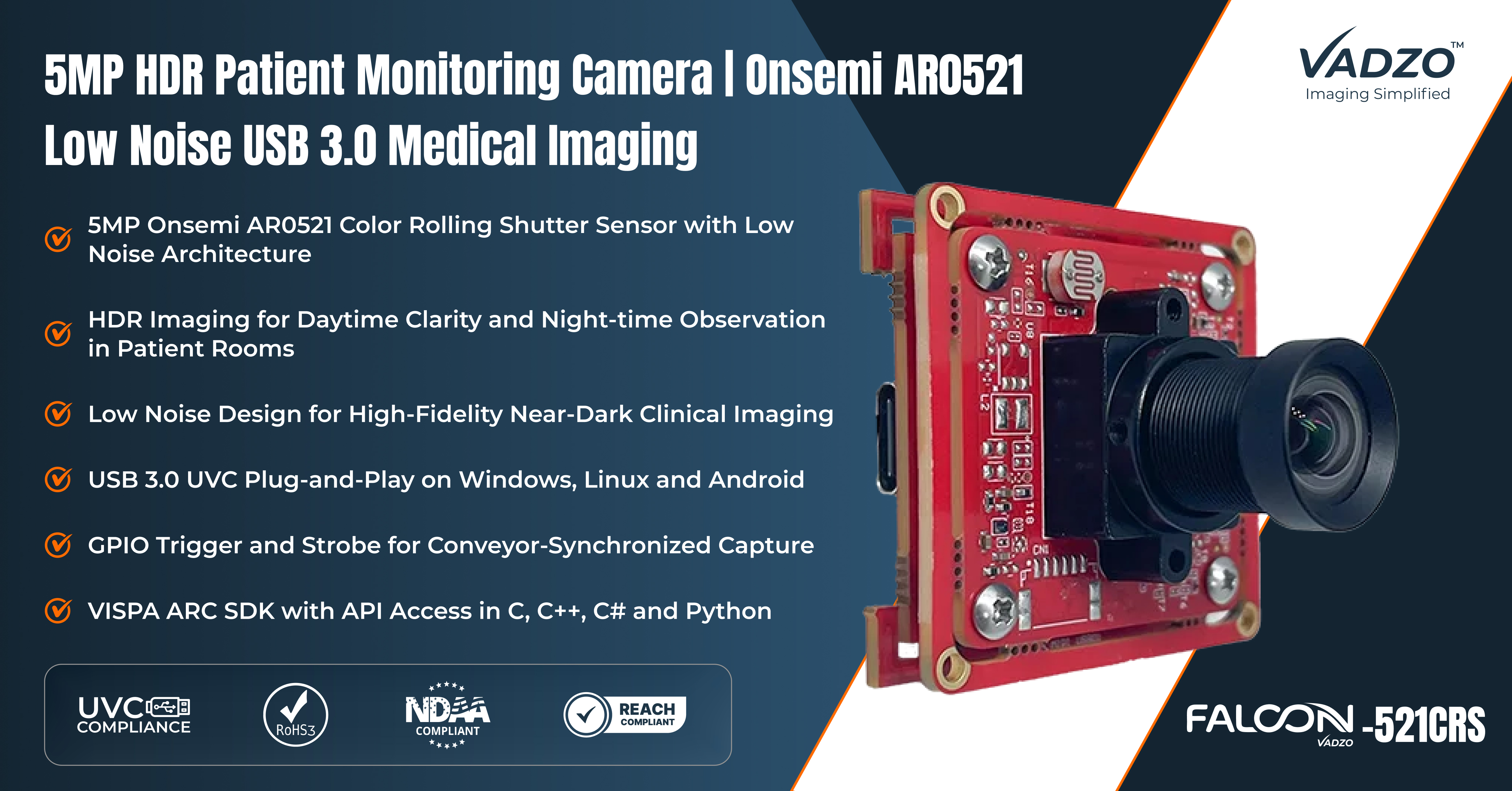
FORT WORTH, Texas, July 24, 2026 (Newswire.com) - Vadzo Imaging today presents the Falcon-521CRS, an AR0521 5MP patient monitoring camera built for clinical device engineers and embedded vision developers who require reliable 24/7 image quality across the full day-to-night lighting cycle of a patient room. Built on the Onsemi AR0521 color rolling shutter CMOS sensor and delivered over USB 3.0 with full UVC compliance, this 5MP low noise USB 3.0 camera provides a plug-and-play integration path for bedside monitoring terminals, telehealth platforms, ICU observation systems, fall detection deployments and remote patient monitoring solutions without custom driver development overhead.
Patient rooms present a specific combination of imaging demands that general-purpose USB camera products consistently fail to address. Room lighting transitions between full overhead illumination during clinical rounds, partial dimming during rest periods and near-complete darkness at night with only monitoring indicator lights and hallway spill light as illumination sources. A patient monitoring camera that cannot maintain usable image quality across this lighting range forces engineering teams to add supplemental IR illumination hardware or accept degraded nighttime visibility. The AR0521 sensor's low noise architecture reduces the noise floor at low-signal conditions, preserving image detail in dim environments without relying on aggressive digital gain that introduces artifacts into the clinical image stream.
Onsemi AR0521 Sensor and Camera Overview
The Onsemi AR0521 is a 5MP color rolling shutter CMOS image sensor engineered for applications where low noise and high image fidelity are the primary design targets. The sensor captures 5MP resolution in color with a rolling shutter architecture optimized for signal quality across the illumination range encountered in clinical and medical environments. At 5MP the Falcon-521CRS delivers sufficient spatial detail for face-level patient observation, limb position tracking for fall risk assessment and video documentation in bedside and ICU configurations without post-capture upscaling. The wide angle field of view provides room-scale coverage from a ceiling or wall-mounted position, eliminating the need for multiple sensor installations to cover a standard patient bay or private room.
Key specs: 5MP | Onsemi AR0521 | Color Rolling Shutter | USB 3.0 | S-Mount (M12) | HDR | UVC, RoHS 3, REACH | VISPA ARC SDK
Key Capabilities of the Onsemi AR0521 5MP Low Noise USB 3.0 Patient Monitoring Camera
HDR Imaging for Reliable Day/Night Clinical Coverage
Patient room lighting transitions from bright daytime conditions to dim nighttime environments multiple times within a monitoring shift. Standard dynamic range sensors produce blown highlights during clinical rounds under full overhead lighting and deliver noisy unusable frames once lights are dimmed or extinguished. The AR0521 color camera addresses this with HDR imaging capability that maintains scene detail and tonal range across high-contrast conditions without relying on multi-exposure compositing pipelines that introduce latency. For a clinical monitoring camera operating continuously, HDR imaging is a sensor-level requirement rather than a post-processing option because the clinical team monitoring the video feed needs usable image data at any point in the patient day/night cycle without waiting for a frame merge pipeline to stabilize.
Low Noise Architecture for High-Fidelity Nighttime Observation
Low light performance in patient rooms is not a convenience requirement. ICU monitoring, fall detection and overnight vital sign surveillance all depend on the camera delivering recognizable patient detail at minimal illuminance levels. When nursing staff dim overhead lighting to allow patient rest but must maintain visual surveillance, the camera must produce clean image data from minimal photon flux. The AR0521 sensor's low noise design reduces the electronic noise floor across the full sensitivity range meaning the camera can capture usable detail in near-darkness without the grain and smearing that high-gain operation introduces into lower quality sensors. For OEM developers building a low noise medical camera this translates directly into fewer supplemental IR emitters required in the hardware design and reduced post-processing demands on the host compute platform.
Wide Angle Field of View for Room-Scale Patient Coverage
Positioning a hospital bedside camera in a patient room requires capturing the full patient bed within the field of view from a fixed ceiling or wall mount point without requiring pan-tilt actuators or mechanical repositioning. A narrow field of view forces either a closer mounting position that restricts placement flexibility or a wider mounting position that loses resolution at the patient level. The wide angle field of view of the Falcon-521CRS provides the room-scale coverage that patient room surveillance requires from a single fixed mounting point, accommodating both standard ward configurations and ICU bay layouts without changing the lens or mount position between installations.
USB 3.0 with UVC Compliance for Integration Without Driver Development
The camera connects over USB 3.0 with full UVC compliance, registering as a standard video input device on Windows, Linux and Android without any custom driver installation. For OEM developers and system integrators building telehealth terminals, nurse call system camera products and embedded medical camera module designs, UVC compliance removes driver development from the integration scope entirely. The camera streams immediately on connection without OS-specific setup which also reduces long-term maintenance overhead as the host OS updates over the product's deployment lifetime. The USB-powered architecture keeps the system design clean for integration into compact medical device enclosures that cannot accommodate separate power regulators.
Product Specifications
Specification | Details |
Sensor | Onsemi AR0521 |
Resolution | 5MP (2592 x 1944) |
Sensor Type | Color Rolling Shutter CMOS |
Interface | USB 3.0 |
HDR | Supported |
Optics | S-Mount (M12 Standard) |
SDK Support | VISPA ARC SDK (Windows, Linux, Android) |
Compliance | UVC, RoHS 3, REACH |
"Clinical environments ask a very specific set of questions from an imaging sensor. Can it see clearly during a busy daytime shift with overhead lighting at full intensity? Can it deliver usable nighttime images when the room is near-dark and the patient is resting? Does it connect without driver development overhead so the integration team can focus on the clinical application rather than the camera interface? The AR0521 answers all three. The low noise architecture handles the nighttime challenge at the sensor level and the HDR capability covers the daytime-to-night transition without application-level HDR merging. On USB 3.0 with UVC compliance it connects and streams on any standard host without setup. That combination is what clinical hardware developers actually need in a patient monitoring camera."- Alwin Vincent, Product Manager, Vadzo Imaging
Applications
ICU Monitoring and Critical Care Observation: In intensive care settings, continuous camera-based patient observation supplements nursing surveillance during high-census periods and overnight shifts when staff coverage is reduced. A ICU monitoring camera must deliver clear visual data across the full range of ICU lighting conditions including task lamp illumination during procedures, overhead dimming during rest periods and near-darkness overnight. Fall detection algorithms running on the downstream compute platform require consistent image quality to maintain detection accuracy across this lighting range. The AR0521 sensor's low noise architecture and HDR capability together provide a consistent image signal across this full range without requiring additional illumination hardware beyond what the clinical environment already provides.
Telehealth and Remote Patient Monitoring: Remote patient monitoring and telehealth platforms require an OEM medical camera module that delivers sufficient image resolution for remote clinical assessment, connects to the telemedicine terminal host without driver setup and operates reliably across the variable home and clinic lighting conditions encountered in real telehealth camera deployments. At 5MP the camera provides the spatial resolution needed for remote clinician assessment including face-level observation for pain scoring and limb assessment for wound evaluation. The USB 3.0 UVC connection integrates into Windows-based and Linux-based telehealth terminal hardware without driver development overhead, reducing integration time for device manufacturers building remote patient monitoring camera systems for point-of-care and home use.
Fall Detection and Elder Care Monitoring: Fall detection in elder care facilities and patient wards depends on computer vision algorithms analyzing patient position and movement from continuous video feeds. The accuracy of a fall detection camera deployment is directly tied to the image quality delivered to the inference engine. Frames degraded by low-light noise, overexposed highlights or motion-related artifacts reduce detection confidence and increase false negative rates. The AR0521 color camera's low noise architecture reduces the noise floor that degrades inference performance in nighttime conditions and the HDR capability maintains scene contrast when a window or corridor light creates high-contrast zones within the patient room. At 5MP the resolution is sufficient for limb and torso tracking that fall detection models require without demanding excessive bandwidth from the USB 3.0 interface.
Vital Sign Monitoring and Non-Contact Assessment: Non-contact vital sign monitoring systems that extract respiration rate and heart rate from color video require high image fidelity at the pixel level because photoplethysmography-based vital sign extraction depends on detecting subtle RGB channel fluctuations in skin tone regions across sequential frames. Sensor noise directly corrupts these subtle signals producing erroneous vital sign readings at low illuminance. The AR0521's low noise design preserves these subtle per-pixel color variations at the signal level, supporting non-contact vital sign camera algorithms in low-light patient room conditions where clinical lighting is reduced for patient comfort.
VISPA ARC SDK and Software Support
The AR0521 5MP USB camera is supported by the Vadzo VISPA ARC SDK, providing programmatic control over streaming parameters, Region of Interest configuration, exposure settings, binning and windowing. APIs are available in C, C++, C# and Python across Windows, Linux and Android. For OEM development teams integrating the camera into bedside monitoring terminals, telehealth platforms and nurse call systems, the SDK provides full camera control alongside the native UVC stream without disrupting the plug-and-play behavior for standard streaming use cases. The VISPA ARC SDK also covers still image capture, image flip, Smart GPIO management and secure firmware updates. SDK documentation and evaluation resources are available at vadzoimaging.com.
Frequently Asked Questions
Q: What makes a 5MP USB camera suitable for 24/7 patient room monitoring in ICU and ward environments?
A: For 24/7 patient room monitoring the critical requirements in a medical USB camera are low noise performance for nighttime imaging in dim clinical environments, HDR capability for the transition from daytime overhead lighting to near-darkness overnight, sufficient resolution for clinical observation and fall detection inference and plug-and-play USB integration that eliminates driver development on the medical device host platform. The AR0521 5MP patient monitoring camera from Vadzo Imaging is built around exactly these requirements. The Onsemi AR0521 sensor's low noise architecture reduces the noise floor in low-signal conditions, preserving image detail in near-dark patient rooms without supplemental IR illumination. The HDR capability maintains scene clarity across the full daylight-to-nighttime lighting range of a clinical environment. At 5MP over USB 3.0 with full UVC compliance the camera integrates into Windows and Linux-based monitoring terminals and telehealth terminal hardware without custom driver installation. Engineering teams can access full product documentation at vadzoimaging.com/medical-device-and-patient-care.
Q: How does low noise sensor design improve nighttime patient observation in a clinical environment?
A: In a patient room at night overhead lighting is typically dimmed or extinguished to support patient rest while nursing surveillance must remain continuous. The photon flux reaching the camera sensor under these conditions is a fraction of the daytime value. Standard camera products operating at high pixel gain in low light conditions deliver image data dominated by read noise, shot noise and thermal noise, producing a grainy or smeared output that makes patient detail difficult to interpret and renders computer vision inference unreliable. A low noise medical camera addresses this at the sensor architecture level by minimizing the noise floor, allowing usable image signal to be extracted from minimal photon flux without the digital gain amplification that increases noise alongside signal. For fall detection camera systems, vital sign monitoring platforms and ICU observation terminals that must maintain usable video overnight, the sensor's low noise characteristic determines whether the system functions as designed during nighttime hours. Vadzo Imaging's AR0521 patient monitoring camera delivers this low noise performance as a sensor-level design property of the Onsemi AR0521. For a broader overview of clinical imaging challenges this camera addresses refer a vadzoimaging.com.
Q: Which 5MP USB camera is best for fall detection of AI inference and live patient observation on the same medical device host?
A: A 5MP USB camera with UVC compliance streams to any UVC-compatible video application on the host simultaneously with any application that can access a standard video capture device. Because UVC-compliant camera products register as standard OS-level video devices the video stream can be accessed by multiple applications concurrently through the OS video capture stack. At 5MP the camera provides sufficient resolution for both human-readable observation at the monitoring station display and AI inference pipelines running fall detection or vital sign extraction algorithms on the same host or a downstream inference edge device. Vadzo Imaging's AR0521 patient monitoring camera supports Region of Interest cropping and pixel binning through the VISPA ARC SDK, allowing OEM developers to configure the frame size delivered to the AI inference pipeline independently of the full-resolution stream used for clinical observation. This reduces bandwidth and computes demands on the host without requiring hardware changes.
Q: What specifications should OEM developers evaluate when selecting a medical grade USB camera for telehealth and remote monitoring platforms?
A: For telehealth and remote patient monitoring platforms the most important evaluation criteria are resolution for remote clinical assessment, interface compatibility for the host hardware and OS platform, sensor noise performance for operation in variable home and clinical lighting and regulatory compliance for integration into medical device products. At the resolution level 5MP provides sufficient detail for facial observation, wound assessment and limb evaluation at the distances typical in home and clinic telehealth configurations. At the interface level USB 3.0 with UVC compliance eliminates driver development and ensures cross-platform operation on Windows and Linux telehealth terminal hardware. At the sensor level low noise performance matters because home environments and outpatient clinic rooms do not have the controlled overhead illumination of hospital wards. RoHS 3 and REACH compliance supports regulatory qualification for medical grade USB camera integration in regulated markets. Vadzo Imaging's 5MP patient monitoring camera addresses all these criteria in a single embedded medical camera module with VISPA ARC SDK support.
Q: Does Vadzo offer OEM customization for patient monitoring and clinical imaging camera products?
A: Yes. Vadzo Imaging provides full OEM customization for its medical camera portfolio including lens selection for specific field of view and working distance requirements, optical filter integration for NIR or specific wavelength applications, board form factor modifications for custom enclosure constraints, firmware customization for clinical device-specific feature sets and software integration support through the VISPA ARC SDK. For patient monitoring and bedside monitoring camera deployments where the standard product configuration does not match the installation constraint, Vadzo's engineering team engages directly at the hardware and firmware level to adapt the camera to the system requirement. This approach is particularly relevant for clinical device OEMs building proprietary monitoring terminals, telehealth endpoints and ICU observation systems where the camera form factor and interface behavior must match the host platform exactly.
Availability
The Falcon-521CRS AR0521 5MP Low Noise USB 3.0 patient monitoring camera is available for evaluation and production orders. Engineering teams can access the full product datasheet, CAD files and VISPA ARC SDK documentation at vadzoimaging.com or contact Vadzo's team directly for volume pricing, OEM customization requirements and integration support.
About Vadzo Imaging
Vadzo Imaging develops embedded and machine vision camera products for OEMs and system integrators building production-ready vision systems across industrial automation, robotics, healthcare and smart infrastructure. The company's imaging platforms span USB, MIPI, GigE, Wi-Fi and SerDes interfaces. Beyond hardware, Vadzo provides end-to-end imaging support including sensor integration, ISP tuning, firmware development and SDK frameworks, giving engineering teams a single partner from initial evaluation through production lifecycle management.
Media Contact
Alwin Vincent
Vadzo Imaging
Email: alwin@vadzoimaging.com
LinkedIn: Vadzo Imaging
YouTube: Vadzo Imaging
X: Vadzo Imaging
SOURCE: Vadzo Imaging
Source: Vadzo Imaging