Vadzo Imaging Launches Falcon-544CRS: 5MP Onsemi AR0544 HyperLux LP Wearable Medical Camera Engineered for Body-Worn Imaging
Vadzo Imaging's Falcon-544CRS is a 5MP wearable medical camera built on the Onsemi AR0544 HyperLux LP sensor delivering USB 3.2 connectivity, a 1/4.2-inch BSI architecture with 1.4 µm pixel pitch, rolling shutter imaging and embedded HDR in a compact form factor for body-worn clinical systems. As an AR0544 low power USB camera in Vadzo's Falcon USB camera series the Falcon-544CRS brings 2592×1944 resolution and UVC plug-and-play integration to body worn camera module designs for ambulatory monitoring, wound care documentation, telemedicine endpoints and surgical vision platforms where conventional USB camera products are too heavy or too power-hungry for patient-worn deployment.
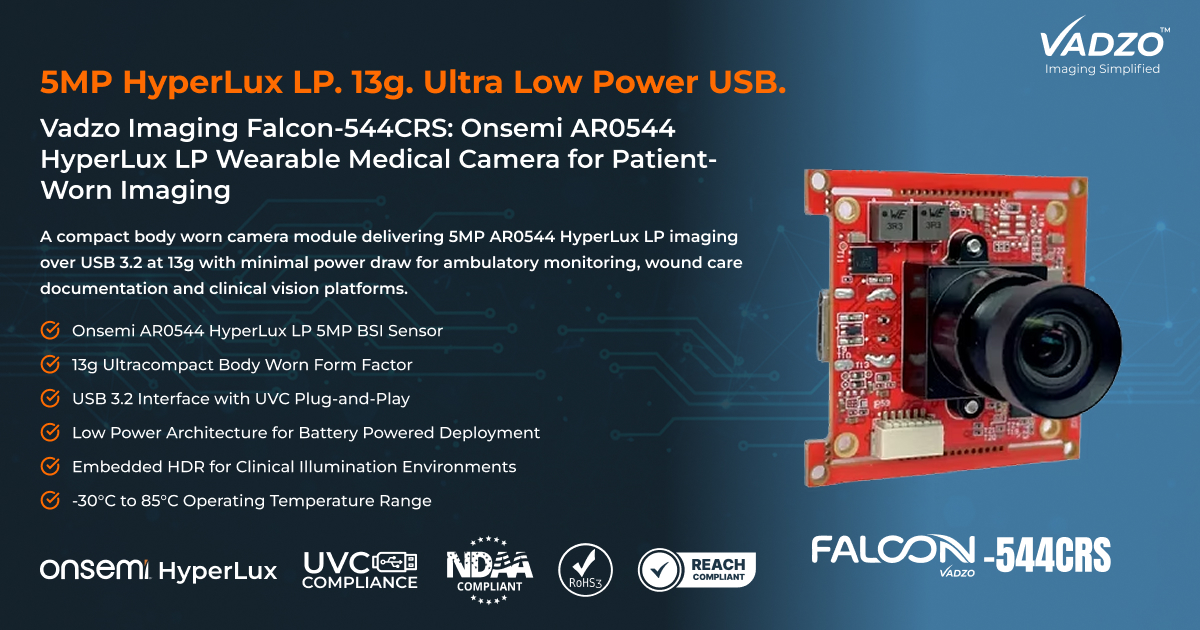
FORT WORTH, Texas, July 7, 2026 (Newswire.com) - Vadzo Imaging, a provider of embedded vision camera products for OEMs and system integrators, today announces the Falcon-544CRS, an Onsemi HyperLux LP USB camera engineered for wearable medical imaging where form factor and power consumption determine whether a camera product can integrate into a body-worn device at all. The Falcon-544CRS brings Onsemi AR0544 sensor-level efficiency to USB-connected clinical vision in a configuration that medical device and patient care engineers can mount directly on a patient without disrupting mobility or battery runtime.
The Power and Weight Problem in Patient-Worn Medical Camera Design
Engineering a camera product that a patient wears across a clinical procedure or ambulatory monitoring session requires solving two constraints simultaneously: mass and power draw. A patient monitoring camera for ambulatory use cannot exceed the weight threshold at which it becomes mechanically disruptive to patient movement. For systems worn on the upper torso, arm, or wound site, that threshold is measured in grams and 13g represents a hard engineering target. The power constraint is equally strict. Patient worn imaging systems run on compact lithium polymer cells where sensor power draw directly determines monitoring session duration per charge cycle. Sensors designed for high-throughput industrial vision draw power budgets incompatible with an extended ambulatory session. This is the architectural gap the Falcon-544CRS addresses as a low power wearable camera built on a sensor architecture where power efficiency is designed into the pixel structure itself.
Why the Onsemi AR0544 HyperLux LP Sensor Architecture Matters for Wearable Medical Imaging
The Onsemi AR0544 belongs to the HyperLux LP sensor family in which LP designates Low Power as a core architectural objective. The 1.4 µm back-illuminated pixel captures photons with higher quantum efficiency than front-illuminated equivalents at the same pixel pitch meaning the sensor resolves clinically relevant detail at lower illumination intensities without requiring high gain settings that introduce noise into wound assessment. The 1/4.2-inch format at 5MP fits within compact board designs while providing sufficient spatial resolution for wound boundary delineation, skin texture analysis and telemedicine USB camera consultation imaging. Embedded HDR addresses the clinical lighting challenge where bright procedure lighting combines with shadowed anatomical recesses in the same frame. The AR0544 preserves detail across the full dynamic range within a single readout cycle without multi-exposure fusion which adds latency in medical IoT camera deployments.
Falcon-544CRS: AR0544 HyperLux LP 5MP USB Camera for Body-Worn Medical Systems
The Falcon-544CRS is Vadzo Imaging's AR0544 medical camera implementation targeting medical device engineers who require USB connectivity without the weight and power overhead of conventional compact USB camera products. At 13g the board-level form factor integrates into wearable device housings, patient-worn harnesses and compact endoscopy camera module designs. The USB 3.2 interface delivers 5MP resolution for full-frame clinical imaging. UVC compliance means the Falcon-544CRS connects to standard medical computing terminals and telemedicine platforms without custom driver development, reducing OEM certification scope. The -30°C to 85°C operating temperature range supports deployment across sterilization-adjacent environments and mobile clinical settings.
Key Features and Technical Details
5MP BSI Sensor Architecture for Clinical Image Detail
The AR0544 HyperLux LP sensor resolves 2592×1944 pixels across a 1/4.2-inch BSI architecture with 1.4 µm pixel pitch. For wound care camera applications the sensor captures fine texture gradients in wound beds, granulation tissue, and peri-wound skin for clinical wound assessment scoring. For remote patient camera and telemedicine applications, the 5MP output delivers sufficient resolution for dermatological assessment and skin lesion documentation at standard consultation distances.
Low Power Architecture for Battery-Powered Wearable Deployment
The HyperLux LP designation reflects a sensor-level power optimization architecture engineered within the constraints of compact battery powered wearable camera systems. This distinguishes the AR0544 from industrial sensors that prioritize frame rate over power budget. For ambulatory monitoring camera systems running on wearable battery packs, the HyperLux LP architecture extends session duration meaningfully compared to standard imaging sensors affecting clinical usability in home-based remote care programs.
Embedded HDR for Clinical Illumination Environments
Operating theater lighting, endoscopic illumination systems and bedside procedure lighting create scenes where specular highlights from instruments or wet tissue surfaces coexist with shadowed anatomical structures in the same frame. The AR0544 HyperLux LP embedded HDR captures high and low gain pixel data within a single readout cycle recovering detail across both extremes without motion artifacts. For ICU vision camera deployments where patient status must be documented accurately across varying ambient light conditions, this intra-frame HDR architecture is directly relevant to image reliability and clinical documentation quality.
Compact S-Mount Optics and Board-Level Integration
The Falcon-544CRS accepts standard S-Mount M12 optics allowing medical device design engineers to select optical configurations appropriate to their application including wide-field wound site documentation, normal field endoscopy integration and longer working distance telemedicine imaging. The board-level form factor without enclosure allows integration into custom patient-worn device housings where the OEM controls the mechanical assembly.
Product Specifications
Sensor | Onsemi AR0544 HyperLux LP |
Resolution | 5MP (2592 x 1944) |
Pixel Size | 1.4 µm |
Sensor Format | 1/4.2" |
Shutter Type | Rolling Shutter |
Interface | USB 3.2 Gen1 Type C Interface Backward Compatible to USB 2.0 |
Optics | S-Mount (M12 Standard) |
Weight | 13g (Without Lens) |
Operating Temperature | -30°C to 85°C |
Compliance | UVC, NDAA Compliant, RoHS 3, REACH |
"The Falcon-544CRS came out of a clear engineering requirement we kept hearing from medical device teams: they needed USB imaging performance at a weight and power budget that patient-worn form factors actually permit. Most compact USB camera modules available today were designed for kiosk or robotics deployment and carry power overhead and board mass that wearable medical device engineers cannot accommodate. The AR0544 HyperLux LP architecture gives us a 5MP BSI sensor that stays within those constraints without giving up the resolution or dynamic range that clinical imaging applications require."-Alwin Vincent, Product Manager, Vadzo Imaging
Applications
Ambulatory Patient Monitoring and Remote Vital Sign Documentation: Ambulatory monitoring systems accompanying patients through post-surgical ward rounds require a camera product that draws power at a rate compatible with wearable battery systems. The Falcon-544CRS as a low power patient monitoring camera enables interval-triggered image capture of wound sites, drainage systems and infusion access points across multi-hour ambulatory sessions. In remote patient camera configurations connecting via USB to a mobile computing terminal, the AR0544's 5MP resolution supports clinician review of patient condition documentation without requiring the patient to be physically present at a care station.
Wound Care Imaging and Clinical Wound Assessment: Wound care camera applications require imaging that captures tissue color gradients, wound border geometry and surrounding skin texture with sufficient fidelity for clinical wound assessment including pressure injury staging and chronic wound management. The 1.4 µm BSI pixel recovers fine tissue texture at close working distances with standard M12 macro-range optics. Embedded HDR preserves highlight and shadow detail simultaneously across wound beds where specular reflection from wound exudate and absorption from necrotic tissue create high-contrast scenes that single-exposure sensors cannot render accurately.
Telemedicine and Remote Clinical Consultation Imaging: Telemedicine USB camera deployments require a portable patient monitoring camera that a patient can position independently at home or in a remote clinical setting. The Falcon-544CRS as a portable imaging camera connecting over USB to a tablet enables specialist review of skin conditions, post-surgical incision sites, ostomy sites and peripheral vascular conditions. At 13g the device is light enough to be positioned by a patient without assistance, and UVC plug-and-play compliance ensures compatibility with standard telemedicine software platforms without custom driver installation at the patient end.
ICU Vision and Bedside Clinical Imaging: In ICU environments a clinical monitoring camera mounted on a patient-worn harness or bedside positioning arm provides continuous visual documentation of wound sites, incision healing progression and pressure injury development without repeated nursing interventions for camera positioning. The Falcon-544CRS as an ICU vision camera operating over USB to a bedside computing terminal delivers 5MP color documentation frames on demand. Embedded HDR handles the transition between overhead ICU lighting and directional procedure illumination without image quality degradation across the monitoring session.
Minimally Invasive Surgical Vision: Camera module applications in minimally invasive procedures require imaging subsystems with minimal physical footprint that integrate into procedural hardware where board area and weight are constrained by device form factor. The AR0544 HyperLux LP 1/4.2-inch sensor format fits within compact endoscopy platform constraints. For surgical vision camera applications where USB connectivity to a standard OR terminal is required, UVC compliance eliminates the driver integration step that adds to certification scope. Low power draw reduces thermal loading in procedural devices where heat management near patient tissue is a design requirement.
Frequently Asked Questions
Q: What makes a compact USB camera suitable for patient-worn medical device integration?
A: A camera module for patient-worn medical use must satisfy constraints that industrial camera products were not designed to meet. Mass is the primary constraint. A module exceeding the weight that a patient can comfortably wear across an extended ambulatory session is not a viable wearable device regardless of imaging performance. Power draw is equally critical because wearable systems have finite battery reserves, and a sensor drawing typical industrial power budgets will exhaust a compact cell before the session ends. The Falcon-544CRS addresses both constraints through the Onsemi AR0544 HyperLux LP sensor which optimizes power at the pixel design level while maintaining 5MP BSI resolution and embedded HDR. At 13g the board-level form factor is compatible with patient-worn harnesses and wound monitoring dressings. USB 3.2 with UVC compliance means the medical imaging USB camera connects to standard medical computing terminals without driver development.
Q: What is a medical grade USB camera and how does sensor architecture affect clinical imaging quality?
A: A medical grade USB camera is a camera product engineered to operate reliably within the physical, electrical and image quality constraints specific to healthcare environments. This means board-level power draws compatible with isolated medical power supplies, operating temperature stability across clinical settings and image sensor characteristics adequate for the clinical application. The Onsemi AR0544 HyperLux LP qualifies through its BSI pixel architecture which maximizes photon capture efficiency at 1.4 µm pixel pitch. BSI architecture is particularly relevant for clinical imaging because patient-worn camera products frequently operate in available light, and higher quantum efficiency reduces the illumination intensity needed for a usable clinical image. Embedded HDR handles high-contrast lighting conditions in procedure rooms and ICU environments. Vadzo's Falcon-544CRS delivers these sensor capabilities in a 13g USB 3.2 module with UVC compliance and RoHS 3 certification positioning it as a technically qualified platform for OEM integration into medical device programs.
Q: Which low power USB camera is best for ambulatory wound care imaging and remote patient monitoring?
A: The Falcon-544CRS is Vadzo Imaging's purpose-built solution for ambulatory patient monitoring and wearable wound care imaging. Among Vadzo's camera portfolio it is the only product combining the Onsemi AR0544 HyperLux LP low power sensor architecture with a 13g board-level form factor and USB 3.2 connectivity specifically positioned for patient-worn applications. The 5MP BSI sensor at 2592×1944 provides the spatial resolution needed for wound boundary delineation and tissue texture capture in wound care documentation workflows. Embedded HDR handles the combination of direct wound illumination and ambient room lighting that causes single-exposure sensors to clip highlights in wound bed documentation. Vadzo provides full OEM customization support including lens selection, board redesign, firmware modification and ISP tuning calibrated to clinical tissue imaging. Engineering teams can request evaluation units from Vadzo Imaging at support@vadzoimaging.com.
Q: Can a 5MP USB camera support real-time telemedicine video and clinical documentation workflows?
A: Yes. A 5MP USB camera provides resolution above the threshold required for most telemedicine USB camera consultation tasks including dermatological assessment, wound progression documentation, post-surgical incision review and skin lesion evaluation. The Falcon-544CRS meets the key requirements. The AR0544 5MP BSI sensor resolves fine tissue texture at typical patient-to-device working distances with M12 optics. UVC compliance ensures the device appears as a standard USB video device to telemedicine platforms without custom driver installation on the patient side. At 13g patients can position and reposition the module independently during a remote consultation. For medical IoT camera deployments connecting to a remote clinical portal, the Falcon-544CRS provides the imaging performance and integration simplicity that telemedicine deployment scenarios require.
Q: What should engineers consider when selecting a battery-powered wearable camera module for medical applications?
A: Battery-powered wearable camera module selection for medical applications requires evaluating sensor power architecture, form factor and weight and interface compliance. The key distinction is whether the sensor is LP-class with power efficiency built into the pixel structure itself. LP-class sensors such as the Onsemi AR0544 HyperLux LP deliver meaningfully lower active power draw at equivalent resolution. UVC compliant USB camera products eliminate custom driver development reducing certification scope. Vadzo's Falcon-544CRS addresses all considerations in a single compact medical imaging camera platform with 13g board weight, USB 3.2 UVC compliance, -30°C to 85°C operating range and the AR0544 HyperLux LP sensor.
Availability
The Falcon-544CRS 5MP AR0544 HyperLux LP wearable medical camera is available now for OEM evaluation. Evaluation units include the camera module with default S-Mount M12 lens and complete technical documentation. Vadzo Imaging operates with no minimum order quantity. Volume pricing, custom board redesign, firmware modification, and ISP tuning for clinical imaging environments are available upon request. Contact the Vadzo Imaging team at support@vadzoimaging.com or visit vadzoimaging.com.
About Vadzo Imaging
Vadzo Imaging develops high-performance embedded vision camera products for OEMs and system integrators. The company's camera portfolio spans USB, MIPI CSI-2, Gigabit Ethernet and WiFi imaging platforms covering medical device and patient care, automation and robotics, smart city solutions and edge AI. Beyond hardware Vadzo provides sensor integration, ISP tuning, firmware development, and OEM customization services that accelerate development and deployment.
Media Contact
Alwin Vincent
Vadzo Imaging
Email: alwin@vadzoimaging.com
LinkedIn:Vadzo Imaging
YouTube: Vadzo Imaging
X: Vadzo Imaging
SOURCE: Vadzo Imaging
Source: Vadzo Imaging