How Personal Loan Aggregators Work: Direct Fund Center Explains Lending Networks, Tribal Lenders, and Lead Generation
Comprehensive Guide to Lending Aggregator Models, Tribal Lending Economics, and Transparent Lead Generation Practices for Consumers
LAS VEGAS, December 6, 2025 (Newswire.com) - Direct Fund Center: Transparent Lead-Generation Model Reshapes How Consumers Access Emergency Lending in 2025
Direct Fund Center distinguishes itself in the personal loan aggregator market by prioritizing transparent disclosure of how lending networks operate, including the economics of lead generation, lender prioritization systems, and the role of tribal and offshore lenders in the lending ecosystem.
In This Release, You'll Discover:
How personal loan aggregators and lead-generation services differ from direct lenders and why the distinction matters
What a "ping tree" is and how lender position in lending networks is determined
The real mechanics of tribal and offshore lending, including their role in lending networks and their typical costs
What happens step-by-step when you submit a personal loan application through an aggregator
Critical questions to ask before accepting any loan offer
How to evaluate whether a lending aggregator aligns with your financial situation
Alternatives to aggregators that may serve your needs better
Important Notice: This release is for general educational purposes only. It is not financial, legal, or tax advice and does not recommend any specific loan, lender, service, or financial product for your individual situation. Personal loans-especially high-APR and emergency loans-carry significant financial risk. Before taking on new debt, particularly if you are already struggling with payments, consider speaking with a qualified financial professional or nonprofit credit counselor. This article contains affiliate links. If you purchase through these links, a commission may be earned at no additional cost to you. This compensation does not influence the accuracy, neutrality, or integrity of the information presented in this review. All opinions and descriptions are based on publicly available details and are intended to help readers make informed decisions.
Direct Fund Center operates as a personal loan aggregator and lead-generation service that connects consumers seeking personal loans with a diverse lending network including traditional banks, peer-to-peer lenders, tribal lenders, and offshore lenders. The platform emphasizes transparency about how lending networks operate, including how lenders rank in the system (primarily by the price they pay for leads) and why high-APR lenders often appear at the top (because higher profit margins allow them to bid more per lead). The company is operated by Online Loan Network, based in Las Vegas, Nevada, and is not available to New York residents. Personal loan aggregators increase approval odds by distributing applications to multiple lenders simultaneously, but this comes with trade-offs including data sharing with many companies, potential routing to high-cost lenders, and marketing contact from multiple sources.
The Personal Loan Aggregator Market: Understanding How These Services Work
The personal loan aggregator and lead-generation industry has grown significantly, with major platforms collectively connecting millions of borrowers to lenders annually. Major comparison sites have built consumer recognition through advertising and brand building. Smaller platforms focus on specific lending niches or differentiate through operational or communication approaches.
Direct Fund Center's approach emphasizes clarity about how lending networks operate-specifically, the mechanics that most sites address minimally.
This philosophy shapes how the release addresses the hidden mechanics of lending aggregation, particularly around tribal and offshore lenders, which represent a growing but under-explained segment of lending networks.
What Is a Lending Aggregator vs. a Direct Lender?
The distinction matters because it shapes your application experience and options.
When you apply for a personal loan from a bank, credit union, or direct online lender like LendingClub, you're applying to a direct lender. That institution reviews your application, makes a lending decision, and if approved, services your loan.
A personal loan aggregator works differently. You submit one application, which is then shared with multiple lenders in that aggregator's network. Each lender independently reviews your information and decides whether to make an offer. If lenders approve you, they present their specific rates and terms. You choose which offer to accept, if any.
This is a fundamental business model difference. Direct lenders decide who gets credit. Aggregators facilitate connections between borrowers and lenders who have already decided they'll lend to people with certain profiles.
Lead Generation vs. Aggregation: How Business Models Differ
These terms are sometimes confused, but they describe different operational approaches.
A loan aggregator typically builds its own lending network, markets directly to consumers, and maintains direct relationships with its lender partners. The aggregator owns the consumer relationship and controls which lenders see applications.
A lead-generation service builds a platform that collects consumer information and sells that information (the "lead") to lenders or networks of lenders. The lead generator may not have direct relationships with every lender who purchases leads. Instead, leads may be resold through multiple networks before reaching lenders.
Direct Fund Center identifies as both. The company generates leads and also purchases leads from other generators to expand its reach.
Why does this distinction matter to you? When your information is resold multiple times, more companies have access to it. This increases the likelihood of receiving marketing contact, potential data security considerations, and less direct control over who sees your application.
Understanding this operational model helps you make an informed decision about whether using a lead-generation service aligns with your comfort level around data sharing.
Understanding Tribal Lenders: A Common but Controversial Part of Some Lending Networks
Tribal lenders are largely absent from mainstream financial discussion, but they represent a significant segment of the personal lending market and warrant clear explanation.
A tribal lender is a lender organized under the laws of a Native American tribe. These lenders typically claim sovereign immunity from certain state lending regulations because they operate under tribal jurisdiction. In practice, that can mean interest rates and fees that are substantially higher than those offered by traditional banks, credit unions, or regulated online lenders, and in many cases far above what individual states would allow for similar products.
Public data and regulatory reports on payday-style and similar high-cost loans show that many such products carry APRs in the triple-digit range, sometimes approaching or exceeding 300-400% APR, depending on the fee structure and loan term. By comparison, a traditional personal loan from a bank or credit union typically falls in the single- to double-digit APR range.
Why do lending networks include tribal lenders if they're so expensive? Because some borrowers qualify for tribal lenders when they wouldn't qualify elsewhere. If you've been denied by traditional lenders, peer-to-peer platforms, and credit unions, a tribal lender may represent your only available option for emergency capital.
This creates an important trade-off: access to capital at a very high cost versus no access at all. Making this choice requires understanding what you're entering, which is why transparency about tribal lending matters.
Offshore Lenders: A Parallel Structure
Offshore lenders operate similarly. They are organized under foreign jurisdictions and typically claim exemption from U.S. state lending regulations. They often charge comparable APRs to tribal lenders and have similarly flexible approval criteria.
Offshore lenders exist in lending networks for the same reason tribal lenders do: they serve borrowers who don't qualify with state-regulated lenders. However, even when lenders are based offshore, federal consumer-protection laws and some state enforcement efforts may still apply, though pursuing relief can be more complex when dealing with lenders outside your home jurisdiction.
The Ping Tree: How Lending Networks Prioritize Lenders
This is where the mechanics of lending networks become visible-and where most aggregators provide minimal explanation.
A ping tree is a priority system. When your application enters a lending network, it goes to the first lender in the queue. If that lender declines, it moves to the second lender. Then the third. And so on.
The question borrowers rarely ask is: how are lenders ranked in the tree?
Direct Fund Center's own disclosures explain this plainly: lenders rank in the ping tree primarily by the price they're willing to pay per lead.
When a lender purchases a lead from an aggregator, they pay a fee for that connection. Those fees vary. A traditional bank might pay one amount; a tribal lender might pay significantly more. Why? Because tribal lenders have higher profit margins (due to higher APRs), which means they can afford higher lead costs.
Which lender appears first in the ping tree? The one who paid the most.
This creates a natural algorithmic outcome: borrowers with limited credit history or lower credit scores get routed to tribal lenders not because tribal lenders have been evaluated as "best suited" to that borrower, but because tribal lenders can afford to bid higher in the lead marketplace.
This isn't inherently deceptive, but it is crucial information. The lender you're connected to has been chosen partly through economic bidding, not purely through suitability for your financial profile.
Direct Fund Center makes this explicit. Many sites do not. Understanding this mechanic is essential to understanding what happens when you apply.
Step-by-Step: What Happens When You Apply Through an Aggregator
Let's walk through the actual process so you understand exactly what's occurring.
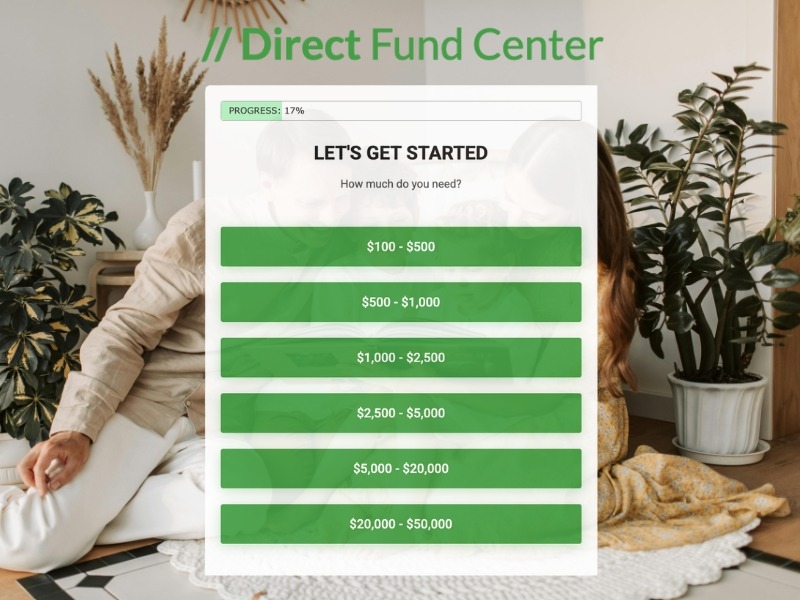
Step One: Application Submission You fill out the online form on Direct Fund Center's website. This takes less than five minutes. You provide basic identifying information, income, employment status, and banking details. You're not applying to Direct Fund Center for a loan. You're providing information that Direct Fund Center will share with lenders.
Step Two: Form Receipt Your application is received by Direct Fund Center's servers in real time. You get immediate confirmation that your form was submitted successfully.
Step Three: Information Verification Direct Fund Center's systems verify basic information, such as email address and mailing address. The company may correct common misspellings and fix incorrectly entered data. This happens automatically.
Step Four: Lead Distribution Your information is shared with lenders according to Direct Fund Center's lending network and ping tree. This occurs either simultaneously to multiple lenders or sequentially (top of tree first, then second, then third). Lenders begin reviewing your application.
Step Five: Lender Review Individual lenders independently review your information. They may perform credit checks, verify employment, check your Social Security number, or review your application against national credit databases. Each lender makes independent decisions. You're not applying to each lender individually, but each is evaluating whether they'll make an offer.
Step Six: Offer Decisions Lenders who are interested in extending an offer inform Direct Fund Center. Lenders who decline do not contact you. Direct Fund Center then routes you to interested lenders' websites.
Step Seven: Lender Presentation You're redirected to the lender's website. You now see their specific offer: loan amount, APR, term, fees, everything. At this point, you're on the lender's site, not Direct Fund Center's. The terms are set by the lender.
Step Eight: Your Decision You review the lender's offer and decide to accept or decline. You're under no obligation to proceed. You can decline an offer without penalty. Different lenders may contact you, but you control whether to respond.
Step Nine: Acceptance and Funding If you accept and proceed with the lender, you're entering into a loan agreement with that specific lender. Direct Fund Center's role ends. Your relationship is now with the lender. The lender services the loan going forward.
This process typically takes 24-48 hours from application to funded loan, though exact timelines vary by lender and depend on your responsiveness to any additional documentation requests.
When a Lending Aggregator Makes Sense for Your Situation
A lending aggregator is a practical option if your situation includes these elements:
You have fair or poor credit and have been declined by traditional lenders. An aggregator's multiple lender connections genuinely improve your odds of approval. Rather than being declined by one bank, you access a network where different lenders have different approval standards.
You need emergency capital quickly. Aggregators process applications faster than traditional lending. You can realistically receive approval and funding within 24-48 hours under ideal conditions.
You want to compare multiple loan offers. Aggregators let you see what different lenders are willing to offer without submitting separate applications to each one.
You're willing to accept the trade-offs of the model, including data sharing with multiple companies and potential routing to higher-cost lenders.
A lending aggregator is likely not the right choice if:
You have excellent credit. If you qualify for traditional bank rates, applying directly to banks and peer-to-peer lenders is more efficient. You'll get better terms, less marketing contact, and more predictable outcomes.
You want a guaranteed rate before proceeding. Aggregators don't provide this. You don't know your actual rate until a lender approves you and presents an offer.
You prioritize data privacy. Aggregators, by definition, share your information with multiple companies. If you're privacy-conscious, this represents a genuine trade-off.
You want to work exclusively with state-regulated lenders. Aggregators' networks often include tribal and offshore lenders. If your values or financial situation require state-regulated options only, understand that you may still be routed to non-state-regulated lenders.
Comparing Personal Loan Options: Aggregators, Direct Lenders, and Banks
Personal loan options exist on a spectrum, each with different trade-offs.
Traditional banks and credit unions often offer lower APRs than online lenders and aggregators, though approval requirements may be stricter. If you qualify, bank and credit-union loans are often among the lower-cost options available, but whether they're appropriate for you depends on your individual financial situation. Processing typically takes longer than aggregators, often one to two weeks.
Peer-to-peer lending platforms like LendingClub and Prosper lend directly (not as aggregators). They charge higher rates than banks but typically lower than tribal lenders. Approval odds are moderate. Processing is faster than banks but slower than aggregators.
Personal loan comparison sites have built large lending networks and strong consumer recognition. Their platforms emphasize rates, offers, and lender categories. These sites provide varying levels of detail about how lead auctions and lender prioritization actually work behind the scenes.
Direct Fund Center takes a different approach by emphasizing explanation of how lead generation, lender bidding, and ping trees operate, and by being explicit about the role and characteristics of tribal and offshore lenders in the network.
Each approach has merit depending on your priorities-brand recognition, speed, lowest possible rates, or transparency about mechanics.
Critical Questions Before Accepting Any Loan Offer
If you receive a loan offer from any lender, whether through an aggregator or directly, ask these questions before committing:
What is the APR exactly, and what does it include? Get a clear, specific number. If you don't understand the rate, ask the lender to explain it.
What are all the fees? Beyond APR, lenders may charge origination fees, prepayment penalties, late fees, and other charges. All must be disclosed before you commit.
What's the repayment schedule? How long do you have to repay? When are payments due?
What happens if I miss a payment? Can you extend? Do extensions charge additional fees? Can the loan roll over into a new loan?
What data are you collecting and how long will you keep it? Understand data handling practices.
Can I communicate directly with the lender? Or am I communicating through intermediaries? This affects dispute resolution and communication clarity.
Understanding Credit Inquiries and Their Impact
When you apply through an aggregator, lenders may perform credit inquiries. Understanding how these work matters.
Credit inquiries come in two types: soft inquiries and hard inquiries. Soft inquiries (for example, when you check your own credit score) do not affect your credit scores. Direct Fund Center states that it does not itself perform credit checks; lenders and service providers in the network may perform hard inquiries when reviewing your application.
Hard inquiries appear on your credit report for up to two years. For most people, a single hard inquiry has a small, temporary impact on your FICO® score-often around five points or less. The effect on your score usually fades over about a year, though this varies depending on the scoring model and your overall credit history.
Some scoring models treat multiple inquiries for the same type of loan within a short shopping window as a single event for scoring purposes, but this is not guaranteed across every scoring model and every type of unsecured personal loan. If you're concerned about your credit score, check your current score before applying and review credit bureau guidance on how inquiries are treated.
Red Flags in Any Lending Relationship
Watch for these warning signs with any lender:
Guaranteed approval claims before reviewing your application. No legitimate lender can guarantee approval without evaluating your financial situation first.
Upfront fees required before you receive any funds. Legitimate lenders disclose fees upfront and deduct them from your loan proceeds, not charge them before funding.
Pressure to decide quickly. Real loans require consideration. High-pressure tactics are a warning sign.
Hidden or unclear APR and terms. You should know your APR before committing. If it's vague, walk away.
Requests for sensitive information before you've formally applied. Legitimate lenders don't ask for your Social Security number until you've requested a specific loan.
Lack of clear contact information or physical address. Legitimate lenders are locatable.
Negative reviews specifically about loan terms being different than advertised. This suggests bait-and-switch practices.
Alternatives to Lending Aggregators You Should Consider
If an aggregator doesn't feel right for your situation, these alternatives exist:
Credit unions often offer personal loans with more flexible criteria than banks and better rates than tribal lenders. If you're a member, start here.
Peer-to-peer lending platforms like Prosper and LendingClub lend directly, not as aggregators. Rates are higher than banks but typically lower than tribal lenders.
Bank personal loans from traditional banks, which aren't as restrictive as many assume. Try applying directly before assuming rejection.
Employer loans or 401(k) loans (if available) often carry zero interest and don't appear on your credit report.
Side income or asset sales, if your timeline allows, may provide faster capital than any loan process.
Payment plans directly with creditors or service providers. Medical providers, utility companies, and repair shops often offer payment arrangements without involving lenders.
Nonprofit credit counseling services, which provide guidance without trying to sell you loans.
Direct Fund Center: How It Works and What to Expect
Direct Fund Center is structured as a lead-generation and lead-aggregation service operated by Online Loan Network, based in Las Vegas, Nevada. The site publishes detailed Terms of Use, privacy notices, and state-specific disclosures explaining how your information is shared, how lead generation works, and which states are excluded (notably, New York).
The company is compensated by lenders and lead purchasers who purchase leads, not by consumers. This means applications are free to submit.
When you apply through Direct Fund Center, your loan agreement-if you accept one-is always with the lender, not with Direct Fund Center. Direct Fund Center's role is connecting you to lenders; the lender's role is determining whether to extend credit and on what terms.
No online service is entirely risk-free. Before using any loan-matching site, read the terms, understand how your data will be used, and decide whether that business model aligns with your privacy and financial comfort level. This is especially important given that your information may be shared with multiple lenders, some of whom may be tribal or offshore lenders, and may be marketed to you by multiple companies afterward.
Tribal and Offshore Lending: Understanding the Risks
If you're routed to a tribal or offshore lender, you're entering a high-cost lending relationship that requires careful evaluation.
Tribal and offshore lenders charge significantly higher interest rates than state-regulated lenders because they operate under different legal frameworks and serve borrowers other lenders won't approve. These lenders may offer approval when no other option exists, but at substantial cost.
Before accepting a loan from a tribal or offshore lender, carefully consider:
Can you actually afford the total repayment cost? Calculate the total amount you'll pay including all interest and fees. If it's more than you can reasonably repay, decline and explore other options.
Is there any alternative? Even if approval odds seem low, consider trying traditional lenders, peer-to-peer platforms, credit unions, or payment plans with service providers before committing to a very-high-cost loan.
Do you understand the renewal/rollover terms? Some tribal loans are designed to roll over repeatedly, creating cycles of debt. Understand these terms fully.
Are you comfortable with the enforcement mechanisms? Some tribal lending agreements use tribal dispute resolution rather than state courts. Understand how disputes would be resolved.
High-cost lending, while sometimes necessary in emergencies, creates financial risk. Be sure you understand what you're entering and have exhausted other options.
If you're considering a high-APR loan from a tribal or offshore lender, it may be helpful to review your options with a nonprofit credit counselor or another qualified financial professional before committing.
Common Questions About Lending Aggregators
How fast can I really get money?
Direct Fund Center states that some borrowers may receive funds as soon as the next business day after approval. Actual funding timelines depend on the specific lender, your bank's processing time, and how quickly you provide any required documentation. Some loans take longer than 24-48 hours to fund.
Will applying hurt my credit score?
When lenders perform credit checks, these are hard inquiries that appear on your credit report. As discussed above, these have a small temporary impact and fade over time. However, this impact is real and should be considered before applying.
What if I get denied?
If no lender in Direct Fund Center's network approves you, nothing happens. You've submitted your information and received rejection. No fee is charged. You're not obligated to do anything. You may receive marketing communications from lenders, but you can opt out.
What if I get approved but don't want the loan?
You're under no obligation to accept. When a lender approves you, they present terms. If you don't like them, decline without penalty. You won't be charged. Your only trade-off is that you now have multiple lenders with your information.
What if my APR is higher than I expected?
Advertised rates represent ranges. Your actual rate depends on your credit score, income, loan amount, and the lender's discretion. If the rate offered is unacceptable, you can decline. There's no penalty for declining.
Will I receive unwanted marketing calls?
Yes, likely. By applying through an aggregator, you've authorized lenders and lead buyers to contact you. You'll receive calls, emails, and texts. You can ask them to stop. If they continue, you can report them. But expect contact to be part of the experience.
Can I apply again if I'm denied?
Yes, but wait. Multiple applications in a short period damage your credit score. If you're denied, wait at least a week before reapplying to give your score time to recover.
The Bottom Line: Making an Informed Decision
Personal loan aggregators like Direct Fund Center solve a real problem: if traditional lenders have declined you and you need emergency capital, an aggregator genuinely increases your odds of approval by connecting you to a diverse lending network.
This comes with explicit trade-offs. Your information is shared with many companies. You may be routed to tribal or offshore lenders with very high APRs. Marketing contact from multiple lenders is inevitable. The lender you're connected to has been chosen partly through economic bidding.
Whether these trade-offs are worth it depends on your specific situation. If you're facing an emergency and traditional lenders have declined you, the trade-offs may be acceptable. If you have better credit and qualify for traditional rates, you're probably better off applying directly.
The most important thing Direct Fund Center offers is transparency about how the system works. With that information, you can make a genuinely informed choice about whether an aggregator is right for you.
Disclosure Notice
Direct Fund Center is a lead-generation and lead-aggregation service, not a lender. The company is operated by Online Loan Network and is based in Las Vegas, Nevada. The company is not available to New York residents.
Direct Fund Center is compensated by lenders and lead purchasers for connecting borrowers with lending offers. This creates incentive structures where lenders willing to pay higher fees may receive prioritized placement in Direct Fund Center's lending network. Tribal lenders and offshore lenders, which typically charge significantly higher interest rates than state-regulated lenders, often have higher profit margins and thus may be able to afford higher lead fees, potentially resulting in their greater presence in lending networks.
By submitting an application, you authorize Direct Fund Center and lenders in their network to pull your credit report, verify your information, and contact you regarding loan offers. Your information will be shared with multiple lenders and may be shared with third-party lead aggregators and marketers. You may receive marketing communications from lenders you did not accept offers from.
Your credit may be affected by hard inquiries that lenders perform when reviewing your application. These inquiries appear on your credit report for up to two years.
You are not obligated to accept any loan offer presented. Rates, terms, and approval decisions are determined solely by individual lenders, not by Direct Fund Center.
This article is educational and informational only. It is not financial, legal, or tax advice. It does not recommend any specific loan, lender, or service for your individual situation. Before accepting any loan offer, particularly a high-APR or emergency loan, carefully review all terms, including APR, fees, and repayment schedule. If you are struggling with debt or financial hardship, speaking with a nonprofit credit counselor may provide valuable guidance before committing to new borrowing.
Lending regulations, enforcement priorities, and court decisions can change over time. Always review the most current disclosures on the lender's and Direct Fund Center websites, and consider checking state or federal consumer-protection resources if you have concerns about lending practices.
For complete information about Direct Fund Center's service, terms, and privacy practices, visit directfundcenter.com or contact support@onlineloannetwork.com or 559-453-0005.
About Direct Fund Center
Direct Fund Center provides a lead-generation service connecting consumers with personal loan lenders. The service is free to consumers. The company is operated by Online Loan Network and based in Las Vegas, Nevada. Service availability varies by state. The company does not serve New York residents. For information on service availability, terms, and privacy practices, visit directfundcenter.com.
Source: Direct Fund Center