Big Cannabis Sold You a Lie. Now the Federal Government Is Giving It to Your Grandparents.
Bombshell lawsuits, a European safety bombshell, and a rogue Medicare program converge in the most dangerous moment in American cannabinoid policy history.
WASHINGTON, DC AND CHICAGO, IL, May 5, 2026 (Newswire.com) - They called it medicine.
They said it could treat your anxiety, your pain, your PTSD, your insomnia, your opioid addiction, your cancer, your irritable bowel syndrome, your grief, your boredom, your sadness, and your shyness.
They built billion dollar companies on those claims. They hired lobbyists, funded public relations campaigns, and placed their products in gleaming dispensaries designed to look like Apple Stores - all while knowing, according to explosive new federal lawsuits, that the science behind those claims was weak, nonexistent, or flatly contradicted by the research they chose not to tell you about.
Now, three events have collided in a single week to reveal what may be the most dangerous moment in American cannabinoid policy history: a $30 billion industry caught allegedly lying to consumers, Europe's top food safety regulator admitting it cannot confirm CBD is safe, and the United States federal government moving to put these products inside Medicare - for your parents and grandparents - without FDA approval.
This is not a policy debate anymore.
This is a five-alarm fire.
The Lawsuits: An Industry Accused of Knowing the Truth and Hiding It
On May 4, 2026, two sweeping federal class action complaints landed in U.S. district courts - one in the Northern District of Illinois, one in the District of Connecticut - and together they read like an indictment of an entire industry.
The defendants are household names in American cannabis: Cresco Labs, Green Thumb Industries, Verano Holdings, and Curaleaf - collectively among the largest cannabis operators in the United States, with revenues running into the billions and dispensary footprints spanning more than a dozen states.
The plaintiffs are ordinary Americans. Consumers from Arizona, Connecticut, Illinois, Maryland, Massachusetts, Michigan, Minnesota, Nevada, New Jersey, New York, Ohio, Rhode Island, and Virginia who walked into dispensaries, reviewed the packaging, and believed what the labels told them.
The lawsuits allege they were lied to.
According to the complaints, these companies marketed cannabis products as medicine capable of treating a staggering list of conditions - insomnia, narcolepsy, cancer, auto-immune disorders, neuropathy, pain, anxiety, PTSD, opioid addiction, and more - while knowing, or having every reason to know, that the science did not support those claims.
The complaints cite a 2025 narrative review and meta-analysis published in the Journal of the American Medical Association analyzing 124 recent randomized controlled trials. Its conclusion: the evidence that cannabis treats pain, anxiety, PTSD, insomnia, and most other marketed conditions is weak or nonexistent.
The American Psychiatric Association, as of December 2025, states its position plainly: there is insufficient evidence that cannabis is an effective treatment for any psychiatric disorder.
And the research the companies allegedly buried? It points in the opposite direction entirely.
Medical research cited in the complaints demonstrates that cannabis use causes and exacerbates the development of schizophrenia, psychosis, bipolar disorder, suicidal ideation, depression, and anxiety. A 2025 study found that states legalizing recreational marijuana with open dispensaries experienced a 12% increase in the number of people admitted to state mental health facilities for schizophrenia and other psychotic disorders.
Persons with mental illnesses - the very population these companies marketed to with promises of relief - have the highest rates of frequent cannabis use in the country.
The complaints allege that Cresco Labs, Green Thumb, Verano, and Curaleaf knew or should have known all of this. And they marketed the products anyway. They promoted cannabis as a cure for the very disorders it allegedly causes.
Green Thumb's mission statement, cited in the Cresco complaint, captures the audacity in a single sentence: "to promote well-being through the power of cannabis."
The lawsuits seek damages for consumers who overpaid for products sold under false medical pretenses, injunctions blocking further deceptive health claims, and orders requiring adequate warnings on every product sold. They cover multiple states and span every major brand these companies operate - Rise, Rythm, Dogwalkers, Sunnyside, High Supply, Mindy's, FloraCal, Curaleaf, Select, Grassroots, and more.
The Cresco complaint runs 320 pages. The Curaleaf complaint runs 253. Neither is the work of fringe litigants. Both are methodically built on peer-reviewed research, regulatory filings, and the companies' own public statements filed with the SEC.
This is not a nuisance lawsuit. This is a reckoning.
The European Verdict: "Safety Cannot Be Established"
While those lawsuits were being filed in American courthouses, a parallel scientific judgment was quietly becoming one of the most important documents in the global CBD debate.
The verdict: safety cannot be established.
The full scientific opinion - available at DOI: https://doi.org/10.2903/j.efsa.2026.10004 - documents the specific failures that led to that conclusion. Between 20% and 30% of the product's composition remains chemically uncharacterized.No toxicological studies were conducted on the actual product under assessment. No human intervention studies were submitted. Stability testing was performed on a material produced by an entirely different manufacturing process. The product's allergenic potential is unknown.
EFSA's expert panel could not determine what the product does to the human body - because the data to answer that question was never provided.
This is not a fringe producer. Charlotte's Web is the company that built the modern CBD industry. If EFSA cannot confirm safety for one of the best-resourced, most sophisticated operations in American hemp, consider what that says about the hundreds of CBD suppliers currently operating without any regulatory scrutiny at all - including the suppliers now entering the U.S. Medicare system.
The Medicare Program: The Government Looks Away
Here is where the story becomes genuinely alarming.
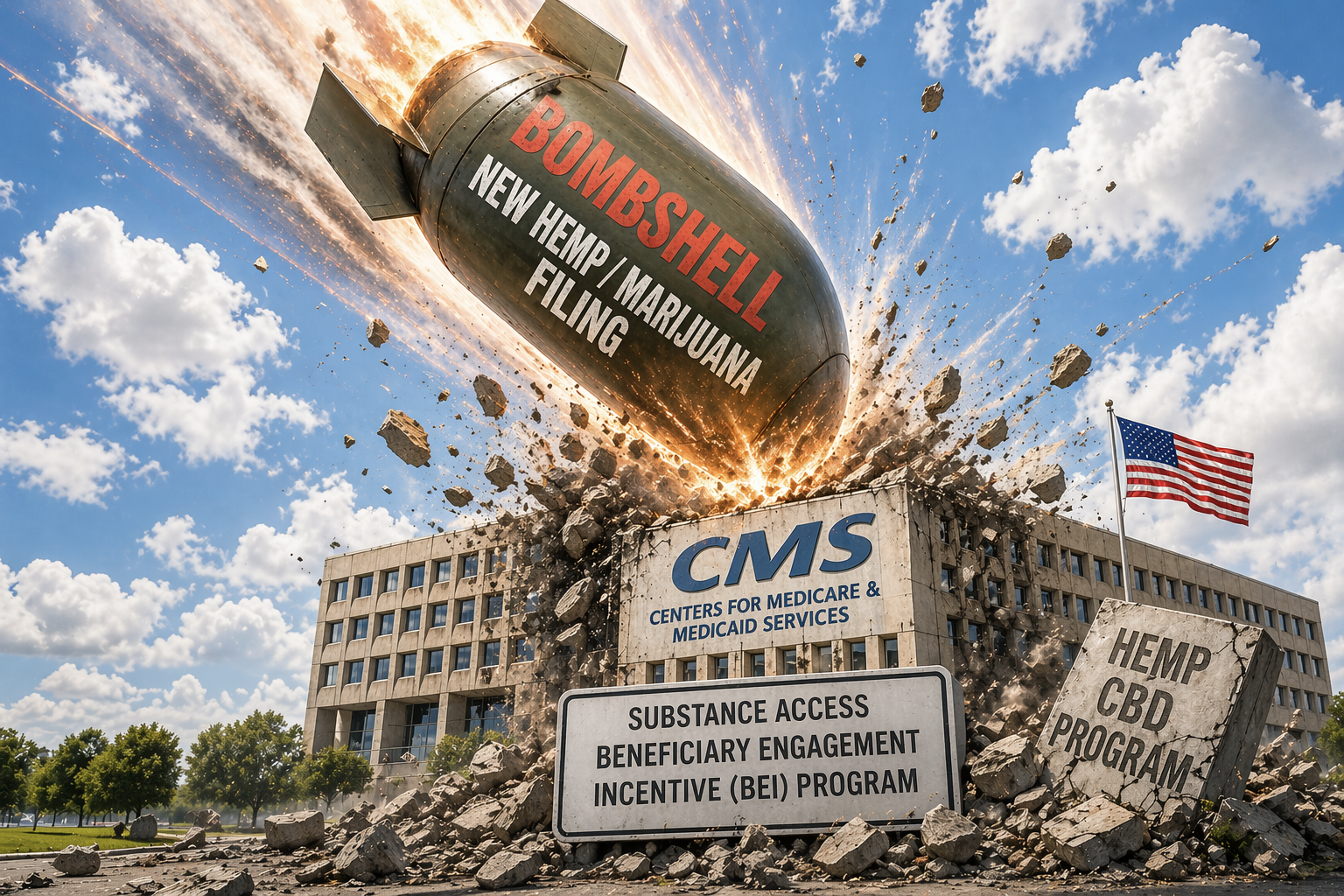
While lawsuits allege the cannabis industry deceived millions of consumers, and while Europe's top food safety regulator concludes CBD safety cannot be confirmed even by leading producers, the Centers for Medicare & Medicaid Serviceshas launched a program that introduces hemp-derived cannabinoid products into federally funded healthcare - without FDA approval.
The Beneficiary Engagement Incentive (BEI) program, operated through CMS's Innovation Center authority, allows participating healthcare providers to discuss and furnish hemp-derived cannabinoid products to Medicare beneficiaries. The target population includes Americans over 65 - people taking multiple medications, more vulnerable to drug interactions, and historically excluded from cannabinoid safety studies.
EFSA specifically noted its provisional safety guidance does not apply to individuals on concurrent medications.
The BEI program targets exactly those people.
What the program does not require is equally striking. No FDA approval. No clinical trial evidence. No notice-and-comment rulemaking. No Federal Register publication. No established safety baseline. No chemistry, manufacturing, or controls validation. No standardized dosing. No adverse-event tracking framework.
In short: none of the requirements that exist to protect patients from unvalidated therapies.
The program's suppliers - the companies actually furnishing these products to Medicare patients - have not filed Investigational New Drug applications with the FDA. They have not undergone CMC validation. They have not conducted human safety studies on their actual products. They have not pursued botanical drug development pathways of any kind.
They have done less than Charlotte's Web did - and Charlotte's Web failed.
For comparison, MMJ International Holdings, Inc. - a biopharmaceutical company developing cannabinoid therapies for Huntington's disease and multiple sclerosis - holds two active FDA Investigational New Drug applications. That means full chemical characterization of the drug substance. Standardized, reproducible dosing. Stability testing on the actual formulation. Human safety protocols. Toxicological studies on representative material. Ongoing FDA oversight at every stage.
These are not bureaucratic formalities. They are the minimum requirements for determining whether a medicine is safe enough to give to a human being.
The BEI program asks none of them. And it is already operating.
Three Signals. One Conclusion.
Step back and consider what has happened in a single week:
Federal courts in Illinois and Connecticut received class action complaints - 573 pages of documented allegations - accusing the largest cannabis companies in America of systematically marketing unproven health claims to millions of consumers while concealing research showing their products cause the very disorders they claimed to treat.
Europe's top food safety authority published a scientific opinion concluding it cannot establish the safety of a CBD product submitted by one of America's most established hemp companies - citing incomplete composition data, inadequate stability testing, missing toxicology studies, and no human safety data.
And the United States federal government's Medicare program is moving forward with cannabinoid furnishing in elderly care settings without satisfying any of the standards that led EFSA to reject Charlotte's Web's application.
These are not three separate stories. They are three chapters of the same story.
An industry that avoided scientific validation while marketing products as medicine. A regulator in another country that caught what the American system has not. And a federal program that has decided access matters more than evidence.
The Federal Court Question Nobody Can Ignore
The collision of these events lands directly inside an active federal courtroom.
In Smart Approaches to Marijuana (SAM) et al. v. Kennedy et al., Case No. 1:26-cv-01081 (D.D.C.), a federal judge in Washington is currently weighing an emergency injunction that could halt the BEI program. The case asks whether CMS exceeded its legal authority by introducing cannabinoid products into Medicare connected infrastructure without FDA approval.
Judge Trevor N. McFadden took the matter under advisement - a signal, legal observers note, that he sees genuine legal tension requiring careful analysis. Courts usually rule immediately when the law is clear. He did not.
The questions now before the court carry new weight in light of this week's developments.
Did CMS create a parallel drug-access pathway outside FDA oversight? The lawsuits filed this week suggest the industry entering that pathway has a documented history of making medical claims its own executives knew were unsupported by science.
Is there irreparable harm to clinical developers? MMJ International Holdings has spent years and millions of dollars pursuing the FDA pathway. The BEI program now rewards suppliers who spent nothing on evidence while penalizing the company that followed every rule.
Does the public interest favor allowing the program to continue? EFSA's conclusion - that safety cannot be established for a leading CBD product - provides the court with international scientific authority directly relevant to that question.
The judge is writing something. Legal observers expect a written memorandum opinion, not simply an order. Whatever he decides will shape cannabinoid policy for years.
What "Promote Well-Being" Actually Cost
In 2024, total U.S. cannabis sales exceeded $30 billion and generated $4.4 billion in tax revenues.
Those numbers represent an industry that built its fortune on a promise: that cannabis was medicine, that it was safe, that it treated disorders that the American Psychiatric Association now says it cannot treat, and that the evidence for its benefits was settled science.
The lawsuits filed this week say that promise was a lie. Not a mistake. Not an overstatement born of enthusiasm. A calculated strategy - and these companies knew it.
The complaints allege that these operators, through their SEC filings, investor presentations, brand marketing, and retail messaging, systematically promoted medical claims they had every reason to doubt. They did it to expand market share. They did it to realize extravagant profits. And they did it while the research they chose not to disclose was documenting the human cost.
The American consumer trusted them.
The federal government is now asking Medicare's most vulnerable population to trust the same supply chain.
The Bottom Line
Duane Boise, CEO of MMJ International Holdings, did not choose his words carefully.
"You have a federal lawsuit alleging the industry misled consumers, Europe saying safety cannot be established, and CMS pushing access to seniors anyway. That is not innovation - that is a breakdown of the entire drug safety system. MMJ followed the rules - IND applications, FDA oversight, validated chemistry, controlled trials. Now the government is effectively telling the market none of that matters."
He is right.
The FDA exists to answer one question before a product enters the American healthcare system: is it safe and effective? That question is not a bureaucratic inconvenience. It is the only thing standing between patients and an industry that, according to federal court filings, has demonstrated it will tell you whatever it takes to get you to buy.
Europe asked the question. The answer came back: safety cannot be established.
America's Medicare program did not ask at all.
A federal judge is about to decide whether that matters.
For the elderly patients already inside this program, the decision may come too late.
CONTACT:
Madison Hisey
MHisey@mmjih.com
203-231-85832
SOURCE: MMJ International Holdings
Source: MMJ International Holdings