Vadzo Introduces Falcon-821CRS Telehealth Camera Module with 4K HDR for Remote Clinical Examinations Under Mixed Lighting
The Falcon-821CRS is an 8MP color rolling shutter USB camera built on the Onsemi AR0821 HyperLux sensor and introduced as a telehealth camera module for remote clinical examinations conducted under mixed lighting conditions. The camera delivers 4K LI-HDR output, on-chip auto exposure, and full UVC compliance with no driver installation required on Windows, Linux, or Android. It supports teleconsultation, virtual care, remote patient examination, telemedicine cart deployments, and OEM medical device integration through a single USB 3.2 connection.
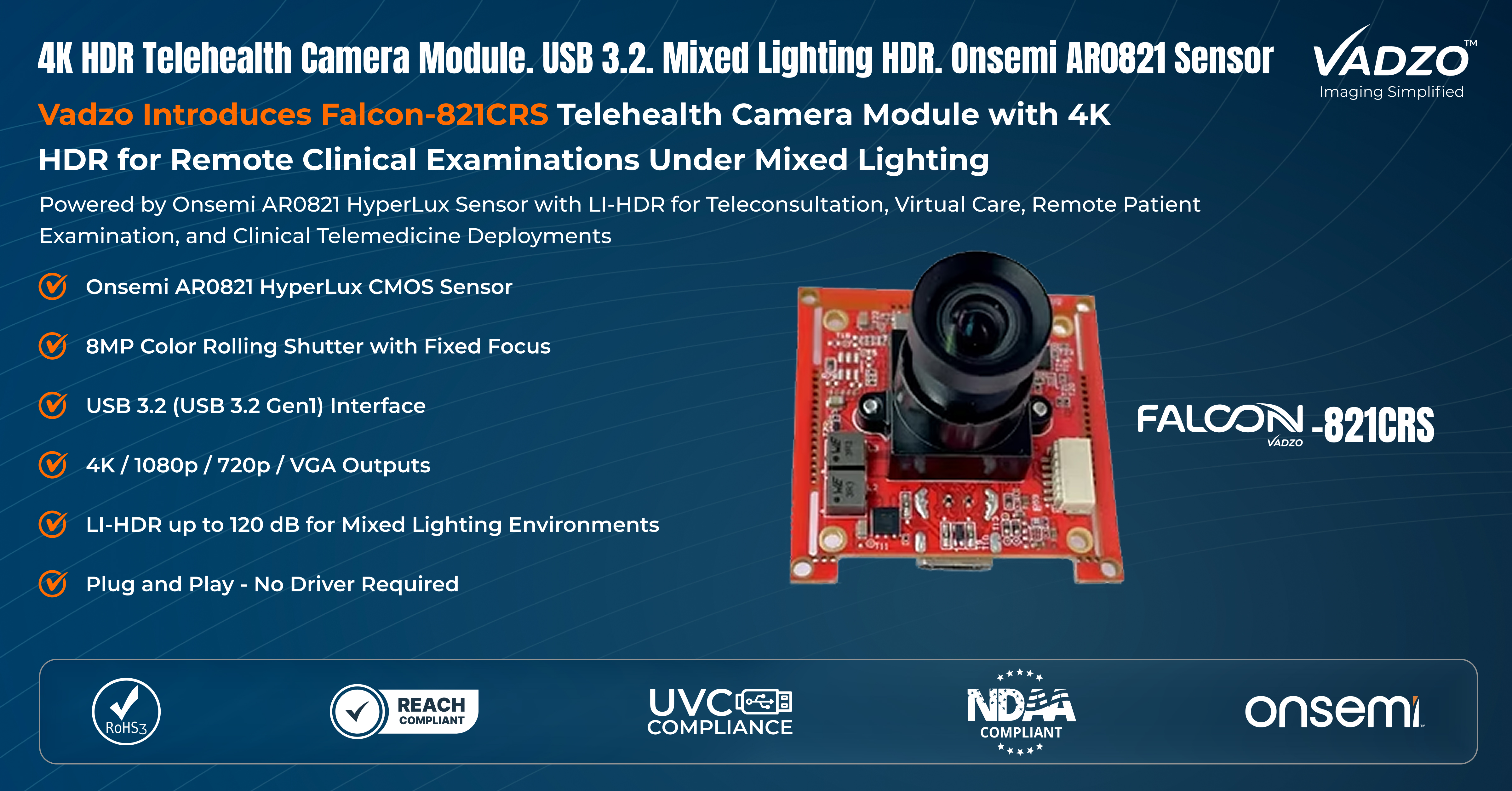
FORT WORTH, Texas, July 9, 2026 (Newswire.com) - Vadzo Imaging, a provider of embedded vision camera products, today introduces the Falcon-821CRS as an AR0821 Telehealth Camera developed for remote clinical examination environments. The Falcon-821CRS functions as a Telehealth Camera Module delivering 8MP 4K output from the Onsemi AR0821 HyperLux sensor with an on-chip LI-HDR capable of up to 120 dB dynamic range. As a 4K Telehealth USB Camera, the module connects USB 3.2 to any telehealth platform, clinical laptop, tablet, or telemedicine cart controller with no driver installation required. Vadzo engineered this camera to address the defining image quality challenge of remote clinical examinations: the inconsistent, mixed lighting found in patient homes, remote clinics, and telehealth consultation rooms that routinely causes highlight clipping, color casts, and shadow loss on standard cameras.
Sensor and Camera Overview
The Falcon-821CRS is an AR0821 Telemedicine Camera built on the Onsemi AR0821 HyperLux CMOS sensor and paired with a high-performance ISP. The AR0821 is an 8MP (3840 x 2160) color rolling shutter sensor with a 1/1.7-inch optical format and 2.1 µm pixel size. The sensor integrates on-chip LI-HDR capable of up to 120 dB dynamic range, which captures detail in both the bright examination light illuminating a wound site and the dimly lit room background within the same video frame. This makes the Falcon-821CRS a purpose-built HDR Telehealth USB Camera for remote clinical encounters where the clinician cannot control the patient's ambient environment. For teleconsultation sessions where skin tone accuracy and lesion color fidelity determine diagnostic quality, the AR0821's color reproduction and high quantum efficiency make the Falcon-821CRS a genuinely Mixed Lighting Medical Camera rather than a repurposed webcam.
The camera delivers full 8MP color output through a USB 3.2 interface with UVC compliance, enumerating instantly on any connected host without driver installation. As a color-accurate telehealth camera, the module draws all operating power from the USB host port at 5V, eliminating external power supplies. Output modes include 4K, 1080p, 720p, and VGA, allowing telehealth software to select the resolution that best matches available network bandwidth. The S-Mount (M12) lens holder accepts standard M12 optics for clinical specialty customization. Auto exposure operates continuously in hardware without host processor involvement, maintaining consistent image brightness across session duration.
Key specs: 8MP (3840 x 2160) | Onsemi AR0821 HyperLux 1/1.7-inch 2.1 µm pixel | Color | Rolling Shutter | Fixed Focus | Auto Exposure and LI-HDR | USB 3.2 Gen1 | UVC Compliant | 4K / 1080p / 720p / VGA | S-Mount (M12) | Windows / Linux / Android
Key Capabilities of the Onsemi AR0821 4K HDR Telehealth Camera Module
On-chip LI-HDR for Mixed Lighting Remote Examinations: The dominant image quality failure in remote clinical examinations is the mismatch between bright examination light on the patient and dim ambient room illumination behind them. Standard cameras clip highlights the examined area or crushes the background into black, and the clinician loses either the lesion detail or the contextual patient's framing. The Onsemi AR0821 sensor uses LI-HDR, which performs multiple exposure captures and combines them at the sensor level before reading out, preserving detail across the full 120 dB brightness range within a single frame. This 8MP Telehealth Camera output captures the full tonal range of a wound site under a bright examination lamp while retaining the patient's surrounding skin tone and room context simultaneously. For a 4K Remote Clinical Camera deployment in a home telehealth visit, this eliminates the need for the patient to adjust room lighting before the consultation and removes the highlight and shadow loss artifacts that undermine clinician confidence in remote image assessment.
Color Fidelity for Remote Dermatological and Wound Assessment: Remote dermatology and wound care teleconsultation depend on faithful skin tone reproduction and accurate lesion color rendering. A camera with poor color science shifts red pigment toward orange, mutes the purple border of a venous ulcer, or alters the erythema boundary that differentiates a healing wound from an infected one. The AR0821's Bayer color filter array and ISP tuning deliver natural color reproduction across diverse skin tones under the variable color temperatures of incandescent, fluorescent, and LED lighting common in home environments. As an AR0821 Remote Clinical Camera, the Falcon-821CRS captures the precise color gradients that dermatologists, wound care nurses, and general practitioners rely on for remote assessment. Vadzo calibrates the ISP color profile specifically for clinical imaging use cases, ensuring that the Remote Clinical Examination Camera output represents tissue color accurately rather than applying the consumer-oriented saturation enhancement common in webcam-class sensors.
UVC Compliance for Zero Driver Telehealth Deployment: Telehealth platforms run on clinical tablets, locked-down laptops, and embedded display controllers that operate under hospital or enterprise IT security policies. Installing a proprietary camera driver on any of these devices requires IT authorization, testing, and ongoing maintenance across OS updates. The Falcon-821CRS is a Zero Driver Telehealth Camera that uses the USB Video Class standard, which is natively supported in the base kernel of Windows 10 and 11, Linux through V4L2, and Android. It operates as a UVC Telehealth Camera that enumerates automatically as a standard webcam within any telehealth application, electronic health record system, or video conferencing platform that accesses the host camera API. There is no installation process, no version compatibility dependency, and no IT approval workflow. As a Plug Play Telehealth Camera, the Falcon-821CRS reduces teleconsultation setup to a single USB connection and opens the application.
Compact 38mm Module for Telemedicine Cart and Device Integration: Telemedicine carts, portable consultation monitors, and tablet-mounted telehealth terminals impose strict dimensional and weight constraints on camera modules. A large housing camera with an external power supply cannot integrate into the compact form factor of a clinical cart head or a tablet accessory bracket. The Falcon-821CRS operates as a Compact Telehealth Camera Module housing the complete AR0821 sensor, ISP, S-Mount lens assembly, and USB 3.2 interface in a 38mm body that mounts directly into cart-mounted enclosures and displays integrated camera bays. As a USB Telehealth Camera Module, it draws power entirely from the USB host, keeping cable count to one and simplifying cart wiring harness design. OEM engineers building this as a Healthcare Camera Module into a clinical device benefit from the compact footprint, S-Mount lens interchangeability, and documented USB descriptor behavior for platform certification.
Selectable Resolution Modes for Variable Network Bandwidth: Telehealth sessions operate across a wide range of network conditions, from hospital-grade broadband to rural LTE and household Wi-Fi connections with variable throughput. A camera that outputs only 4K forces the telehealth application to compress heavily or drop frames on lower bandwidth connections, degrading the consultation experience. The Falcon-821CRS offers selectable output at 4K, 1080p, 720p, and VGA without requiring hardware changes. As a 4K Teleconsultation Camera, it provides maximum detail for skin inspection, wound assessment, and ophthalmic teleconsultation where the remote clinician needs full resolution. As a Telemedicine Cart Camera operating over LTE in a mobile clinic, the same module outputs 720p to maintain frame rate and latency within the available bandwidth. This flexibility makes the Falcon-821CRS useful as a Remote Examination Camera across both high-bandwidth hospital networks and lower bandwidth rural telehealth deployments from a single hardware SKU.
OEM Ready Module for Telehealth Platform Development: Medical device OEMs building dedicated telehealth terminals, teleconsultation workstations, and remote patient monitoring devices require a camera core that arrives ready for integration with compliance documentation, lens options, and engineering support. The Falcon-821CRS is available as an OEM Telehealth Camera Module with RoHS 3 and REACH compliance statements, mechanical drawings, USB descriptor documentation, and factory lens calibration. As a Telemedicine Camera Module, Vadzo offers custom S-Mount lens selection, focus distance calibration for specific cart geometries, and ISP parameter tuning for clinical color profiles. The Onsemi AR0821 Telehealth Camera core is production-proven and supported with direct engineering consultation throughout the OEM device design and regulatory documentation phase.
"The biggest image quality complaint we hear from telehealth engineers is the blown-out outpatient area when any form of examination light is in frame. The AR0821 sensor's LI-HDR resolves that at the sensor level, capturing 120 dB of dynamic range in a single readout without any software blending artifacts. Combine that with the color accuracy that remote dermatology and wound care clinicians need, UVC plug-and-play operation, and a 38mm bus-powered module, and Vadzo gives telehealth platform developers a camera core that handles the real conditions of a home consultation or a rural telemedicine clinic. That level of imaging performance in a module in this compact is what moves telehealth from acceptable to genuinely diagnostic grade." - Alwin Vincent, Product Manager, Vadzo Imaging.
Applications
Teleconsultation and Remote Clinic Deployments: Fixed teleconsultation stations in remote health clinics, rural outposts, and specialist referral hubs require a camera that delivers consistent 4K HDR output session after session without driver maintenance. The Falcon-821CRS operates as a Teleconsultation Camera mounted to a dedicated consultation monitor or cart, connecting over USB 3.2 and enumerating automatically on every session to start. As an AR0821 Teleconsultation Camera, it delivers the color fidelity and HDR performance that specialist physicians expect when reviewing skin, wound, or eye conditions from a remote hub, without requiring the local clinic technician to manage camera configuration.
Virtual Care and Remote Patient Examination: Home-based virtual care visits and remote patient monitoring services need a camera that non-technical users can connect to without support calls, and that delivers clinically useful image quality under household lighting. The Falcon-821CRS serves as a Virtual Care Camera that the patient or caregiver connects via USB to any Windows or Android tablet. No setup is required beyond connecting the cable. As a Remote Patient Examination Camera, the on-chip LI-HDR handles the variable lighting of a living room, kitchen, or bedroom without user adjustment, giving the remote clinician a clear, correctly exposed view of the examination area from the first frame of the session.
Telehealth Consultation Platforms and Virtual Examination Tools: Software-based telehealth platforms integrating camera access through the OS video API benefit from UVC compliance that makes the Falcon-821CRS available as a Telehealth Consultation Camera without any vendor SDK or custom integration work. The camera appears as a standard webcam device to the application layer on Windows, Linux, and Android. As a Virtual Consultation Camera, it supports 4K streaming in telehealth apps that consume raw camera frames, while 1080p and 720p modes serve video conferencing integrations where compressed streams are preferred for latency and bandwidth management.
Remote Healthcare and Digital Health Infrastructure: Integrated digital health networks and remote healthcare delivery programs require a standardized camera module that deploys consistently across diverse endpoint types, from clinic workstations to patient-side tablets. As a Remote Healthcare Camera, the Falcon-821CRS provides uniform image quality and UVC enumeration behavior across all supported operating systems, reducing the platform testing burden for digital health program operators. Its Digital Health Camera capabilities extend to chronic disease monitoring, remote physiotherapy sessions, and community health worker programs, where consistent visual documentation quality supports longitudinal patient tracking and remote clinical review.
Medical Teleconsultation and Remote Diagnosis: Specialist teleconsultation services in dermatology, wound care, ophthalmology, and general medicine require camera output with sufficient resolution, color fidelity, and dynamic range for diagnostic decision making. The Falcon-821CRS serves as a Medical Teleconsultation Camera delivering 4K HDR output that captures the detail a specialist needs to assess lesion characteristics, wound stage, or skin condition without being physically present. As a Remote Diagnosis Camera, it supports store and forward telehealth workflows where still images captured at a maximum 8MP resolution are reviewed asynchronously by the consulting specialist. The Clinical Telemedicine Camera form factor integrates into portable examination kits carried by community health workers in rural and underserved communities.
OEM Teleclinic and Platform Module Integration: Telehealth device manufacturers building dedicated teleclinic kiosks, portable consultation tablets, and remote monitoring terminals need a camera module certified for medical use and supported through device development. The Falcon-821CRS integrates as a Teleclinic Camera Module with RoHS 3 compliance, factory lens calibration, and full USB descriptor documentation for device certification support. As a Telehealth Imaging Camera, the 38mm module fits within compact telehealth device enclosures and supports OEM lens customization for device-specific working distances. Vadzo's engineering team provides integration consultation for Remote Care Camera Module designs throughout the development and regulatory documentation cycle.
Frequently Asked Questions
Q: How does on-chip LI-HDR address the mixed lighting challenge in home-based remote patient assessments?
A: Mixed lighting is the central image quality problem of home-based teleconsultation. Examination lights, window daylight, and room ambience operate at different intensities and color temperatures simultaneously, and a standard camera can expose only one of them at a time. On-chip LI-HDR works by capturing the sensor at two or more different exposures within a single frame readout cycle and combining them in hardware before the image leaves the sensor. The bright regions are captured at a short exposure that avoids clipping, and the dark regions are captured at a longer exposure that avoids noise, and both are merged into a single frame covering the full scene's brightness range. For a Patient Assessment Camera deployed in a home visit, this means a wound site under a bright examination light and the surrounding skin in ambient room light are both correctly exposed and accurately colored in the same frame that the remote clinician reviews. Vadzo tunes the AR0821 ISP settings to optimize this HDR merge for clinical skin tone accuracy rather than the consumer saturation enhancement typical of webcam ISP tuning. The result is a clean, diagnostically useful image without the blown highlights or shadow noise that forces clinicians to ask patients to reposition or adjust lighting before the examination can proceed.
Q: What does UVC compliance actually mean for telehealth software developers and platform integrators?
A: UVC, or USB Video Class, is an industry standard that defines how a USB camera communicates with a host operating system without requiring a vendor-supplied driver. The standard is implemented natively in Windows, Linux, and Android, meaning the operating system kernel already contains the code to recognize and operate a UVC device at the moment it connects. For telehealth software developers, this means the camera appears through the standard OS camera API - the same API that any application uses to access a built-in laptop webcam. There is no SDK to integrate, no driver installer to bundle in the application package, and no risk of driver version conflicts after OS updates. A Virtual Examination Camera built on UVC connects to a telehealth platform in the same way a mouse connects to a computer: plug in the cable and the device is ready. For platform integrators deploying across a mix of Windows tablets, Android terminals, and Linux-based kiosks, UVC compliance means the same camera module works identically across every endpoint without platform-specific driver management. Vadzo ships every Falcon-821CRS with documented UVC descriptor configurations, allowing integrators to confirm enumeration behavior before full platform qualification testing.
Q: When does 4K resolution genuinely matter for a remote clinical consultation versus standard 1080p?
A: The practical difference between 4K and 1080p in teleconsultation appears when the clinician needs to crop or zoom into a specific region of the image without losing the ability to read fine detail. At 1080p, zooming into a 200 x 200-pixel region of a 1920 x 1080 frame produces a heavily interpolated crop that blurs lesion borders and loses color gradients. At 4K, the same region of crop from a 3840 x 2160 frame still contains enough pixels for the remote specialist to assess border irregularity, surface texture, and color variation with confidence. Vadzo's AR0821-based 4K HDR camera delivers native 4K output without digital upscaling, which is an important distinction: native 4K captures actual sensor detail at every pixel, while upscaled cameras simply interpolate a lower resolution frame to a larger format. For storing and forwarding telehealth workflows in dermatology and wound care, where the specialist reviews a captured still image rather than a live video stream, 4K provides the spatial resolution needed for a clinical-grade image. For live video consultations over adequate network bandwidth, 4K also allows the telehealth platform to deliver a smooth full-face framing at the clinical workstation without the pixelation that 1080p can produce on large clinical monitors.
Q: How does Vadzo ensure color accuracy for skin assessment in remote dermatological consultations?
A: Color accuracy in a medical camera goes beyond measuring a color checker chart under laboratory conditions. Clinical skin tone accuracy requires that the camera's color reproduction remains stable across the different color temperatures of incandescent, fluorescent, and LED lighting without the white balance algorithms drifting toward orange or green casts that shift perceived pigment in ways that could affect assessment. Vadzo tunes the AR0821 ISP color matrix and white balance algorithm specifically for clinical environments rather than adopting the consumer ISP profile that prioritizes vibrant, saturated colors over accurate ones. The Onsemi AR0821 sensor's Bayer filter design and 2.1 µm pixel geometry provide sufficient quantum efficiency across the visible spectrum to produce a low noise color signal in the ambient light levels typical of home and clinic rooms. Vadzo's factory's ISP calibration process validates the camera's output against standard clinical skin tone references before shipment, and each module ships with that calibration active by default. OEM customers building the module into a telehealth device can request custom ISP profiles matched to their specific optical path and enclosure lighting conditions.
Q: How does Vadzo Imaging's approach to telehealth camera development differ from off-the-shelf USB camera suppliers?
A: Off-the-shelf USB camera suppliers ship bare modules with a data sheet, a default lens, and no application tuning. The integrator inherits all the ISP calibration work, the lens selection process, the compliance documentation effort, and the platform bring-up engineering. Vadzo Imaging approaches every camera module as a deployed system rather than a component. Every Falcon-821CRS ship factory tested with its S-Mount lens installed, the ISP color calibration validated against clinical tone references, UVC enumeration confirmed on all supported platforms, and compliance documentation prepared. Vadzo provides direct engineering access throughout the integration project, including lens selection guidance for specific cart or device geometries, custom ISP tuning for specific clinical workflows, USB descriptor documentation for device certification support, and production volume pricing without minimum order barriers at the evaluation stage. Customers receive the benefit of Vadzo's telehealth and medical imaging application experience built into the product from day one, rather than discovering ISP and integration issues during clinical validation. Vadzo engineering support does not end at the point of sale but continues through the full device development and production cycle.
Availability
The Falcon-821CRS AR0821 4K HDR USB camera, built on the Onsemi AR0821 HyperLux sensor, is available now for evaluation and production orders. Evaluation kits include the camera module with an S-Mount fixed focus lens, USB 3.2 cable, and integration documentation with no minimum order requirement. Browse the full Vadzo medical and telehealth imaging portfolio at https://www.vadzoimaging.com/ or contact Vadzo at support@vadzoimaging.com to request an evaluation kit or discuss OEM telehealth integration requirements.
About Vadzo Imaging
Vadzo Imaging is a global provider of embedded vision solutions and delivers high-performance 4K HDR camera technologies and imaging platforms for applications in robotics, industrial automation, UAVs, edge AI, and medical systems. Its products are designed for seamless integration with leading embedded platforms. Vadzo supports customers through hardware customization, firmware development, and module-level drivers, enabling faster development and deployment of vision-based systems.
Media Contact
Alwin Vincent
Vadzo Imaging
Email: alwin@vadzoimaging.com
LinkedIn: Vadzo Imaging
YouTube: Vadzo Imaging
X: Vadzo Imaging
SOURCE: Vadzo Imaging
Source: Vadzo Imaging