Vadzo Imaging's Laboratory Automation Camera Falcon-544CRS: AR0544 Low Power HDR USB camera Enables Consistent 5MP Color Capture Across Brightfield and Variable Illumination Lab Systems
Vadzo Imaging's Falcon-544CRS Laboratory Automation Camera combines the Onsemi AR0544 Hyperlux™ LP sensor's low power 5MP color imaging with LI-HDR intra frame capture to hold consistent exposure and color balance across brightfield and variable illumination lab systems, supporting microscopy, histology, cytology, well plate imaging, liquid handling, and flow cytometry deployments over a UVC compliant USB 3.2 interface that runs driverless on Windows, Linux, and Android host platforms.
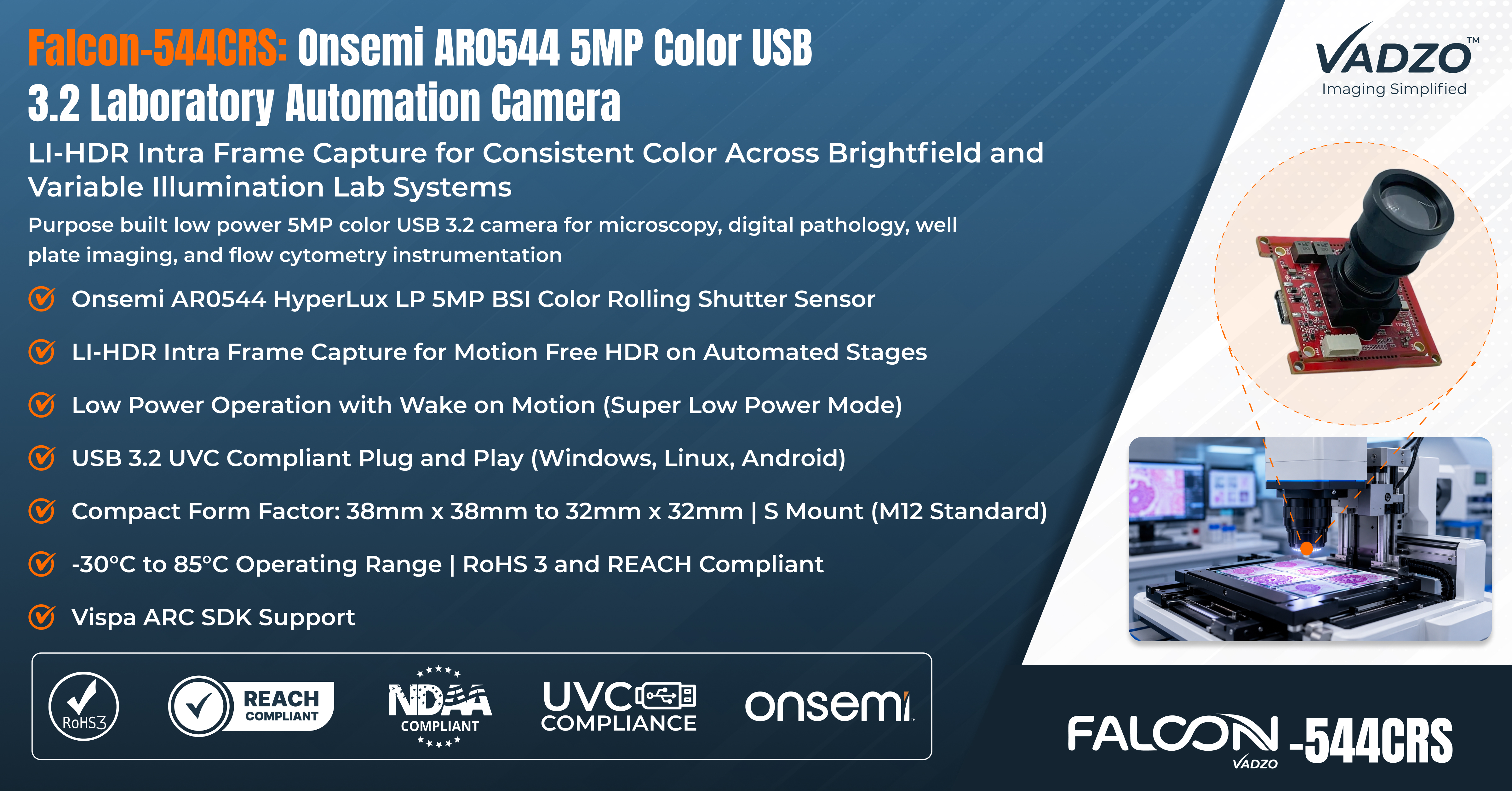
FORT WORTH, Texas, July 22, 2026 (Newswire.com) - Vadzo Imaging, a provider of embedded vision camera products for OEMs and system integrators, today introduces the Falcon-544CRS as a Laboratory Automation Camera built around the Onsemi AR0544 Hyperlux™ LP sensor. The 5MP Color USB Camera module targets engineering teams developing brightfield microscopy instruments, digital pathology scanners, well plate imaging systems, liquid handling platforms, and flow cytometry analyzers that require dependable color and exposure performance under illumination conditions that vary from station to station and from sample to sample. Built on the same Hyperlux™ LP sensor architecture Vadzo has already validated across its Falcon and Bolt camera series, the Falcon-544CRS extends LI-HDR intra-frame capture and low-power operation into a life sciences-focused USB 3.2 configuration with full UVC compliance for driverless operation on Windows, Linux, and Android host platforms.
Technical Problem Definition
Automated laboratory imaging systems present a distinct dynamic range problem that general-purpose industrial camera products are not built to solve. A brightfield microscope illuminates a sample from below or through a condenser, producing a field where the specimen itself absorbs and scatters light unevenly while the surrounding fluid or mounting medium transmits the illumination source almost directly into the sensor. A well plate imaging camera faces a related but distinct challenge, where the curved meniscus at the top of each well creates a specular reflection that can saturate several stops brighter than the sample volume beneath it. In both cases, a standard dynamic range sensor forces the imaging engineer to choose between two failure modes: underexposing the sample to protect highlight detail in the illumination path, or exposing correctly for the sample and clipping the highlight into a featureless white region that a downstream classification or stain quantification algorithm cannot use.
Multi-frame HDR techniques that merge separate long and short exposures address the dynamic range gap in static photography, but they introduce a timing problem that automated lab platforms cannot absorb. Liquid handling robots, motorized microscope stages, and plate reader transport mechanisms move the sample relative to the camera on a continuous automation cycle, and a multi-frame capture taken across two or more separate exposure intervals records the sample in two different positions. The resulting composite frame shows blur or edge misalignment at exactly the boundaries a cell segmentation or colony counting algorithm depends on. For a lab automation camera deployment running on a fixed cycle time, the exposure strategy has to resolve the full dynamic range of the scene inside a single frame period, not across several.
Onsemi AR0544 Hyperlux™ LP Sensor Architecture and LI-HDR Capture
The Falcon-544CRS is built around the Onsemi AR0544 Hyperlux™ LP, an AR0544 5MP Image Sensor engineered for color imaging in low-power embedded platforms. The AR0544 resolves 2592 x 1944 through a 1/4.2 inch optical format with a 1.4-micron pixel pitch, and its rolling shutter readout is paired with an onboard image signal processor that handles HDR reconstruction, auto exposure, and auto white balance without adding processing load to the host system. For a Color Industrial HDR USB Camera used in life sciences instrumentation, this onboard processing matters because it keeps stain color and sample color reproduction consistent from unit to unit without requiring the OEM to tune a host-side image pipeline for every deployment.
The sensor's LI-HDR mode is Onsemi's intra-frame HDR implementation. Rather than merging two exposures captured at different moments, LI-HDR reads high-gain and low-gain row data within a single frame period, reconstructing an HDR frame from data that was captured simultaneously across the sensor array. That single-frame architecture is the property that makes AR0544 LI-HDR Camera technology appropriate for a plate reader camera or a microscopy platform running on a moving stage, because there is no second exposure interval during which the sample can shift position. The result is a Brightfield Imaging Camera and Variable Illumination Camera platform that extends usable dynamic range without introducing the motion penalty that multi-frame HDR carries into automated transport cycles.
Key specs: 5MP (2592 x 1944) | Onsemi AR0544 Hyperlux™ LP | 1/4.2″ Sensor Format | 1.4 µm Pixel Size | Rolling Shutter | LI-HDR | USB 3.2 Gen1 Type C Interface (backward compatible to USB 2.0) | S Mount (M12 Standard) | -30°C to 85°C Operating Temperature | UVC, RoHS 3 and REACH Compliance
Key Capabilities of the Falcon-544CRS HDR USB Camera
LI-HDR Intra-Frame Capture for Motion-Free HDR on Automated Stages: Because LI-HDR resolves the full dynamic range of a scene within one frame period, the Falcon-544CRS produces artifact-free HDR output even while a motorized stage or plate transport mechanism is advancing the sample between capture cycles. For an automated slide scanner or a well plate imaging camera integrated into a liquid handling workstation, this single-frame property removes the tradeoff between dynamic range and throughput that multi-frame HDR approaches impose. Engineering teams do not need to pause stage motion, insert a settling delay, or discard frames captured during transport to obtain a usable HDR image.
5MP BSI Color Sensor for Stain and Sample Color Fidelity: The AR0544's backside illuminated pixel architecture increases the fraction of incoming light that reaches the photodiode compared to a front side illuminated sensor of equivalent pixel size, improving signal to noise ratio in the lower light regions common to transmitted brightfield illumination and fluorescence adjacent workflows. At 5MP resolution across a 1/4.2 inch format, the sensor resolves fine morphological detail relevant to cell boundary detection and stain distribution analysis while keeping the optical format compact enough for bench-top and portable instrument housings. Consistent color reproduction across units matters directly to histology and cytology applications, where a shift in white balance or color gain between instruments can alter the apparent intensity of an H&E stain or an immunohistochemistry marker.
Low Power Operation and Wake on Motion for Bench Top and Portable Instruments: The Hyperlux™ LP sensor family is engineered for reduced power draw relative to earlier-generation CMOS sensors of comparable resolution, a characteristic that benefits bench-top life sciences instruments in two ways. Lower sensor power draw reduces the thermal load inside compact analyzer housings, which helps preserve optical alignment and focus stability in instruments that hold tight depth of field tolerances. The Falcon-544CRS also supports Wake on Motion, holding the imaging core in a super-low-power standby state until motion is detected in the field of view, a feature relevant to portable diagnostic and point of care platforms where battery endurance between charges is a design constraint.
USB 3.2 UVC Compliance for Driverless Integration with Lab Automation Software: The Falcon-544CRS HDR USB Camera connects over USB 3.2 with full UVC compliance, meaning the module is recognized as a standard video capture device on Windows, Linux, and Android without custom driver installation. For OEM developers integrating a camera product into an existing laboratory information management system or instrument control application, UVC compliance removes driver development and driver maintenance from the integration timeline entirely. Access to GPIO control, Wake on Motion configuration, and other features beyond the UVC baseline is available through the Vadzo VISPA ARC SDK, which operates alongside the native UVC stream without disrupting standard plug-and-play behavior.
Compact Form Factor for Space-Constrained Analyzer and Microscopy Housings: The Falcon-544CRS ships in a board-level form factor that converts from 38mm x 38mm to 32mm x 32mm, giving instrument designers flexibility to fit the module into the tightly constrained optical paths of bench-top microscopes, compact plate readers, and portable diagnostic housings. An S Mount M12 standard lens interface supports a wide range of lens options for Lab Imaging Camera configurations, and an operating temperature range of -30°C to 85°C keeps the sensor within specification across the climate-controlled and semi-controlled environments life sciences instruments are deployed in.
Product Specifications
Sensor | Onsemi AR0544 Hyperlux™ LP |
Sensor Format | 1/4.2 inch |
Max Resolution | 5MP (2592 x 1944) |
Pixel Size | 1.4 µm x 1.4 µm |
Shutter Type | Rolling Shutter |
Interface | USB 3.2, UVC Compliant (backward compatible to USB 2.0) |
Optics | S Mount (M12 Standard) |
Power Feature | Wake on Motion, Super-Low-Power Mode |
Form Factor | 38mm x 38mm to 32mm x 32mm |
Operating Temperature | -30°C to 85°C |
Platform Support | Windows, Linux, Android (Need additional SDK) |
SDK | Vadzo VISPA ARC SDK (C, C++, C#, Python) |
Compliance | UVC, RoHS 3, REACH |
"Lab automation platforms do not get to pause for a better exposure. A liquid handling robot or a motorized microscope stage is already moving to the next position by the time a multi-frame HDR capture would need its second exposure. LI-HDR resolves the dynamic range problem inside one frame, which is the only way to get consistent color and exposure out of a camera that has to keep pace with an automation cycle it does not control." - Alwin Vincent, Product Manager, Vadzo Imaging
Applications
Brightfield and Variable Illumination Microscopy: Brightfield microscopy systems illuminate the sample through a condenser lens, producing a field where the specimen absorbs light unevenly against a bright background that can vary in intensity from one imaging session to the next as bulb output drifts or LED sources are adjusted. As a Brightfield Microscopy Camera, the Falcon-544CRS holds consistent exposure and color balance across that drift, giving a Microscopy USB Camera integration stable output for image-based analysis software that assumes consistent input across a batch of samples.
Histology, Cytology, and Digital Pathology: Digital pathology workflows depend on accurate reproduction of stain color to support both visual review by a pathologist and automated stain intensity quantification. As a Histology Camera and Cytology Camera, the Falcon-544CRS's 5MP BSI color sensor resolves cellular and tissue-level detail while LI-HDR prevents highlight clipping at the bright edges of a coverslip or mounting medium boundary that a Histopathology Camera commonly encounters. For Clinical Pathology Camera integrations, consistent unit-to-unit color reproduction supports the reproducibility that laboratory accreditation standards require across an instrument fleet, and the same sensor platform serves as a Pathology Imaging Camera across bench-top and portable diagnostic form factors.
Well Plate Imaging and Liquid Handling Automation: A Well Plate Imaging Camera integration built into a liquid handling or plate reader system must resolve sample detail at the bottom of each well while managing the specular highlight the well's meniscus creates near the illumination source. The Falcon-544CRS functions as a Plate Reader Camera and Sample Analysis Camera capable of holding usable detail across both regions within a single frame, supporting Cell Analysis Camera applications such as confluence estimation and colony counting that depend on consistent exposure across every well in a plate.
Flow Cytometry and Biological Sample Analysis: A Flow Cytometry Camera configuration that uses imaging-based detection alongside or instead of photomultiplier-tube-based detection benefits from a sensor that can resolve fast-moving particles under illumination conditions that shift with fluid flow rate and channel geometry. As a Biological Vision Camera and Life Sciences USB Camera, the Falcon-544CRS's rolling shutter readout and LI-HDR capture support consistent particle detection across the range of illumination intensities a flow cell can present, without the frame rate penalty multi-frame HDR would introduce into a high-throughput analysis cycle.
Bench-Top Life Sciences Instrumentation: Beyond dedicated microscopy and plate reading platforms, the Falcon-544CRS serves as a Low Power Color Camera and Low Power Compact Camera for general-purpose bench-top life sciences instrumentation, including sample identification stations, reagent inspection systems, and quality control imaging steps embedded within a larger automated workflow. The module's compact form factor and USB 3.2 UVC compliance let instrument designers add camera-based inspection to existing platforms without a dedicated frame grabber or custom driver stack.
Vadzo VISPA ARC SDK for Advanced Camera Control
The Falcon-544CRS streams through standard UVC drivers for baseline video capture on Windows, Linux, and Android, and pairs with the Vadzo VISPA ARC SDK for control beyond the UVC baseline. The SDK provides APIs in C, C++, C#, and Python for GPIO configuration, Wake on Motion settings, region of interest selection, and firmware update management, installing alongside the native UVC stream without disrupting plug-and-play behavior for teams that only need standard video capture. For lab automation camera integrations that combine standard streaming with event-triggered capture, such as capturing a frame only when a liquid handling arm reaches a defined position, the SDK's GPIO access allows that trigger logic to be implemented without a separate frame grabber or external trigger controller. Full SDK documentation and reference code for the AR0544 USB camera platform are available at vadzoimaging.com.
Frequently Asked Questions
Q: What is a low-power USB camera for laboratory automation, and why does a lab instrument need one?
A: A low-power USB camera for laboratory automation is a UVC-compliant imaging module built to hold consistent exposure and color output while operating inside bench-top or portable instruments with limited thermal and power budgets. Reduced sensor power draw matters in these instruments because heat generated inside a compact analyzer housing can shift optical alignment and focus over an operating session, which is a more serious problem in microscopy and plate imaging than in general-purpose industrial vision. Vadzo Imaging's Falcon-544CRS addresses this with the Onsemi AR0544 Hyperlux™ LP sensor, an AR0544 Low Power USB Camera with LI-HDR capture that draws less power than earlier-generation sensors of similar resolution while still resolving the dynamic range that brightfield and well plate imaging scenes require.
The power budget consideration extends beyond a single imaging session. Many laboratory automation platforms run unattended for multiple hours across overnight plate reading cycles or continuous slide scanning batches, and a sensor that runs hot during that window can introduce a slow exposure or color drift as internal temperature rises, a failure mode that is difficult to diagnose because it appears gradually rather than as a hard fault. The Falcon-544CRS's Wake on Motion feature compounds the power advantage further by holding the imaging core in a super-low-power standby state between capture events rather than streaming continuously, which is relevant to instruments that only need to capture a frame at defined intervals such as a plate transport arrival or a stage indexing step. For OEM developers, this combination of a low-power sensor and an event-driven capture mode reduces the enclosure-level thermal management the instrument design otherwise has to budget for.
Q: How does LI-HDR differ from multi-frame HDR in a microscopy or lab imaging camera?
A: Multi-frame HDR merges two or more exposures captured at different moments to extend dynamic range, which works for static scenes but introduces motion artifacts and timing delays when the sample or the camera is moving during the capture cycle. LI-HDR, used in the Onsemi AR0544 sensor, captures high-gain and low-gain row data within a single frame period, avoiding the multi-exposure timing gap entirely. For a Microscopy USB Camera or LI-HDR Microscopy Camera running on an automated stage, this single-frame property is the difference between usable HDR output and HDR output that only works when the sample is stationary.
The practical failure mode that LI-HDR avoids is easiest to see in a plate reading cycle. A multi-frame HDR capture reads a long exposure frame, then a short exposure frame, then merges the two in software, and if the stage or transport mechanism advances between those two exposures, the merged image shows ghosting or doubled edges at any boundary that moved, exactly the boundaries a cell counting or colony detection algorithm needs to resolve cleanly. Because LI-HDR reads its high-gain and low-gain row data from the same frame period, the sample position is identical across both gain paths, so there is nothing to misalign even if the stage is indexing to its next position immediately after the shutter closes. This is also why LI-HDR does not require the instrument firmware to insert a settling delay between stage motion and image capture, which keeps overall plate or slide throughput closer to the mechanical limit of the transport system rather than the imaging limit of a multi-exposure sensor.
Q: What specifications should engineers evaluate in a 5MP color USB camera for histology and cytology imaging?
A: Engineers evaluating a 5MP color USB camera for Histology Camera or Cytology Camera integration should look at pixel size and sensor format for light-gathering capacity, HDR method and whether it operates within a single frame or across multiple exposures, interface compliance for driverless integration, and operating temperature range if the instrument is deployed outside a fully climate-controlled lab. Vadzo Imaging's Falcon-544CRS covers these criteria with a 1/4.2 inch 1.4 µm BSI AR0544 sensor, LI-HDR single frame capture, full USB 3.2 UVC compliance, and a -30°C to 85°C operating range, packaged in a board-level module that converts from 38mm x 38mm to 32mm x 32mm for space-constrained pathology instrument housings.
Two additional criteria are worth adding to that evaluation list. The first is access to control beyond the UVC baseline, since a Pathology Imaging Camera integration frequently needs GPIO-triggered capture synchronized to a slide stage or a stain processor rather than continuous free-running video, and the Vadzo VISPA ARC SDK exposes that control in C, C++, C#, and Python without breaking standard UVC streaming for teams that only need it occasionally. The second is unit-to-unit consistency, since a fleet of instruments distributed across a lab network or a multi-site pathology group needs every camera to reproduce stain color the same way, and the AR0544's onboard ISP handling auto exposure and auto white balance at the sensor level reduces the calibration burden on each individual instrument compared to a sensor that relies on host-side color tuning.
Q: Can a USB 3.2 camera integrate with existing lab automation software and LIMS platforms without custom drivers?
A: Yes. A USB 3.2 camera with full UVC compliance is recognized as a standard video capture device by Windows, Linux, and Android without any custom driver installation, because UVC support is built into each operating system's native driver stack. Vadzo Imaging's Falcon-544CRS is fully UVC compliant, which means it integrates directly with existing laboratory information management systems, instrument control applications, and image analysis software that already support standard UVC video sources. For control beyond standard streaming, such as GPIO-triggered capture synchronized to a liquid handling cycle, the Vadzo VISPA ARC SDK provides API level access in C, C++, C#, and Python without disrupting the camera's plug-and-play UVC behavior.
USB 3.2 bandwidth is also relevant to integration planning. At 5MP resolution, the Falcon-544CRS has enough USB 3.2 throughput headroom to stream full-resolution frames well above the frame rate most lab automation applications require, since most plate reading, slide scanning, and sample identification steps capture a single frame per event rather than continuous high-frame-rate video. This matters for OEM developers laying out cable runs inside an instrument chassis, because USB 3.2's bandwidth margin at this resolution tolerates the cable lengths and connector routing typical of a bench-top instrument without falling back to a reduced resolution or frame rate mode, which a bandwidth-constrained interface at higher resolutions sometimes requires.
Q: What is the difference between brightfield illumination challenges and variable illumination challenges in plate reader and liquid handling systems?
A: Brightfield illumination challenges arise from the transmitted light path itself, where the illumination source sits directly opposite the sensor and can dominate the exposure if the sample does not sufficiently absorb or scatter it. Variable illumination challenges arise when the intensity or angle of that illumination changes between imaging sessions or between wells on the same plate, whether from bulb aging, LED drive current drift, or meniscus curvature at each well's surface. A Plate Reader Camera or Liquid Handling Camera needs a capture method that tolerates both simultaneously, which is why sensor-level HDR captured within a single frame period, as implemented in the AR0544 sensor used in Vadzo's Falcon-544CRS, is better suited to this application than exposure bracketing techniques that assume a static scene between frames.
In a typical 96- or 384-well plate, the meniscus effect is not uniform across the plate. Wells near the edge often see a different illumination angle than wells at the center, depending on how the light source and diffuser are positioned in the instrument, which means a fixed exposure setting tuned for center wells can clip the meniscus highlight at edge wells or underexpose the sample there instead. A Sample Analysis Camera that resolves this variation within a single frame, rather than requiring a per-well exposure recalibration, keeps a full plate scan running on one consistent capture setting. The same reasoning applies to a Well Plate Imaging Camera used across plates from different manufacturers, since well geometry and surface treatment can shift the meniscus profile enough to change the highlight-to-shadow ratio the camera has to resolve without any change to the instrument's software configuration.
Availability
The Falcon-544CRS Onsemi AR0544 5MP Color USB 3.2 Camera is available now for evaluation and production orders through Vadzo Imaging, with no minimum order quantity requirement. Evaluation units include the camera module, an S Mount lens, a USB cable, and Vadzo VISPA ARC SDK documentation. Engineering teams can request technical datasheets, CAD files, and volume pricing by contacting Vadzo Imaging directly.
About Vadzo Imaging
Vadzo Imaging develops embedded vision camera products for OEMs and system integrators building production-ready imaging systems across life sciences, industrial automation, robotics, and smart infrastructure. The company's camera portfolio spans USB, MIPI, Gigabit Ethernet, Wi-Fi, and SerDes interfaces, and Vadzo provides end-to-end support including sensor integration, ISP tuning, firmware development, and SDK frameworks that carry engineering teams from initial evaluation through production deployment. Visit vadzoimaging.com to explore the full embedded vision camera portfolio.
Media Contact
Alwin Vincent
Vadzo Imaging
Email: alwin@vadzoimaging.com
LinkedIn: Vadzo Imaging
YouTube: Vadzo Imaging
X/Twitter: Vadzo Imaging (@VadzoImaging)
SOURCE: Vadzo Imaging
Source: Vadzo Imaging