Vadzo Imaging Validates Wake on Motion and Autofocus Capability on Bolt-830CRH 8MP AR0830 Autofocus MIPI Camera
Built for battery-powered perimeter surveillance, motion-triggered commercial security, and smart access monitoring that must conserve power without missing a genuine event, this camera pairs the Onsemi HyperLux LP AR0830 sensor with Wake-on-Motion and autofocus over MIPI CSI-2, giving smart surveillance integrators genuine power efficiency without sacrificing detection reliability.
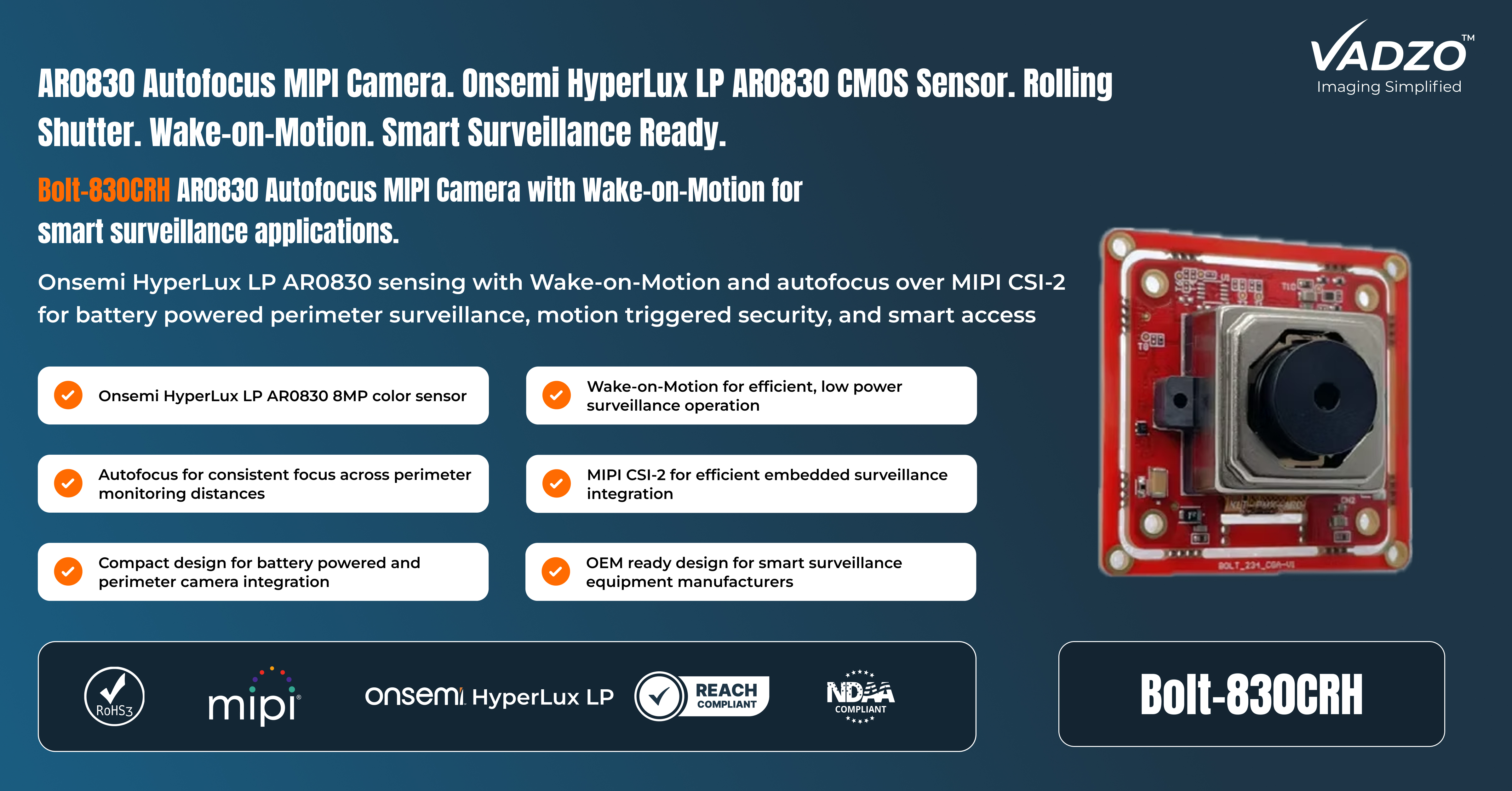
FORT WORTH, Texas, September 7, 2026 (Newswire.com) - Vadzo Imaging, a global leader in embedded vision solutions, today announced the validation of Wake on Motion and Autofocus capability the Bolt-830CRH, an AR0830 MIPI Camera built around the Onsemi HyperLux LP AR0830 sensor for battery-powered perimeter surveillance, motion-triggered commercial security, and smart access monitoring applications that need genuine power efficiency without missing a real event.
Why Smart Surveillance Needs an AR0830 Autofocus MIPI Camera Built for Wake-on-Motion
Battery-powered and remote surveillance camera products face a genuine power budget constraint that a continuously recording camera was simply never designed to work within. A camera capturing and processing video around the clock draws power constantly, regardless of whether anything worth recording is actually happening in the frame, which shortens battery life or increases the electrical infrastructure a remote installation would otherwise require to sustain continuous operation. A Wake-on-Motion MIPI Module addresses that constraint directly, remaining in a low-power state until genuine motion actually appears in the frame.
An Onsemi AR0830 Wake Camera approaches that problem with Wake-on-Motion, remaining in a low-power state until genuine motion is detected and only then activating full capture and processing. A Wake-on-Motion Camera configuration like this one gives smart surveillance integrators meaningful power savings without asking a system to sacrifice detection reliability the moment something actually happens.
A second, related consideration is maintaining focus accuracy once the camera does wake and begin capturing, since a perimeter or access monitoring camera often observes subjects at varying distances. An AR0830 Wake-on-Motion Camera addresses that consideration with autofocus, adjusting focus electronically as soon as motion triggers full operation.
Neither challenge exists on its own in a real surveillance deployment. A camera that saves power but cannot maintain focus once it wakes still produces an unreliable image at the exact moment an event actually occurs, and a camera with excellent focus but no genuine low-power state still drains a battery far faster than a remote installation can support. Solving both from the same sensor platform is what makes a camera genuinely suited to battery-powered surveillance rather than adequate on only one specification.
Engineering Explanation: Power Efficiency and Autofocus Together
Onsemi designed the HyperLux LP AR0830 with genuine low-power operation in mind from the outset, and Vadzo Imaging pairs that sensor with Wake-on-Motion processing specifically for battery-powered and remote surveillance applications where continuous operation is not a realistic power budget. As an AR0830 Low Power Wake Sensor, the module remains in a low-power state until motion is genuinely present in the frame.
That low power foundation works alongside the sensor's motion detection capability rather than as a separate system. As an AR0830 Motion Sensor Module, the Bolt-830CRH monitors for genuine motion using a fraction of the power full capture and processing would require, giving smart surveillance integrators confidence that the camera is genuinely conserving power between real events rather than only nominally idling.
Autofocus completes the design once Wake-on-Motion has triggered full camera operation. As a HyperLux LP Wake Camera, the Bolt-830CRH adjusts focus electronically as soon as motion activates the sensor, keeping a perimeter or access monitoring subject in focus regardless of the specific distance a triggering event happens to occur at during actual field use.
MIPI CSI-2 connectivity completes the design for embedded surveillance integration. As a Wake-on-Motion Autofocus Sensor, the Bolt-830CRH connects directly to the native camera interface most embedded surveillance compute platforms already provide, avoiding the additional power draw and complexity a USB or networked interface would introduce into an already power-constrained device.
Product Overview
The Bolt-830CRH pairs the Low Power Wake Sensor Module with Wake-on-Motion and autofocus in a compact design suited to battery-powered surveillance, perimeter monitoring, and smart access integration. As an 8MP Motion Wake Camera, it outputs full 8-megapixel resolution with Wake-on-Motion processing active by default, giving smart surveillance integrators a single camera platform that covers perimeter detection, access monitoring, and general-purpose low-power surveillance from one module.
At the core of the module sits the Motion Activated MIPI Camera sensor, chosen specifically for the combination of power efficiency and detection reliability that battery-powered surveillance requires. Because the camera pairs Wake-on-Motion power savings with autofocus accuracy, the 8MP Low Power Surveillance Camera reaches usable image quality across a full range of triggering distances while drawing meaningfully less average power than a continuously operating camera.
Product Specifications
Key specs: 8MP (3848 × 2168) Max Resolution | Onsemi HyperLux LP AR0830, 1/2.9-inch Sensor Format | 1.4 µm Pixel | Color, Rolling Shutter with Wake-on-Motion | MIPI CSI-2 Interface | S Mount (M12 Standard) with VCM Based Autofocus Capability
Key Capabilities
Onsemi HyperLux LP AR0830 Sensor for Detailed 8MP Surveillance Capture: The Bolt-830CRH is built around the Onsemi HyperLux LP AR0830 sensor, a device that resolves genuine 8 megapixel detail for perimeter and access monitoring applications. This gives the module 8MP Wake Sensor Module performance suited to surveillance tasks that need to identify a person or vehicle clearly, not just detect that motion occurred somewhere in the frame. That distinction matters directly for security review, since a system that only confirms motion happened without resolving enough detail to identify who or what caused it provides limited practical value during an actual investigation. As a 4K MIPI Camera Module, it also fits directly into Vadzo Imaging's broader 4K MIPI camera portfolio for integrators comparing resolution options across product lines.
Wake-on-Motion for Efficient, Low-Power Surveillance Operation: A camera capturing and processing video continuously draws power constantly regardless of whether anything worth recording is actually happening, which becomes a genuine constraint for battery-powered or remote installations. As an 8MP MIPI Surveillance Sensor, the Bolt-830CRH remains in a low-power state until motion is genuinely detected, and a Low Power Surveillance Sensor configuration like this one extends operating time meaningfully compared to a continuously recording camera. That extended operating time matters directly for remote installations without easy access to grid power, where a technician visit to replace a battery or service a solar charging system represents a genuine cost in both time and travel that a manufacturer would rather minimize through the camera's own design efficiency.
Autofocus for Consistent Focus Across Perimeter Monitoring Distances: A perimeter or access monitoring camera observes subjects at varying distances depending on exactly where an approach or intrusion actually occurs, and a fixed focus lens tuned for one assumed distance produces an unreliable result the moment actual distance deviates from that assumption. As a Motion Wake MIPI Sensor, the Bolt-830CRH's autofocus adjusts electronically as soon as Wake-on-Motion activates full operation, keeping a triggering subject in focus regardless of the specific distance involved. That focus accuracy matters directly for identification purposes after an event, since a blurred frame captured at an unexpected distance provides far less practical value to a security review than a sharp frame regardless of where within the monitored area an approach actually took place.
MIPI CSI-2 for Efficient Embedded Surveillance Integration: Most embedded compute platforms used in battery-powered and remote surveillance hardware already include a native MIPI CSI-2 camera interface, which makes a MIPI-connected camera a more direct and power-efficient fit than a USB camera requiring additional controller hardware. The Bolt-830CRH connects directly to that existing interface, reducing both the bill of materials and the power budget of a surveillance device's camera integration. That reduced component count also improves overall device reliability, since fewer discrete parts in a battery-powered enclosure means fewer potential points of failure across a long-term outdoor deployment.
Compact Design for Battery-Powered and Perimeter Camera Integration: Battery-powered surveillance housings and perimeter camera enclosures often have limited space, leaving little room for a camera and its supporting electronics without a significant redesign. The Bolt-830CRH's compact design fits into that constrained space, integrating directly into existing surveillance hardware without requiring a custom enclosure redesign. That compatibility matters directly for manufacturers upgrading an established surveillance product line to Wake-on-Motion capability, since redesigning an enclosure across an entire product family would add real cost and time to what should otherwise be a straightforward component upgrade.
OEM Ready Design for Smart Surveillance Equipment Manufacturers: Smart surveillance equipment manufacturers producing units at scale need a camera platform that stays consistent across a long production run, from early prototype validation through full-scale deployment. Vadzo Imaging supports full customization on this platform as an OEM Wake MIPI Module, including connector changes, housing design, and firmware adjustments for manufacturers headed into volume production across multiple smart surveillance product lines. That customization extends to motion sensitivity tuning as well, since a manufacturer building equipment for a busy commercial entrance may need a different trigger threshold than one building equipment for a quiet rural perimeter, even though both rely on the same underlying sensor.
"Battery-powered surveillance teams keep telling us the same thing: a camera that records continuously drains a battery far faster than the deployment actually allows for, but a camera that misses a genuine event to save power is not actually solving their security problem either. The AR0830's Wake-on-Motion combined with autofocus gives the Bolt-830CRH real power savings without sacrificing detection reliability the moment something actually happens. We built this camera for deployments measured in months between battery changes, not a device plugged into continuous power." - Alwin Vincent, Product Manager at Vadzo Imaging.
Application-Specific Sections
Battery Powered Perimeter Surveillance: Battery-powered perimeter surveillance depends on a camera that conserves power effectively between events without missing a genuine intrusion attempt at the exact moment it actually occurs. As a Surveillance Wake Sensor Module, the Bolt-830CRH's Wake-on-Motion supports that power conservation, and functioning as a Smart Perimeter Surveillance MIPI, it extends the same reliability to broader perimeter monitoring deployments.
Motion Triggered Commercial Security: Commercial security systems benefit from a camera that activates specifically when motion actually occurs, rather than processing continuous footage that mostly shows an empty scene. As a Motion Triggered Surveillance Camera, the Bolt-830CRH supports that triggered operation, and a MIPI Motion Detection Camera configuration of the same module extends the same capability to broader commercial security integration.
Smart Perimeter and Access Monitoring: Smart perimeter and access monitoring systems need reliable detection at entry points and property boundaries without the cost of continuous power delivery to every camera position. As a Commercial Surveillance MIPI Camera, the Bolt-830CRH supports that reliability, and a Smart Perimeter Motion Camera configuration of the same module extends the same capability to broader access monitoring tasks.
Low Power Multi Camera Surveillance Networks: Surveillance networks deploying many camera units across a large property need every unit to manage its own power budget efficiently, since a network of continuously operating camera units multiplies power demand across the entire deployment. As a Motion Wake Security Camera, the Bolt-830CRH supports that network-wide efficiency, giving system planners confidence that adding camera positions does not introduce a proportional increase in power infrastructure requirements. That predictability matters directly for planning a phased rollout across a large property, since power infrastructure decisions made early in a deployment do not have to anticipate a worst-case scenario where every camera operates at maximum continuous power simultaneously.
OEM Integration for Smart Surveillance Equipment Manufacturers: Smart surveillance equipment manufacturers building their own perimeter, access control, or commercial security hardware need a camera vendor who understands the power efficiency and detection requirements those systems demand. The Bolt-830CRH ships from a Wake Camera Manufacturer with those requirements built in, and Vadzo Imaging supports OEM customization for cable length, connector type, and firmware for manufacturers standardizing on one camera across multiple smart surveillance product lines. As a battery-powered surveillance camera, it fits directly into a manufacturer's existing platform architecture.
Frequently Asked Questions
Q: What is Wake-on-Motion, and how does it differ from a camera that simply records continuously?
A: A continuously recording camera captures and processes video constantly regardless of whether anything worth observing is actually happening within the frame, which means it draws power at the same rate whether a scene is completely empty or an actual event is unfolding. Wake-on-Motion instead keeps the camera in a low-power monitoring state until genuine motion is detected within the frame, activating full resolution capture and processing only once something actually worth recording occurs. The Bolt-830CRH builds this capability in specifically because most surveillance positions spend the overwhelming majority of their operating time observing an empty or unchanging scene, and a camera that treats that idle time the same as an active event wastes power a battery-powered or remote installation genuinely cannot spare. A camera relying only on continuous recording also generates far more footage to store and review than one that activates specifically around genuine events, which adds a secondary storage and review burden beyond the power consideration alone.
Q: Why does battery-powered surveillance specifically benefit from Wake-on-Motion?
A: A battery-powered surveillance camera operates within a fixed energy budget that has to last between physical battery changes or recharging visits, and a camera drawing full power continuously depletes that budget dramatically faster than one that only activates full operation when genuine motion actually occurs. Extending the interval between battery changes matters directly for remote or hard-to-access installations, where a maintenance visit represents real cost and logistical effort beyond simply replacing a battery. The Bolt-830CRH's Wake-on-Motion is built specifically around that battery-powered use case, since a surveillance camera that requires monthly battery changes is a meaningfully different deployment proposition than one that can operate for a full season between visits.
Q: Does Wake-on-Motion risk missing an event that happens too quickly for the camera to wake up in time?
A: A well-designed Wake-on-Motion system is built to transition from its low-power monitoring state to full operation quickly enough to capture a genuine event as it unfolds, rather than only detecting that something already happened after the fact. The monitoring state itself still actively watches for motion using a small fraction of full operating power, rather than being completely inactive, which is what allows the camera to respond quickly once real motion actually appears. The Bolt-830CRH is designed around that responsive wake behavior specifically because a surveillance camera that misses the actual event while waking up has not solved the underlying security problem, regardless of how much power it saved in the process. Integrators evaluating a Wake-on-Motion camera for a time-sensitive application should request actual wake response timing data rather than relying solely on a stated power savings figure, since a camera can technically save significant power while still responding too slowly for a specific security requirement.
Q: Can Vadzo Imaging customize a Wake-on-Motion MIPI camera module for a specific smart surveillance platform?
A: Yes. Vadzo Imaging supports full OEM customization on the Bolt-830CRH, including optics selection suited to a specific mounting position or field of view, connector and cable configuration matched to a particular surveillance housing design, and firmware adjustments tuned for a specific motion sensitivity or wake response profile. Evaluation units ship with no minimum order requirement, and the same engineering team that built the standard product works directly with smart surveillance equipment manufacturers to adapt the module for a specific perimeter, access control, or commercial security platform headed into volume production.
Q: What should smart surveillance equipment manufacturers look for when choosing a Wake-on-Motion camera supplier?
A: A camera that demonstrates good power savings in a single controlled bench test does not necessarily deliver the same real-world battery life once deployed across varied outdoor conditions and genuine motion frequency at an actual installation site. Manufacturers should look for genuine wake response speed validated under realistic triggering conditions rather than a single demonstrated scenario, autofocus that holds up across the range of distances a real perimeter or access point presents, and a supplier able to support customization for a specific power or sensitivity profile. The Bolt-830CRH is built around exactly these priorities, since a battery-powered surveillance deployment depends on both genuine power savings and reliable event capture, not just one of the two. Requesting evaluation data from an installation site with genuinely variable weather and motion conditions, rather than a controlled indoor demonstration, is generally the more reliable way to confirm a camera will perform consistently once deployed at scale.
Availability
The Bolt-830CRH AR0830 Autofocus MIPI Camera is available now and ready for evaluation and OEM integration. Evaluation kits include the camera module, mounting hardware, and integration documentation covering Wake-on-Motion configuration and autofocus setup, with no minimum order requirement. Contact Vadzo Imaging at support@vadzoimaging.com to request an evaluation unit or discuss volume production and OEM customization. Evaluation feedback is also welcome directly through the same contact channel, since real battery-powered deployment conditions often surface details a bench test alone would not reveal, and that feedback helps confirm a configuration before a manufacturer commits to a full production order across an entire installed base.
About Vadzo Imaging
Vadzo Imaging develops embedded and machine vision camera products for OEMs, system integrators, and smart surveillance equipment manufacturers building production-ready vision systems across security, access control, robotics, and edge AI. The company's portfolio spans MIPI CSI-2, USB, GigE, Wi-Fi, FPD-Link III, and SerDes interface camera products, supporting deployment architectures from compact onboard modules to distributed networked installations. Vadzo provides end-to-end imaging support, including sensor integration, ISP tuning, firmware development, and SDK frameworks to accelerate system deployment, and the company's engineering team works directly with customers throughout evaluation, pilot deployment, and volume production rather than handing off support after the initial sale. That ongoing engineering relationship matters most for smart surveillance programs, where a camera platform may remain deployed across remote or battery-powered installations for years after initial deployment, often across seasons and conditions the original installation team never directly observed. Visit Vadzo Imaging to explore the full embedded vision camera portfolio.
Media Contact
Alwin Vincent
Vadzo Imaging
Email: alwin@vadzoimaging.com
LinkedIn: Vadzo Imaging
YouTube: Vadzo Imaging
X: Vadzo Imaging
SOURCE: Vadzo Imaging
Source: Vadzo Imaging