Vadzo Imaging Positions Falcon-544CRS AR0544 5MP HDR Low Power USB UVC Camera as an AMR Navigation Camera for Extended Battery Runtime and Obstacle Detection
Vadzo Imaging's Falcon-544CRS 5MP HDR Low Power USB UVC Camera, built on the Onsemi AR0544 HyperLux LP sensor, delivers 5MP imaging with embedded HDR and Wake-on-Motion for autonomous mobile robot navigation, obstacle detection, and battery constrained delivery and warehouse robotics.
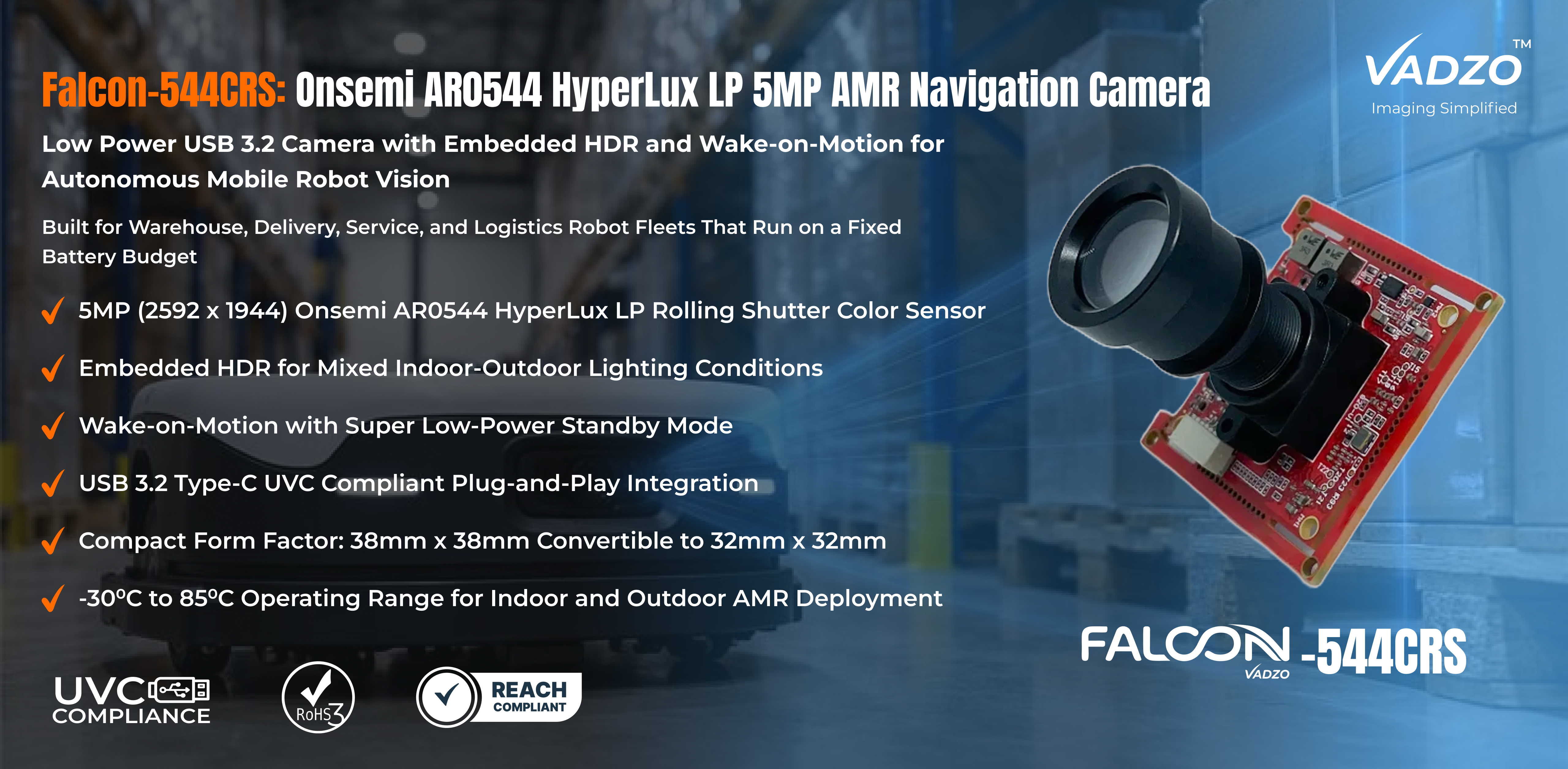
FORT WORTH, Texas, July 29, 2026 (Newswire.com) - Vadzo Imaging, a provider of embedded vision camera products for OEMs and system integrators, today positions the Falcon-544CRS 5MP HDR Low Power USB UVC Camera as an AMR Navigation Camera for autonomous mobile robot platforms where battery runtime, obstacle detection accuracy, and continuous imaging uptime compete directly against each other in the platform power budget. Built on the Onsemi AR0544 HyperLux LP sensor, the Falcon-544CRS delivers 5MP color imaging with embedded HDR processing and Wake-on-Motion power management in a USB 3.2 UVC-compliant module sized for direct integration into AMR sensor heads, delivery robot chassis, and mobile robot vision systems.
The Power Budget Problem in Autonomous Mobile Robot Vision
Autonomous mobile robot platforms run on a fixed battery budget shared across drive motors, compute, communications, and imaging. A navigation camera that draws continuous full power regardless of scene activity reduces the runtime available for the robot's actual task, whether that is picking, delivery, or patrol coverage. This becomes a harder constraint outdoors, where a delivery robot camera must handle direct sunlight, shaded building entrances, and dusk operation within the same shift, and where a standard dynamic range sensor either blows out highlights or loses shadow detail. A Robot Vision Camera that is not power efficient forces system designers to choose between shortening operating hours, adding battery mass that increases drive power consumption, or accepting reduced obstacle detection performance during idle periods. For engineers building Battery-Operated Robot Camera systems, the sensor selected for navigation and obstacle avoidance directly determines how much of the platform's energy budget remains for locomotion and payload tasks. This tradeoff compounds at fleet scale, where a small per-unit power saving in the vision subsystem can translate into a meaningfully smaller charging infrastructure footprint and fewer mid-shift charging interruptions across a hundred-unit deployment.
AR0544 HyperLux LP Sensor Architecture and Embedded HDR
The Onsemi AR0544 belongs to the HyperLux LP sensor family, a low-power design line built for exactly this constraint. As a HyperLux LP AMR Camera platform, the AR0544 pairs 5MP resolution with a power architecture tuned for continuous operation on battery-backed hosts rather than peak frame rate or maximum resolution. The 1/4.2 inch optical format with 1.4 micron BSI pixels keeps the sensor die compact while embedded HDR processing extends dynamic range on chip, so the navigation camera pipeline receives usable frames across mixed lighting without a multi exposure merge step running on the host processor. Rolling shutter readout is appropriate here because AMR platforms typically operate at walking speed or below, well within the motion envelope where rolling shutter distortion remains negligible for obstacle classification and floor marker tracking. Combined with Wake-on-Motion, the AR0544 gives system architects a 5MP AMR Camera that behaves as a low-power obstacle camera during idle dwell time and returns to full imaging the moment the scene changes. On-chip processing of both HDR merge and exposure control also means the host processor is free to dedicate its compute budget to SLAM, path planning, and object classification rather than sensor housekeeping.
Key specs: 5MP (2592 x 1944) | Onsemi AR0544 Hyperlux™ LP | 1/4.2 inch | 1.4 μm x 1.4 μm Pixel Size | Rolling Shutter | Color | Embedded HDR | Wake-on-Motion | USB 3.2 Gen1 Type C | S-Mount (M12 Standard) | -30⁰C to 85⁰C Operating Temperature | 38mm x 38mm convertible to 32mm x 32mm | Windows, Linux, Android (Need additional SDK) | UVC, RoHS 3, REACH | VISPA ARC SDK
Key Capabilities of the Falcon-544CRS AR0544 5MP HDR Low Power USB UVC Camera
HyperLux LP Sensor Architecture for Extended AMR Battery Runtime: The Falcon-544CRS is built around the HyperLux LP sensor platform specifically because runtime matters more than peak throughput in most mobile robot deployments. A Power Efficient USB Camera reduces the current draw allocated to vision, which for Battery Operated Robot Camera systems translates directly into additional operating hours per charge cycle or a smaller battery pack for the same runtime target. As an Energy-Efficient Robot Camera, the AR0544 sensor lowers the standing power cost of keeping a navigation camera active across an entire shift, which matters more as fleets scale and every watt saved per unit multiplies across dozens or hundreds of deployed robots. For OEM teams building a Low Power Robot Camera into a cost-sensitive AMR bill of materials, sensor-level power efficiency reduces both battery sizing and thermal management requirements at the same time.
Embedded HDR for Mixed Indoor-Outdoor Lighting Conditions: Delivery robots and Outdoor AMR Camera deployments cross between direct sunlight, shaded doorways, and interior lighting within a single route, often within seconds of each other. A standard dynamic range sensor forces a choice between exposing for the bright exterior or the dim interior, losing detail in the other. The AR0544's embedded HDR processing extends usable dynamic range at the sensor level, giving the Falcon-544CRS the profile of a 5MP Obstacle Detection Camera that maintains classification accuracy through doorway transitions, building shadows, and midday glare without requiring a separate HDR merge stage in the robot's vision pipeline. This matters directly for Last Mile Delivery Camera deployments where curb approaches, building entrances, and porch lighting vary block to block.
Wake-on-Motion for Power-Efficient Always-On Obstacle Monitoring: An AMR Obstacle Avoidance Camera does not need to stream at full power when the robot is stationary at a charging dock or waiting in a queue. The Falcon-544CRS integrates Wake-on-Motion, holding the sensor in a super low-power standby state until motion enters the field of view, then returning to full imaging automatically. For a Mobile Robot Obstacle Camera parked between delivery cycles or a warehouse AMR waiting at a pick station, this reduces standing power draw without leaving a blind spot, since the sensor itself performs the wake decision rather than relying on host-side polling. As a Low Power Obstacle Camera, this feature is handled entirely at the sensor level, so the host controller carries no additional software burden for power state management.
5MP Resolution with Rolling Shutter for Navigation and Mapping Detail: As a 5MP Robot Navigation Camera, the Falcon-544CRS resolves floor markers, docking targets, and obstacle edges at a pixel density that lower-resolution sensors cannot match, while staying within a bandwidth envelope that embedded AMR compute platforms can process in real time. The 2592 x 1944 output gives an AR0544 Robot Navigation Camera pipeline enough spatial detail for reliable SLAM feature extraction and object classification without the frame size becoming a bottleneck on USB bandwidth or inference latency. As a 5MP USB Navigation Camera, it strikes the balance that AMR system architects look for between detection accuracy and the compute budget available on the robot's onboard processor.
USB 3.2 UVC Compliance with VISPA ARC SDK for AMR Integration: The Falcon-544CRS operates as a plug-and-play USB 3.2 AMR Camera under native UVC support on Windows, Linux, and Android, removing custom driver development from the robot integration timeline entirely. As a UVC AMR Camera Module, it streams immediately once connected, while the Vadzo VISPA ARC SDK exposes region of interest control, exposure management, GPIO, and firmware updates for teams that need parameters beyond the UVC baseline. For robotics teams building a fleet-wide AMR Vision Camera standard across multiple robot models, a single SDK interface across the Falcon lineup keeps integration and long-term maintenance consistent.
Falcon-544CRS Product Specifications
Specification | Details |
Sensor | Onsemi AR0544 Hyperlux™ LP |
Sensor Format | 1/4.2 inch |
Resolution | 5MP (2592 x 1944) |
Pixel Size | 1.4 μm x 1.4 μm |
Shutter Type | Rolling Shutter |
Output | Color |
HDR | Embedded HDR |
Power Management | Wake-on-Motion, Low-Power Consumption |
Interface | USB 3.2 Gen1 Type C Interface Backward Compatible to USB 2.0 |
Optics | S-Mount (M12 Standard) |
Operating Temperature | -30⁰C to 85⁰C |
Board Dimensions | 38mm x 38mm convertible to 32mm x 32mm |
Platform Support | Windows, Linux, Android (Need additional SDK) |
Compliance | UVC, RoHS 3, REACH |
SDK | VISPA ARC SDK |
"Battery runtime is the metric that decides whether an AMR program scales past a pilot fleet. Every additional watt a navigation camera draws is a watt that does not go toward drive motors or payload capacity. The AR0544 lets us hand robotics teams a 5MP AMR camera that behaves responsibly inside a battery budget instead of competing against it. That is the design conversation we have with every AMR and delivery robot customer building toward fleet scale, not a handful of demo units." - Alwin Vincent, Product Manager, Vadzo Imaging.
AMR Navigation Camera Applications
Indoor Warehouse AMR Navigation and Obstacle Avoidance: Warehouse robot camera deployments operate continuously across long shifts inside facilities where aisle lighting is generally stable, but power budget still constrains fleet size and charging cycle frequency. The Falcon-544CRS functions as a Warehouse Automation Camera for forward-facing obstacle detection and downward-facing floor marker tracking, with Wake-on-Motion reducing draw during dock queuing and charging dwell time. As an Indoor Navigation Camera, the 5MP resolution resolves pallet edges, floor tape, and pedestrian workers at typical warehouse aisle widths, supporting the obstacle avoidance and lane following tasks that Mobile Robotics Camera systems handle in distribution centers.
Outdoor Last-Mile Delivery Robots and Sidewalk Autonomous Platforms: A Delivery Robot Camera operating on public sidewalks encounters the widest lighting range of any AMR deployment type, cycling between open sky, tree shade, and building shadow within a single block. The Falcon-544CRS serves as an Autonomous Delivery Camera in this role, with embedded HDR maintaining curb and obstacle detail across those transitions and the HyperLux LP power profile extending route range per charge. As a Last Mile Delivery Camera, it also benefits from the -30⁰C to 85⁰C operating range, which covers outdoor deployment across most seasonal climates without additional enclosure heating or cooling.
Service Robots in Hospitality, Retail, and Facility Navigation: Service robot camera platforms operating in hotels, retail floors, and office buildings must navigate around moving people at close range while maintaining a compact, low-power sensor footprint. The Falcon-544CRS gives Service Robot Camera integrators an Autonomous Robot Camera that handles variable indoor lighting from skylights, window walls, and mixed fixture types, while the USB 3.2 UVC interface simplifies integration into the compact single-board computers common in this robot class. As a robot vision camera for guest-facing platforms, low standing power draw also reduces the audible fan noise and thermal load that battery-powered service robots must manage in occupied spaces.
Logistics and Fulfillment Center Mobile Robot Fleets: Logistics robot camera fleets scale into the hundreds of units at large fulfillment operations, where even small per-unit power savings compound into meaningful reductions in charging infrastructure and fleet downtime. The Falcon-544CRS operates as an Autonomous Mobile Robot Camera across pick, sort, and transport robot classes, giving fleet operators a single AMR Vision Camera platform to standardize software integration across mixed robot models. Wake-on-Motion further reduces power draw during the queuing and staging periods that make up a significant share of a fulfillment robot's operating cycle.
SLAM-Based Mapping and Indoor Autonomous Navigation: Simultaneous localization and mapping systems depend on consistent feature detection across a robot's full operating environment, from open floor space to narrow equipment corridors. The Falcon-544CRS functions as a SLAM Camera and Robot Mapping Camera, providing the 5MP spatial resolution needed for reliable landmark and feature extraction while embedded HDR preserves feature contrast in unevenly lit corridors and loading areas. As an Autonomous Navigation Camera, it supports the mapping and localization workloads that mobile robotics camera platforms rely on for accurate indoor positioning without external beacon infrastructure.
VISPA ARC SDK for AMR Developer Integration
The Falcon-544CRS is supported by the Vadzo VISPA ARC SDK, giving robotics developers programmatic control over region of interest configuration, exposure, gain, GPIO, and firmware management beyond the UVC baseline. APIs are available in C, C++, and Python across Windows, Linux, and Android, allowing AMR software teams to integrate camera control directly into navigation and perception stacks without writing driver-level code. For OEM developers standardizing across multiple robot platforms, the same SDK interface spans Vadzo's broader Falcon camera portfolio, including its Medical Device and Patient Care imaging line, reducing the engineering overhead of supporting mixed sensor deployments across a growing robot fleet. SDK access also covers firmware-level configuration for Wake-on-Motion sensitivity and HDR blending strength, letting integrators tune the Falcon-544CRS to a specific facility's lighting profile or a delivery route's outdoor exposure conditions rather than relying on a single fixed default configuration.
Frequently Asked Questions
Q: What should engineers look for in a low-power USB camera for autonomous mobile robot platforms?
A: The core requirements are sensor-level power efficiency, embedded HDR for mixed lighting without a host-side merge step, adequate resolution for obstacle and marker detection, and a standby power mode for stationary dwell periods. Interface choice matters too, since a UVC-compliant USB camera avoids custom driver development across the mixed operating systems common in robot fleets. Beyond the sensor itself, system architects should evaluate how much of the imaging pipeline runs on chip versus on the host processor, since offloading HDR blending and exposure control to the sensor frees compute cycles for SLAM, path planning, and obstacle classification, which are the workloads that actually determine navigation reliability. A Battery-Efficient Camera Module also needs a documented power draw profile across streaming and standby states, since fleet operators size battery packs and charging schedules around worst-case continuous draw, not datasheet averages. Vadzo Imaging's Falcon-544CRS, built on the Onsemi AR0544 HyperLux LP sensor, addresses all of these requirements in a single 5MP AMR Camera module, combining embedded HDR, Wake-on-Motion, and USB 3.2 UVC compliance for direct integration into AMR sensor heads and delivery robot platforms. As a Power-Efficient USB Camera, it is built specifically for engineering teams that treat the vision subsystem as a line item in the platform's total power budget rather than a fixed cost to be worked around.
Q: How does Wake-on-Motion reduce power consumption in a battery-powered mobile robot camera?
A: Wake-on-Motion holds the imaging sensor in a super low-power standby state and monitors the scene using minimal circuitry, triggering a full return to imaging only when motion enters the field of view. This removes the need for the robot's host controller to manage camera power states in software, since the decision happens at the sensor level. In the Falcon-544CRS, this means an AMR platform parked at a charging dock, waiting at a pick station, or queued at a delivery drop point draws less power from its navigation camera significantly during those idle periods, extending the runtime available for actual drive and payload tasks between charges. Across a full operating shift where an AMR spends a substantial share of its time queued or docked rather than actively navigating, this standby behavior accumulates into a measurable reduction in total daily energy draw from the vision subsystem alone. The practical benefit scales with the deployment pattern. A hospital delivery robot cycling between a supply room and patient floors spends significant time stationary in elevators and hallway queues, a warehouse AMR often idles at a pick station waiting for a human operator, and a sidewalk delivery robot pauses at crosswalks and building entrances. In each case, a Low Power Obstacle Camera that only draws full power when the scene changes avoids paying the continuous streaming cost of a camera that has no equivalent standby behavior. Because the wake decision is handled entirely at the sensor, integrators do not need to write or validate host-side logic for detecting idle states, which removes a class of firmware bugs that would otherwise need testing across every robot model in a mixed fleet.
Q: Why does dynamic range matter for an outdoor delivery robot or AMR navigation camera?
A: A delivery robot or Outdoor AMR Camera moves between direct sunlight, building shadow, and covered entryways multiple times during a single route. A standard dynamic range sensor can only correctly expose one of these conditions at a time, producing blown highlights in bright areas or crushed shadow detail in dark ones, either of which degrades obstacle and curb detection accuracy. The Falcon-544CRS addresses this with embedded HDR processing on the Onsemi AR0544 sensor, extending dynamic range at the hardware level so the AMR Navigation Camera pipeline receives consistent, usable frames across lighting transitions without an additional HDR merge stage running on the robot's compute platform. This matters specifically at glass doors and building entrances, where a robot approaching from a bright exterior sees a dark interior through a narrow glazed opening, a scene structure that defeats a single exposure setting almost immediately. It also matters on reflective warehouse floors and painted concrete under skylights, where specular glare from overhead lighting can saturate a standard sensor's highlights while shaded pallet racks remain underexposed in the same frame. Because the HDR processing happens on chip rather than through a software merge of multiple exposures, there is no added frame latency from combining images captured at different moments, which matters for a navigation loop where the robot has already moved between exposures in a multi-frame HDR approach. For a 5MP Obstacle Detection Camera operating at walking pace or faster, single-frame HDR capture keeps the obstacle detection pipeline working from a geometrically current scene rather than a composite of slightly different moments in time.
Q: What interface and software support does a USB 3.2 AMR camera need for fleet-scale robot deployment?
A: Fleet-scale AMR deployment benefits from full UVC compliance so the camera streams natively on Windows, Linux, and Android without custom drivers, plus an SDK for parameters beyond basic streaming, including region of interest configuration, exposure control, and firmware management. The Falcon-544CRS delivers this through USB 3.2 AMR Camera UVC compliance paired with the Vadzo VISPA ARC SDK, which provides C, C++, and Python APIs. This combination lets robotics software teams integrate the same UVC AMR Camera Module across multiple robot models while retaining SDK-level control for advanced navigation and perception features when needed. At fleet scale, the practical advantage of this split is that a robot can ship and stream out of the box on any of the three supported operating systems without engineering intervention, while software teams retain a separate, optional integration path for tuning Wake-on-Motion sensitivity, adjusting HDR blend strength for a specific facility, or triggering region of interest capture synchronized with the robot's motion controller. For an AMR Vision Camera deployed across mixed robot classes, a single SDK also simplifies firmware update management, since engineering teams can push configuration changes across an entire fleet through one interface rather than maintaining separate driver stacks for pick robots, delivery robots, and mapping robots individually. This reduces both the initial integration timeline and the long-term maintenance burden as new robot models are added to a growing deployment.
Q: Is the Falcon-544CRS suitable for both indoor warehouse robots and outdoor delivery robots?
A: Yes. The Falcon-544CRS operates across a -30⁰C to 85⁰C range and combines embedded HDR with a HyperLux LP low power sensor architecture, which covers both the stable indoor lighting of Warehouse Robot Camera deployments and the variable outdoor lighting and temperature swings that last mile delivery robots encounter on public routes. Vadzo Imaging supports both deployment classes with the same Falcon-544CRS module and VISPA ARC SDK, giving OEM teams a single AMR navigation camera platform rather than separate indoor and outdoor sensor solutions to qualify, stock, and maintain across their robot lineup. This matters operationally for OEMs building a mixed fleet product line, since qualifying one sensor across both indoor and outdoor robot classes reduces the number of bill of materials variants, simplifies spare parts inventory, and lets engineering teams reuse the same SDK integration and firmware update process across every robot model they ship. A Mobile Robotics Camera standard that holds up in a climate-controlled fulfillment center and on an uncovered sidewalk in direct winter cold or summer heat also reduces the qualification testing burden during new product development, since one thermal and optical validation cycle covers the full deployment range rather than separate cycles for each robot class. For OEM teams planning a product roadmap that spans indoor logistics robots today and outdoor delivery or patrol robots in a future product line, standardizing on the Falcon-544CRS as a Low Power Robot Camera now avoids a sensor migration project later.
Availability
The Falcon-544CRS 5MP HDR Low Power USB UVC Camera based Onsemi AR0544 HyperLux LP is available now for evaluation and pre-production sampling, with production quantities available for OEM robotics programs. Engineering teams can access the full technical datasheet, CAD files, and SDK documentation at vadzoimaging.com or contact Vadzo's engineering team directly for volume pricing, fleet deployment support, and integration assistance.
About Vadzo Imaging
Vadzo Imaging develops embedded and machine vision camera products for OEMs and system integrators building production-ready vision systems across robotics, industrial automation, healthcare, and smart infrastructure. The company's imaging platforms span USB, MIPI, Gigabit Ethernet, Wi-Fi, and SerDes interfaces, covering deployment architectures from compact edge devices to distributed networked systems. Beyond hardware, Vadzo provides end-to-end imaging support including sensor integration, ISP tuning, firmware development, and SDK frameworks, giving robotics engineering teams a single partner from initial evaluation through fleet-scale production.
Media Contact
Alwin Vincent
Vadzo Imaging
Email: alwin@vadzoimaging.com
LinkedIn: Vadzo Imaging
YouTube: Vadzo Imaging
X/Twitter: Vadzo Imaging
SOURCE: Vadzo Imaging
Source: Vadzo Imaging