Vadzo Imaging Expands 13MP High-Resolution Camera Portfolio with Falcon-1335MRS: 13MP AR1335 Monochrome USB Camera for Medical and Life Sciences
Built for diagnostic imaging, clinical documentation, and high-resolution slide scanning that depend on resolving fine structural detail rather than a resolution number reduced to keep cost or file size down, this camera pairs the Onsemi AR1335 sensor with genuine 13-megapixel monochrome capture over USB 3.2 Gen 1, extending Vadzo Imaging's high-resolution camera portfolio with a platform built specifically for the diagnostic detail medical and life sciences imaging actually requires.
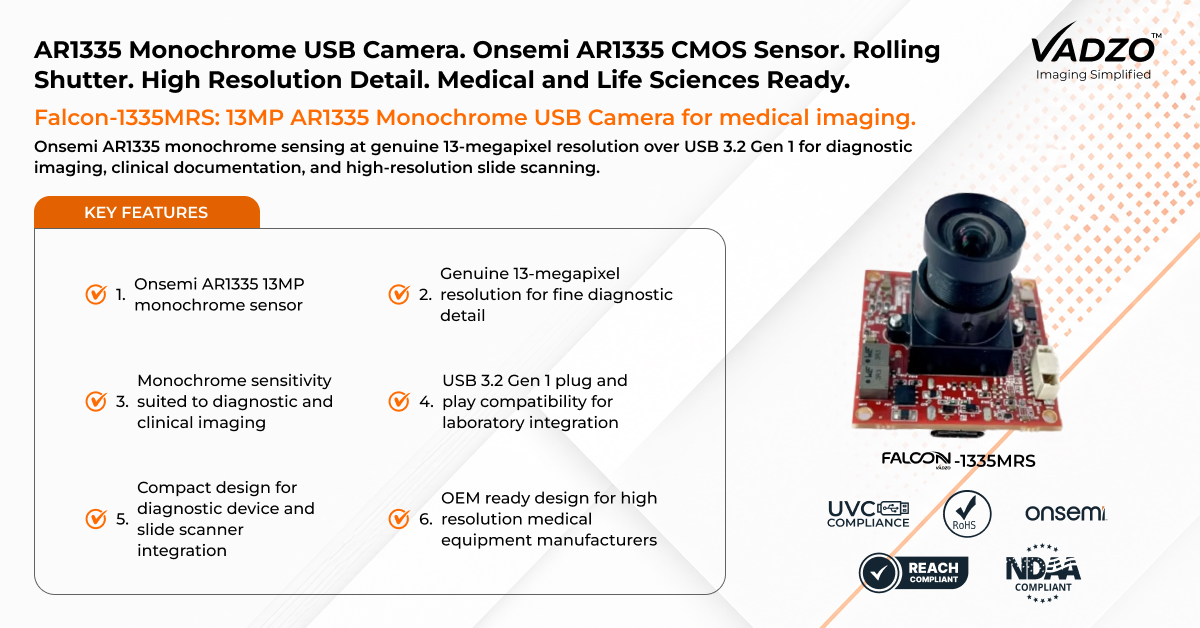
IRVINE, Calif., September 9, 2026 (Newswire.com) - Vadzo Imaging, a provider of embedded vision solutions, today expanded its high-resolution camera portfolio with the Falcon-1335MRS, an AR1335 High Resolution Camera built around the Onsemi AR1335 sensor for diagnostic imaging, clinical documentation, and high-resolution slide scanning applications that need genuine fine structural detail.
Why Diagnostic and Clinical Imaging Needs an AR1335 Monochrome USB Camera Built for Genuine Resolution
A diagnostic or clinical imaging decision often depends on resolving a fine structural detail that a lower resolution sensor simply cannot capture, regardless of how well that sensor otherwise performs under favorable conditions. A High Resolution Mono USB Camera needs to deliver genuine, uninterpolated pixel detail specifically because a diagnostic reviewer cannot recover detail a sensor never actually captured in the first place.
A High Pixel Density Mono Camera approaches that requirement directly, packing genuine 13 megapixel resolution into a sensor package still compact enough for diagnostic devices and slide scanning platforms with real space constraints. A 13MP Precision Optics Camera configuration like this one gives medical and life sciences equipment manufacturers real detail to work with, rather than a resolution specification that depends on interpolation to reach its stated figure.
A second, related consideration is whether that high resolution actually benefits from a monochrome sensor design specifically, rather than a color sensor at the same stated resolution. As an AR1335 USB 3.2 Sensor, the Falcon-1335MRS removes the Bayer color filter array a color sensor requires, which means every pixel contributes directly to structural detail rather than a portion of that resolution being interpolated from neighboring color-coded pixels.
Neither genuine resolution nor monochrome design alone fully solves the diagnostic detail problem. A sensor with genuine resolution but a Bayer filter array still loses some structural detail to color interpolation, and a monochrome sensor without genuine native resolution still cannot resolve detail finer than its actual pixel count regardless of how efficiently that sensor uses its available pixels. Combining both is what makes a sensor genuinely suited to diagnostic and clinical work rather than adequate on only one specification.
Engineering Explanation: Genuine Resolution and Monochrome Detail Together
Onsemi designed the AR1335 to deliver genuine 13 megapixel resolution built directly into the sensor architecture, and Vadzo Imaging validates that resolution specifically in monochrome form for diagnostic and clinical applications where fine structural detail matters more than color reproduction. As an AR1335 4K Mono Sensor, the module resolves detail at full sensor resolution rather than a reduced output mode, giving diagnostic equipment manufacturers real pixel-level detail to build a clinical decision around.
That genuine resolution matters specifically because a diagnostic or research program often needs to compare imaging results across many sessions and, in some cases, across many years of a device's service life. As a High Resolution Portfolio Camera, the Falcon-1335MRS delivers the same real resolution consistently, avoiding the interpolation artifacts a lower native resolution sensor would introduce when its output is upscaled to match a stated specification.
Monochrome design extends that genuine detail specifically for tasks where color information does not add diagnostic value. As a 4K USB 3.2 Mono Camera, the Falcon-1335MRS dedicates its full resolution to structural detail rather than splitting that resolution across color channels, and a 13MP 4K Mono Module configuration like this one gives diagnostic and research applications the fine detail those tasks actually depend on.
USB 3.2 Gen 1 connectivity completes the design for practical diagnostic and laboratory integration. As an Onsemi AR1335 13MP Sensor, the Falcon-1335MRS delivers the bandwidth genuine 13 megapixel capture requires, connecting directly to the diagnostic and laboratory imaging software most medical device platforms already run.
Product Overview
The Falcon-1335MRS pairs the 13MP USB 3.2 Camera sensor with genuine monochrome resolution in a design suited to diagnostic devices, clinical documentation, and slide scanning integration. As a Diagnostic Mono Camera Module, it outputs full 13-megapixel resolution by default, giving medical and life sciences equipment manufacturers a single camera platform that covers fine structural detail, clinical documentation, and general-purpose diagnostic imaging from one module.
At the core of the module sits the AR1335 Portfolio Camera sensor, chosen specifically for the combination of genuine resolution and monochrome sensitivity that diagnostic and clinical applications require. Because the camera pairs 13MP USB 3.2 Sensor Module resolution with monochrome detail, the Falcon-1335MRS reaches usable diagnostic image quality across tasks that would be limited by a lower resolution or color-filtered alternative, including High Res Slide Scanning Camera applications that depend on resolving fine tissue or sample structure.
Product Specifications
Key specs: 13MP (4208 × 3120) Max Resolution | Onsemi AR1335, 1/3.2 inch Sensor Format | 1.1 µm Pixel | Monochrome, Rolling Shutter Chroma and Shutter | USB 3.2 Gen 1 Interface | Fixed Focus, S-Mount (M12) Optics
Key Capabilities
Onsemi AR1335 Sensor for Detailed 13MP Diagnostic Capture: The Falcon-1335MRS is built around the Onsemi AR1335 sensor, a device that resolves genuine 13 megapixel detail for diagnostic imaging, clinical documentation, and slide scanning applications. As a 13MP High-Resolution Camera, this gives the module Precision Mono Imaging Camera performance suited to tasks that need real, uninterpolated detail rather than a resolution figure that depends on upscaling to reach its stated specification. That distinction matters directly for regulatory documentation and technical review, where a specification sheet claiming a resolution the sensor does not genuinely deliver could become a real liability during an audit or a technical evaluation. As a 13MP Detail Capture Camera, it also gives integrators a high-res 13MP Sensor they can reference confidently during a technical specification review.
Genuine High Resolution for Fine Diagnostic Detail: A diagnostic decision often depends on resolving a structural detail too fine for a lower resolution sensor to capture at all, regardless of how that sensor otherwise performs under a given lighting condition. The Falcon-1335MRS's genuine 13-megapixel resolution captures that detail directly, giving diagnostic reviewers real pixel-level information to work with rather than an interpolated approximation. That real detail matters most in exactly the cases where a diagnostic decision is genuinely difficult to make, since a borderline finding is precisely where the difference between real and interpolated detail becomes clinically meaningful.
Monochrome Design for Structural Detail Without Compromise: As a Scientific Mono Camera Module, the Falcon-1335MRS dedicates its full sensor resolution to structural detail rather than splitting that resolution across color channels the way a color sensor's Bayer filter array requires. That design matters directly for diagnostic and research tasks where color information does not add clinical or scientific value, since every pixel instead contributes to the structural detail an examination actually depends on. A researcher or clinician reviewing a monochrome image at full resolution examines genuinely more structural information per pixel than the same reviewer would from an equivalently specified color sensor.
USB 3.2 Gen 1 Plug and Play Compatibility for Laboratory Integration: The Falcon-1335MRS enumerates automatically on Windows, Linux, and macOS without a proprietary driver install, which matters directly for medical device manufacturers building on existing diagnostic or laboratory imaging software that already expects a standard UVC device. As a Plug and Play 13MP Camera, it integrates the same way across every one of these platforms without a specialized interface or a custom capture card. That broad compatibility matters directly for manufacturers supporting installations across a range of existing computer and operating system environments, since a camera requiring a proprietary driver would introduce compatibility testing burden across each supported platform.
Compact Design for Diagnostic Device and Slide Scanner Integration: Diagnostic device housings and slide scanner optical paths often have limited internal space, leaving little room for a camera and its supporting electronics without a significant redesign effort. The Falcon-1335MRS's compact design fits into that constrained space, integrating directly into existing diagnostic and laboratory hardware without requiring a custom mounting redesign. That compatibility matters directly for manufacturers upgrading an established diagnostic product line to higher resolution capability, since redesigning housing across an entire product family would add real cost and regulatory recertification burden to what should otherwise be a straightforward component upgrade.
OEM Ready Design for High Resolution Medical Equipment Manufacturers: High resolution medical equipment manufacturers producing units at scale need a camera platform that stays consistent across a long production run, from early prototype validation through full-scale manufacturing. Vadzo Imaging supports full customization on this platform as an OEM High Resolution Mono Module, including optics selection, connector changes, and firmware adjustments for manufacturers headed into volume production, and as a USB 3.2 Mono Camera Kit, it gives OEM customers a proven foundation to build a differentiated diagnostic or research product around. That customization extends to exposure and output format tuning as well, since a manufacturer building a portable point-of-care device may need a different configuration than one building a benchtop slide scanning instrument, even though both rely on the same underlying sensor.
"Medical device and life sciences teams keep telling us the same thing: a diagnostic decision depends on detail a sensor either genuinely captured or did not, and no amount of processing recovers structural information a lower resolution sensor never resolved in the first place. The AR1335's genuine 13 megapixel monochrome resolution gives the Falcon-1335MRS real diagnostic detail, not an interpolated approximation. We built this camera to expand our high-resolution portfolio specifically for the fine detail medical and life sciences imaging depends on, not a marketing specification." - Alwin Vincent, Product Manager at Vadzo Imaging.
Application-Specific Sections
Diagnostic Imaging and Clinical Documentation: Diagnostic imaging and clinical documentation depend on resolution genuinely enough to support a real clinical decision, not a specification that depends on interpolation to reach its stated figure. As a Medical Grade Mono Sensor, the Falcon-1335MRS supports diagnostic accuracy, and functioning as a Mono Camera for Diagnostics, it extends the same reliability to broader clinical documentation workflows. As a High Resolution Clinical Camera, it gives clinical teams a proven high-resolution platform to standardize around.
High Resolution Slide Scanning: High-resolution slide scanning depends on a camera that resolves fine tissue or sample structure at genuine pixel resolution, since a scanned slide reviewed later cannot recover detail the original capture never resolved. The Falcon-1335MRS's genuine 13 megapixel resolution supports that scanning accuracy, and a Precision Optics Lab Camera configuration of the same module extends the same reliability to broader high-resolution laboratory imaging tasks beyond dedicated slide scanning.
Scientific and Research Documentation: Scientific and research documentation depends on resolution consistent enough to support valid comparisons across many samples and sessions, since inconsistent resolution between capture sessions can undermine confidence in a study's findings. As a High Detail Lab Camera, the Falcon-1335MRS delivers that consistency, supporting research programs that depend on reliable, comparable imaging results over time. That consistency matters directly for peer-reviewed publication and regulatory submission, where imaging methodology and equipment consistency are often scrutinized alongside the research findings themselves.
Long-Term Diagnostic Platform Deployment: Diagnostic and clinical imaging platforms often remain in service for many years, and a camera platform's resolution needs to remain genuinely useful across that entire service life rather than becoming outdated as diagnostic standards advance. The Falcon-1335MRS's genuine 13 megapixel resolution gives diagnostic equipment manufacturers a platform built to remain useful well beyond an initial deployment, supporting the same detailed imaging standard across a device's full service life.
OEM Integration for High-Resolution Medical Equipment Manufacturers: High-resolution medical equipment manufacturers building their own diagnostic, clinical, or research hardware need a camera vendor who understands the resolution and monochrome requirements those systems demand. The Falcon-1335MRS ships from a high-resolution mono supplier with those requirements built in, and Vadzo Imaging supports OEM customization for cable length, connector type, and firmware for manufacturers standardizing on one camera across multiple products in Vadzo's growing 13MP Camera Product Line.
Frequently Asked Questions
Q: Why does diagnostic and clinical imaging specifically benefit from 13 megapixel resolution rather than a lower resolution sensor?
A: A diagnostic or clinical imaging decision often depends on resolving a specific structural detail, and a lower resolution sensor simply does not capture that detail at all regardless of how well it otherwise performs under good lighting or focus conditions. Once a frame is captured at a given resolution, no amount of downstream processing can recover detail the sensor never actually resolved in the first place, which makes genuine sensor resolution a hard limit on what a diagnostic reviewer can ultimately examine. The Falcon-1335MRS is built around genuine 13 megapixel resolution specifically because a diagnostic decision should not be constrained by a sensor limitation the original capture could have avoided. Teams evaluating a camera for this kind of application should request confirmation of native, uninterpolated sensor resolution specifically, rather than accepting a stated specification at face value without technical verification.
Q: Why does high resolution matter more for monochrome diagnostic imaging than it might for a general-purpose camera?
A: A monochrome sensor already dedicates its full pixel resolution to structural detail rather than splitting that resolution across red, green, and blue color channels the way a color sensor's Bayer filter array requires, which means the genuine benefit of a higher-resolution monochrome sensor is more directly realized in actual structural detail. A general-purpose camera often uses resolution to support color reproduction and general scene composition, where the marginal benefit of additional resolution is less pronounced than it is for a diagnostic task specifically examining fine structural features. The Falcon-1335MRS combines genuine 13 megapixel resolution with monochrome design specifically because diagnostic and clinical applications benefit from that combination more directly than a general-purpose imaging task would.
Q: Can a single high-resolution monochrome camera really serve both diagnostic imaging and high-resolution slide scanning?
A: Yes, provided the camera delivers genuine, uninterpolated resolution suited to both close-range diagnostic examination and detailed slide scanning, since both applications depend on the same underlying requirement: capturing fine structural detail accurately rather than approximating it through processing. Both diagnostic imaging and slide scanning also depend on standard USB connectivity that integrates with existing laboratory and diagnostic software, and a compact form factor that fits varied device and instrument designs. The Falcon-1335MRS is designed around that shared requirement specifically, since most medical and life sciences equipment manufacturers would rather standardize on one proven high-resolution platform than qualify separate hardware for diagnostic devices and slide scanning instruments.
Q: Can Vadzo Imaging customize a high-resolution monochrome USB camera module for a specific medical or diagnostic platform?
A: Yes. Vadzo Imaging supports full OEM customization on the Falcon-1335MRS, including optics selection suited to a specific working distance or field of view, connector and cable configuration matched to a particular diagnostic device or slide scanner design, and firmware adjustments tuned for a specific exposure or output format. Evaluation units ship with no minimum order requirement, and the same engineering team that built the standard product works directly with medical and life sciences equipment manufacturers to adapt the module for a specific diagnostic, clinical, or research platform headed into volume production.
Q: What should medical and life sciences equipment manufacturers look for when choosing a high-resolution monochrome camera supplier?
A: A camera that claims a high-resolution specification does not always deliver that resolution genuinely, since some sensors reach a stated figure through interpolation rather than native pixel capture, which matters directly for a diagnostic task depending on real structural detail. Manufacturers should look for confirmed native sensor resolution rather than an interpolated or upscaled specification, a monochrome design genuinely suited to the application rather than a color sensor converted after the fact, and a supplier able to maintain consistent hardware and firmware across a long, regulated production run. The Falcon-1335MRS is built around exactly these priorities, since a diagnostic or research platform depends on genuine, verifiable resolution, not a marketing specification that does not hold up under technical review.
Availability
The Falcon-1335MRS AR1335 Monochrome USB Camera is available now and ready for evaluation and OEM integration. Evaluation kits include the camera module, a factory-calibrated S-Mount lens, a USB 3.2 Gen 1 cable, and integration documentation covering resolution configuration and exposure setup, with no minimum order requirement. Contact Vadzo Imaging at support@vadzoimaging.com to request an evaluation unit or discuss volume production and OEM customization. Evaluation feedback is also welcome directly through the same contact channel, since real diagnostic and laboratory deployment conditions often surface details a bench test alone would not reveal, and that feedback helps confirm a configuration before a manufacturer commits to a full production order across an entire product line.
About Vadzo Imaging
Vadzo Imaging develops embedded and machine vision camera products for OEMs, system integrators, and medical device manufacturers building production-ready vision systems across diagnostics, research imaging, robotics, and edge AI. The company's portfolio spans MIPI CSI-2, USB, GigE, Wi-Fi, FPD-Link III, and SerDes interface camera products, supporting deployment architectures from compact onboard modules to distributed networked installations. Vadzo provides end-to-end imaging support, including sensor integration, ISP tuning, firmware development, and SDK frameworks to accelerate system deployment, and the company's engineering team works directly with customers throughout evaluation, pilot deployment, and volume production rather than handing off support after the initial sale. That ongoing engineering relationship matters most for diagnostic and research platforms, where a camera platform may remain part of a validated device design for many years after initial deployment, often across multiple product revisions the original design validation never anticipated. Visit Vadzo Imaging to explore the full embedded vision camera portfolio.
Media Contact
Alwin Vincent
Vadzo Imaging
Email: alwin@vadzoimaging.com
LinkedIn: Vadzo Imaging
YouTube: Vadzo Imaging
X: Vadzo Imaging
SOURCE: Vadzo Imaging
Source: Vadzo Imaging