Get Bars 7-OH Tablets Reviews 2026: What's in the Pack? Inside the Product Lines, Labels, and Lab Reports
A closer look at Get Bars' 7-OH and 7OH-Alternative tablets, brand-stated ingredients, published batch reports, pricing, and the questions the available information leaves unanswered.
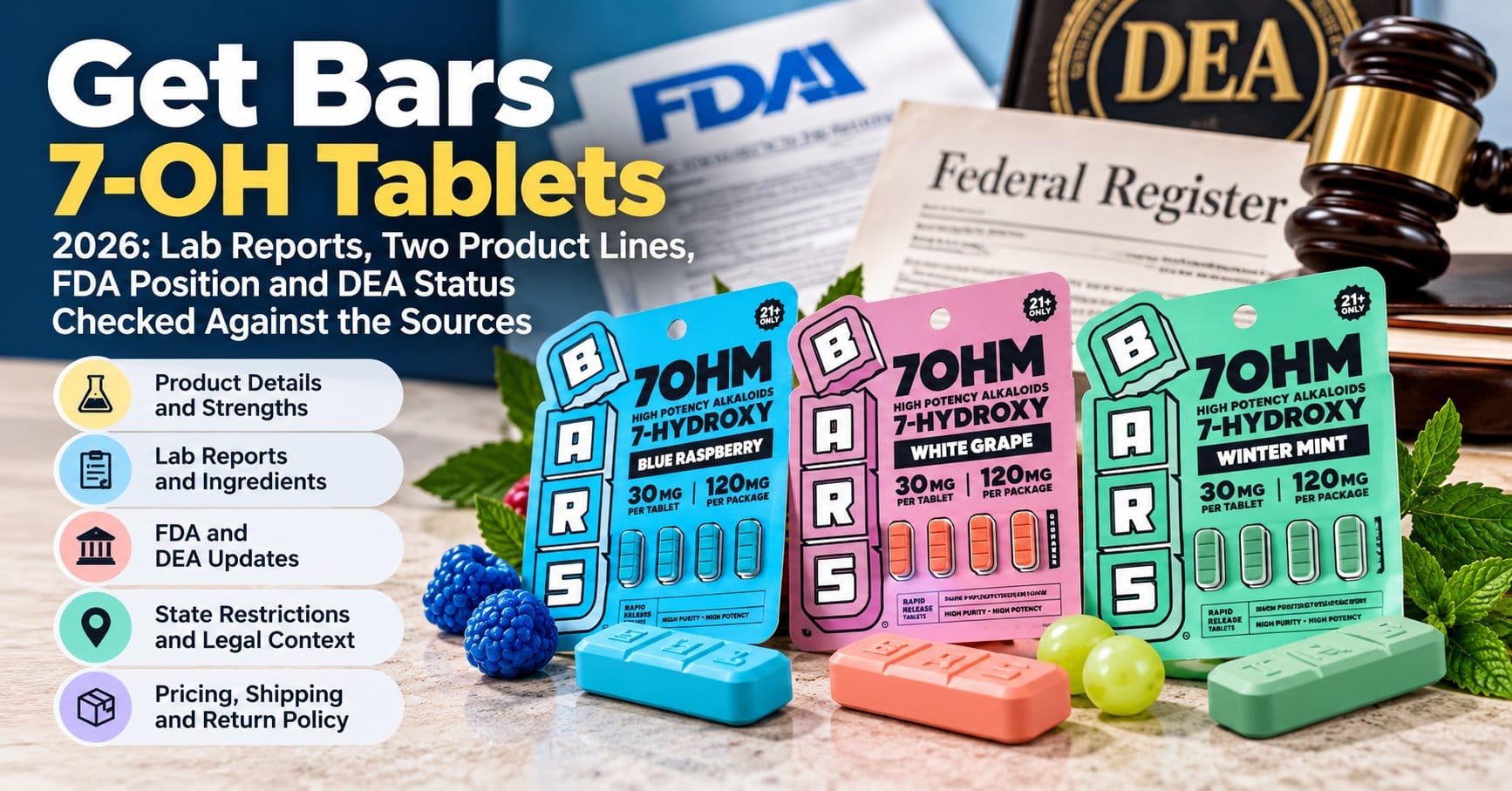
WASHINGTON, October 3, 2026 (Newswire.com) - Advertorial notice: This is advertorial content, promotional in nature and intended for consumer education about a commercially available product. It contains no affiliate links, isn't medical advice, and doesn't recommend buying or using anything. Brand statements are the brand's own and haven't been independently verified. Brand website: getbars.co. Reviewed October 3, 2026.
Get Bars Pricing, Shipping and Product Details
Get Bars 7-OH Tablets Reviews: Researching Lab Reports, FDA Position and DEA Status Explained (Consumer Research)
TL;DR: Get Bars 7-OH Tablets are flavored kratom-alkaloid tablets sold at getbars.co in two separate lines: 7-OH tablets labeled 30mg or 60mg per tablet, and a "7OH-Alternative" line the brand says contains no 7-OH. As reviewed October 3, 2026, FDA calls 7-OH a potent opioid. DEA has filed a notice of intent, not an effective order, to schedule 7-OH above a threshold. Three related compounds were placed in Schedule I on August 26, 2026.
Last verified: October 3, 2026. Prices, strengths, shipping lists, and legal status are all dated because each can change fast. Federal status for 7-OH is re-checked before publication and updated whenever DEA acts on Docket DEA-1570.
Saw Get Bars in an ad, a feed, or a search result and want the real picture first? That's what this page is for. In about five minutes you'll know what the product is, what its own lab reports show, what FDA and DEA have actually put in writing, and which questions nobody can answer yet.
In This Article
- Get Bars 7-OH Tablets: Quick Verification Snapshot (As Reviewed October 3, 2026)
- What Are Get Bars 7-OH Tablets?
- Get Bars 7-OH vs. Get Bars 7OH-Alternative: Two Different Product Families
- What Product Strengths Does Get Bars Currently List?
- What Do the Get Bars Lab Reports Show?
- How to Read a Certificate of Analysis (COA)
- What Is 7-Hydroxymitragynine (7-OH)?
- Concentrated 7-OH vs. Natural Kratom Leaf: What's the Difference?
- What Has FDA Said About 7-OH?
- What Is the Current DEA Status of 7-OH?
- Notice of Intent vs. Temporary Scheduling Order: A Plain-English Timeline
- How Do the Proposed Thresholds Compare With the Brand's Reported Numbers?
- Which State Restrictions Apply?
- Get Bars Pricing and Shipping Information (As Reviewed October 3, 2026)
- What Does the Get Bars Refund Policy Say?
- What the Brand's Reviews and Marketing Language Include
- Known Safety, Dependence, and Interaction Concerns From Authoritative Sources
- What Information Remains Unverified
- How to Check Current Status Yourself
- Get Bars 7-OH Tablets Fast Facts
- Quick Answers About Get Bars 7-OH Tablets
- Get Bars 7-OH FAQ
- The Bottom Line on Get Bars 7-OH Tablets
- Get Bars Contact Information
Get Bars 7-OH Tablets: Quick Verification Snapshot (As Reviewed October 3, 2026)
- Official brand website: getbars.co. The brand's Terms identify BARS as associated with 113 Ventures, LLC.
- Two product families: conventional "BARS 7 Hydroxy Tablets" and a separate "7OH-Alternative" line the brand says is built on a proprietary blend called Mitraxidine.
- 7-OH strengths: the brand's pages are inconsistent. Product listings show 60mg for several flavors, while a collection page says the "primary formula" delivers 30mg and its table lists some flavors at 30mg.
- Alternative tablets: the product page describes 4 tablets per pack, 16 servings per pack, 300mg of Mitraxidine per tablet, and 75mg per quarter-tablet serving.
- Brand-posted lab report, 60mg Watermelon (Batch 14-31-058): 7-OH at 60.5 mg per serving, 242 mg per package, and 21.6 percent by weight.
- Brand-posted lab report, 7OH-Alternative Mixed Berry (Batch MB082526): 7-OH not detected; mitragynine at 7.454 percent.
- FDA: describes 7-OH as a potent opioid and states it isn't lawful in dietary supplements or conventional foods. No FDA-approved drug contains it.
- DEA, 7-OH (Docket DEA-1570): notice of intent published July 6, 2026. No later temporary scheduling order was located.
- DEA, related compounds (Docket DEA-1644): mitragynine pseudoindoxyl, MGM-15, and MGM-16 were temporarily placed in Schedule I, effective August 26, 2026.
- Return terms: the brand's site shows both a 60-day and a 30-day window.
- Brand contact: Info@GetBars.co (full details near the end of this article).
- State law: restrictions vary by state and by product; the brand's shipping restrictions differ from page to page.
What Are Get Bars 7-OH Tablets?
Short answer: According to the brand's website, Get Bars sells flavored chewable tablets under the BARS name. Here's what the brand's own pages say:
- Format: multi-tablet packs, with each tablet described as breaking into four servings.
- Age: packaging shows "21+ Only," and the site opens with an age-confirmation prompt.
- Quality claims: the brand calls the tablets lab-tested and says they're made in a Current Good Manufacturing Practices (cGMP) facility. The materials reviewed don't identify the manufacturer, so the cGMP statement is the brand's claim and wasn't verified here.
- Marketing: the brand markets the tablets for psychoactive consumer experiences. That isn't validated here and shouldn't be read as an established health or therapeutic effect. Product pages carry a "may cause psychotropic effects" warning and advise consulting a physician.
- Labeling: the Mixed Berry 7OH-Alternative page, the Winter Mint page, and the 7-OH collection page show no Supplement Facts panel or standard dietary-supplement disclaimer about FDA evaluation. They use an "Ingredients" section instead.
Review Current Get Bars Product Information
Get Bars 7-OH vs. Get Bars 7OH-Alternative: Two Different Product Families
Short answer: Get Bars runs two separate product lines, and search results often blur them together.
- BARS 7 Hydroxy Tablets: described by the brand as containing 7-hydroxymitragynine. The brand-posted Watermelon 60mg report lists 7-OH as the principal measured alkaloid at a concentrated level.
- BARS 7OH-Alternative Tablets: built, per the brand, on a proprietary kratom-derived blend called Mitraxidine. On the Mixed Berry page the brand states the product contains no 7-OH, mitragynine pseudoindoxyl, MGM-15, or MGM-16, and the same page uses the phrases "legal alternative" and "fully legal."
- What this article adopts: none of the brand's lawfulness language. It doesn't independently conclude that any product is lawful anywhere, and it doesn't say what Mitraxidine is chemically, because the reviewed materials call it only a proprietary blend.
- What the record shows: one brand-posted report for one flavor (Mixed Berry, Batch MB082526) that lists 7-OH as not detected. One batch doesn't establish what other flavors or batches contain.
- Brand blog excerpt: an excerpt seen in search results (not opened in full) describes the Mitraxidine tablets as formulated to be as close as possible to a one-to-one substitute for the earlier 7-hydroxy tablets. That's marketing language, and it's one reason the distinction between the two families matters.
The 7-OH tablets
The 7OH-Alternative tablets
What Product Strengths Does Get Bars Currently List?
As reviewed October 3, 2026, the brand's pages give these figures. Everything below is brand-stated labeling information, not a use recommendation.
- 60mg 7-OH line: product listings show "60mg" with "240mg total" per four-tablet pack for Watermelon, Blue Raspberry, and Mixed Berry.
- 30mg 7-OH line: the Winter Mint page reads "30mg 7-Hydroxy per tablet," with four servings per tablet and 16 servings per container, and the packaging images show 30MG per tablet and 120MG per package.
- 7OH-Alternative line: 300mg of Mitraxidine per tablet, four tablets per pack, 16 servings per pack, and 75mg per quarter-tablet serving.
The alternative line's numbers add up on their face
The product page states four 300mg tablets per pack, each tablet split into four servings. That gives 1,200mg per pack and 75mg per serving, and the figures are internally consistent.
Where the brand's strength information still conflicts
- The 7-OH collection page says the primary formula delivers 30mg of 7-hydroxymitragynine in every four-serving tablet. The table on the same page lists Blue Raspberry, Mixed Berry, and Watermelon at 60mg, and Winter Mint and White Grape at 30mg.
- The brand's current pages contain conflicting strength references for White Grape: the package text shown on the storefront lists 60MG per tablet, while the collection page table lists 30mg.
- The Mixed Berry 7OH-Alternative lab report lists a package weight of 1.032 grams (1,032 mg) and a serving weight of 0.065 grams (65 mg). The product page lists 1,200mg of Mitraxidine per pack and 75mg per serving. The materials don't explain how those figures relate, for example whether the lab weights reflect the whole tablet, the sampled units, or something else. The label's 1,200mg figure shouldn't be read as 1,200mg of any measured alkaloid.
These are source-backed inconsistencies on the brand's own pages. The reviewed materials don't resolve them, and anyone comparing products would need the brand to say what each figure measures.
What Do the Get Bars Lab Reports Show?
Short answer: Two brand-posted certificates of analysis were reviewed. They weren't commissioned or authenticated by this article, text extraction from the PDFs was partial in places, and a potency report doesn't establish safety, effectiveness, or legality. The downloads are on the brand's Lab Reports page.
Watermelon 60mg, Batch 14-31-058
- Report: potency certificate produced June 30, 2026, by Infinite Chemical Analysis Labs (San Diego, California).
- Sample listed as: "BARS x TRE House 7-OHM Kratom Tablets - Watermelon 60mg - 4ct (Concentrate)."
- 7-OH: 60.5 mg per serving, 242 mg per package, 21.6 percent by weight.
- Weights: 0.28 g serving; 1.12 g package.
- Other results: mitragynine below the limit of quantitation; mitragynine pseudoindoxyl and MGM-15 not detected.
- Report note: no compliance regulations were applied to the potency test.
- Second certificate, same batch number: produced June 16, 2026, covering solvents, metals, microbial, mycotoxin, and pesticide panels, with an overall pass against the limits shown.
- Details listed: client CBDfx; matrix "Edible Solid"; 1.05 g package; 0.26 g serving.
- Open question: the two records for one batch differ on client name, matrix, and weights, and the reviewed materials don't explain why.
7OH-Alternative Mixed Berry, Batch MB082526
- Report: certificate produced September 8, 2026, by SC Labs (Warren, Michigan).
- Sample listed as: "BARS X TRE House 7-OH Alternative Tablets - Mixed Berry 1200mg - 4ct."
- Weights: 0.065 g serving; 1.032 g package.
- 7-OH: not detected.
- Mitragynine: 7.454 percent (4.845 mg per serving; 76.925 mg per package). Paynantheine: 0.308 percent.
- Related compounds: mitragynine pseudoindoxyl and MGM-15 appear as not detected as extracted; the MGM-16 row did not extract cleanly.
- Report notes: "for quality assurance purposes only," with its synthetic alkaloid and kratom potency sections marked beyond the lab's accreditation scope.
Check Current Get Bars Product Details
What the lab report index doesn't show
- It lists no report for the Orange Citrus 7OH-Alternative product that appears on the storefront.
- It lists no reports for the 30mg products on the page reviewed.
- Only two reports were opened. Nothing here describes other flavors, strengths, or batches.
How to Read a Certificate of Analysis (COA)
Lab reports can look intimidating, and a few details make them much easier to read. These are general reading tips, not a judgment about any particular document.
- Match the batch: the batch number on the report should match the batch of the product you're comparing it with.
- Check who ran the test: look for the laboratory's name and accreditation, and note any sections marked as beyond the lab's accredited scope.
- Read the units: results can be shown as milligrams per serving, milligrams per package, or percent by weight, and the serving size defined on the report may differ from the serving size on a label.
- Know the shorthand: "ND" means not detected, and "LOQ" is the limit of quantitation, the lowest amount the lab can reliably measure.
- Look at the date and the client: reports can be old, and the client named on the report may differ from the brand selling the product.
- Remember what a COA can't show: a potency report describes the sample tested. It doesn't establish safety, effectiveness, or legality.
What Is 7-Hydroxymitragynine (7-OH)?
Short answer: 7-hydroxymitragynine (7-OH) is a minor alkaloid associated with the kratom plant (Mitragyna speciosa), a tropical tree native to Southeast Asia.
- Natural levels: according to FDA's scientific assessment, less than 2 percent of total alkaloid content in leaf, and typically no more than roughly 0.01 to 0.04 percent by dry weight.
- Pharmacology: FDA describes 7-OH as a mu-opioid receptor agonist, the receptor family targeted by morphine and fentanyl, and reports greater potency than morphine in preclinical studies.
- Evidence limits: FDA knew of no clinical studies using isolated, purified 7-OH, so much of the evidence comes from laboratory and animal work.
- DEA: its notices describe similar opioid-type activity.
Concentrated 7-OH vs. Natural Kratom Leaf: What's the Difference?
- Botanical kratom leaf: contains 7-OH only in trace amounts. The threshold in DEA's notice separates material above a specified 7-OH level from material at or below it, and FDA has separately distinguished concentrated 7-OH products from the much lower levels found naturally in leaf, while continuing to raise broader safety concerns about kratom products.
- Concentrated or "enhanced" 7-OH products: contain far more 7-OH than the plant holds. FDA's assessment says the extra 7-OH is likely produced by chemically converting mitragynine, because extracting large quantities directly from leaf would be impractical. DEA's notice says the lab-made and naturally occurring molecule are structurally identical.
A word like "botanical" on a label describes an origin story, not a concentration. In the one 60mg lab report reviewed, 7-OH was reported at 21.6 percent by weight, which is hundreds of times the plant's trace range.
What Has FDA Said About 7-OH?
FDA's position, as published in its materials, comes down to these points:
- FDA describes 7-OH as a potent opioid that poses an emerging public health threat, especially in concentrated products.
- FDA's assessment states that kratom, mitragynine, and 7-OH are not lawful when added to conventional foods, sold as dietary supplements, or used in any FDA-approved drug, and that no FDA-approved drug contains kratom or 7-OH for any therapeutic indication.
- DEA's notice reports that FDA sent seven warning letters in June and July 2025 to marketers of 7-OH products.
- In July 2025, FDA recommended that concentrated 7-OH be placed in Schedule I. HHS later told DEA, in a March 6, 2026 letter, that it had no objection to the temporary placement DEA proposed.
- FDA's 7-OH page, with content current as of July 13, 2026, links to a consumer guide, a letter to health care professionals, and announcements about warning letters and seizures.
- These are FDA's statements about 7-OH products generally. This article doesn't claim FDA has made a finding about Get Bars specifically.
- The reviewed Get Bars pages show no FDA approval, and this article doesn't classify the product as a dietary supplement.
- Primary source: FDA's scientific assessment of 7-OH.
What Is the Current DEA Status of 7-OH?
DEA announced two actions on July 1, 2026, and the Federal Register published both on July 6, 2026. They moved on different tracks, so each gets its own answer.
7-OH above a specified threshold (Docket DEA-1570): notice of intent only
- What it says: DEA intends to issue a temporary scheduling order placing 7-OH above a specified threshold in Schedule I (notice of intent, 91 FR 40917).
- Threshold: more than 0.050 percent 7-OH by dry weight for kratom plant material. For other articles such as extracts, concentrates, edibles, or pressed pills: more than 0.050 percent by weight or volume, or more than 1.00 milligram of 7-OH in the article.
- Timing: not before August 5, 2026; effective the day it's published in the Federal Register; two years, with a possible one-year extension.
- Status as of October 3, 2026: no temporary scheduling order for 7-OH under DEA-1570 was located. On a same-day re-check, the Federal Register page for the notice pointed to no later order (the companion notice for the related compounds does point to its order), and a news roundup dated October 1, 2026, describes the 7-OH scheduling as still pending.
- HHS: opened a request for information on the proposed threshold and, by a notice published August 26, 2026, extended its comment period to September 10, 2026.
- What this means: a notice of intent is not the temporary scheduling order. This article therefore does not say DEA has banned 7-OH, and it doesn't say 7-OH is federally Schedule I.
Three related compounds (Docket DEA-1644): order in effect
- Order: DEA temporary scheduling order, 91 FR 54948, published August 26, 2026 (Docket DEA-1644).
- Substances: mitragynine pseudoindoxyl, MGM-15, and MGM-16.
- Dates: effective August 26, 2026, through August 26, 2028, unless extended or made permanent.
- Retail sales: the order states that retail sales of Schedule I substances to the general public aren't allowed under the Controlled Substances Act.
Why one brand-page detail matters here
- 7OH-Alternative page: states the product contains none of these compounds.
- Collection page table: shows "No" under "Contains Pseudo" for the five 7-OH flavors.
- Winter Mint page (marked noindex): still carries language offering "Orange Citrus 7OH + Pseudo Tablets" and an ingredient line reading "7-Hydroxymitragynine 30mg or 7-Hydroxymitragynine + Pseudo."
- Why it's flagged: mitragynine pseudoindoxyl became Schedule I on August 26. This article doesn't determine whether any currently sold product contains it, and the page text may be outdated. The brand would need to clarify which pages are current.
Notice of Intent vs. Temporary Scheduling Order: A Plain-English Timeline
- July 28 to 29, 2025: HHS sends DEA a scientific evaluation, and FDA publicly recommends Schedule I placement for concentrated 7-OH.
- December 15, 2025 and February 24, 2026: DEA notifies HHS of its intent for the related compounds and for 7-OH, respectively; HHS replies it has no objection (January 20 and March 6, 2026).
- July 1, 2026: DEA announces two notices of intent.
- July 6, 2026: both notices and the HHS request for information are published.
- August 5, 2026: earliest date a temporary order could issue.
- August 26, 2026: the related-compounds order takes effect; HHS extends the comment period.
- September 10, 2026: the extended HHS comment period closes.
- Not located as of October 3, 2026: a temporary scheduling order for 7-OH under DEA-1570.
How Do the Proposed Thresholds Compare With the Brand's Reported Numbers?
This is arithmetic, not a legal determination. Whether a specific product is covered depends on the final order's text, the product's composition, and how it's applied.
- For numerical context only, the reviewed Watermelon report lists 7-OH at 21.6 percent by weight. Mathematically, that concentration is approximately 432 times the 0.050 percent figure that appears in DEA's notice. This comparison doesn't determine how DEA would classify or treat a particular product.
- The same report lists 60.5 mg of 7-OH per laboratory-reported serving.
- The 7OH-Alternative Mixed Berry report shows 7-OH as not detected, so that comparison wouldn't apply to that sample on the data in hand.
The threshold itself is debated. One policy-group comment in the HHS docket argues the evidence supports concern about 7-OH's opioid hazards but doesn't identify 1.00 mg or 0.050 percent as the point where an imminent hazard begins. That's a stated view in a public comment, not an agency finding.
Which State Restrictions Apply?
State law is the least settled part of this topic, and a seller's shipping list isn't legal authority. Here's what the sources support.
The brand's shipping restrictions differ by page
- Shipping information page: its 7OH tablets are restricted in Alabama, Arkansas, California, Georgia, Indiana, Louisiana, Rhode Island, Texas, Utah, Vermont, and Wisconsin (brand page).
- Mixed Berry 7OH-Alternative page: a different "does not ship to" list covering Alabama, Arkansas, Connecticut, Indiana, Kansas, Louisiana, Massachusetts, Tennessee, and Wisconsin.
- Takeaway: no single list applies to every Get Bars product.
What DEA's notice says about states
- DEA's notice: citing sources through early 2026, it names nine states (Alabama, Arkansas, Florida, Indiana, Kentucky, Louisiana, Ohio, Vermont, and Wisconsin) as prohibiting 7-OH consumption.
- Other approaches: several states cap 7-OH as a share of alkaloid content, and 19 states have adopted a Kratom Consumer Protection Act framework.
- Preemption: DEA's action doesn't override more restrictive state law.
Later developments
- Tennessee: Matthew Davenport's Law (Public Chapter 950) took effect July 1, 2026. Tennessee's Department of Mental Health and Substance Abuse Services states that possession, manufacture, or sale of kratom is banned statewide and that the law expanded the state's prior restrictions to cover the plant and manufactured kratom products.
- Ohio: Ohio Administrative Code rule 4729:9-1-01.1, effective May 19, 2026, classifies mitragynine-related compounds, including 7-hydroxymitragynine, mitragynine pseudoindoxyl, dihydro-7-hydroxymitragynine, and 7-acetoxymitragynine, as Schedule I controlled substances under state law. The rule excludes mitragynine in natural leaf vegetation form (Ohio rule text).
- Other states: Tennessee and Ohio were verified against official state sources. Florida's status is reported inconsistently, so this article doesn't state a current Florida position, and other states were not individually verified against primary authority.
Check your state's legislature, health department, or board of pharmacy before relying on anything here for a specific location.
Get Bars Pricing and Shipping Information (As Reviewed October 3, 2026)
These terms are reported as the brand states them and aren't an invitation to purchase.
- Listed prices: the storefront shows $34.99 as the current price against a crossed-out $49.99 on the individual flavors reviewed, with a Variety Pack at $24.99 against $35.99. The crossed-out figures are brand-displayed reference prices, not independently verified prior prices.
- The "40% off" language: a banner reads "Subscribe & Save 40% Off + Free Shipping," a button reads "Get 40% Off," and an email form reads "40% off your first order." The Terms and Refund pages reviewed contain no subscription terms, cancellation method, or billing cycle, so how the offer works remains unconfirmed.
- Free shipping: the Terms describe a free USPS option taking 5 to 8 business days; processing can take up to 72 hours; delivery estimates aren't guaranteed; and shipping charges are non-refundable. The product pages reviewed add that free shipping applies to orders of $75 or more after discounts, so it doesn't apply automatically to every order.
- Age: the site requires 21 or older, while the privacy policy's mailing-list section refers to consumers 18 or older.
- Dispute terms: the Terms name 113 Ventures, LLC; California law; binding JAMS arbitration; and a class-action waiver with a small-claims exception.
- Privacy: the privacy policy says information may be shared among affiliated companies and lists categories that can include driver's license numbers and parts of Social Security numbers. Read it in full before sharing personal information with any site.
Check Current Get Bars Pricing and Product Information
What Does the Get Bars Refund Policy Say?
The brand's legal pages contain two return windows, and the reviewed text doesn't say which one governs.
- Terms and Conditions: 60 days from the order date for unopened, unused items in original packaging, with an RMA request by email, customer-paid return shipping on non-defective returns, a 25 percent restocking fee for defective items showing physical damage, and refunds within 3 to 5 business days of receipt.
- Refund and Return Policy page: a "30-Day Guarantee" from the order date for unopened products or items containing a reasonable amount of unused product, with only unopened or minimally used items qualifying.
This article can't determine which version controls. Confirm current terms with the brand at Info@GetBars.co before relying on either.
What the Brand's Reviews and Marketing Language Include
- Reviews: the brand's site displays customer reviews, star ratings, and "Verified Buyer" labels, with counts on individual products ranging from the low hundreds to over 600.
- Not verified here: reviewer identities, purchase status, typicality of any experience, and how the brand authenticates reviews. The review platform isn't disclosed.
- Not reproduced: reviews on the pages include statements about physical and emotional effects, so none are quoted.
- Brand-asserted terms (not adopted here): "lab-tested," "purest," "premium," "ultra-strength," "legal alternative," "fully legal."
- Federal-status statement: the brand's FAQ says 7-OH isn't a controlled substance under federal law. The statement is undated and doesn't mention the pending DEA process, FDA's position, or the August 26 order on related compounds.
- Drug testing: the brand publishes information on the topic. No authoritative agency source reviewed establishes how a particular employer, court, treatment program, or laboratory tests for 7-OH. Policies vary, and this article offers no guidance on them.
Known Safety, Dependence, and Interaction Concerns From Authoritative Sources
This section reports what FDA and DEA have published. It's general information, not medical advice and not a statement about any particular product.
- Opioid pharmacology: FDA describes 7-OH as a mu-opioid receptor agonist. In animal studies it produced respiratory depression at more than three times morphine's potency, along with a reward-related response, physical dependence, and withdrawal signs.
- Dependence: FDA concludes that repeated or prolonged use would be expected to produce tolerance, physical dependence, and potentially opioid addiction. DEA's notice uses similar language.
- Poison center data: FDA's report counted 53 poison-center exposure cases involving 7-OH from February through April 2025. DEA's notice reports 165 exposure cases from January through July 2025, with 35 percent of single-substance cases involving serious health problems and 67 percent treated at a health care facility.
- Adverse events and toxicology: DEA's notice cites 86 FDA adverse-event reports mentioning 7-OH as of February 27, 2026, 79 of them serious and nine involving death, and 85 cases in DEA's toxicology program since 2019, of which 55 were fatal. Both agencies caution that interpretation is hard, because 7-OH is also a metabolite of mitragynine and many cases involved other substances.
- Combinations: DEA's notice calls co-ingestion with central nervous system depressants a serious concern and notes that toxicology samples often contained other drugs, including fentanyl, benzodiazepines, and ketamine.
- Medication interactions: FDA's report cites a study finding that the body's conversion of mitragynine to 7-OH depends heavily on the CYP3A4 enzyme, which many medications affect. That's a question for a pharmacist or physician.
- Product variability: DEA's notice says products in this category often have ambiguous dosing and composition, with per-dose amounts ranging from about 1 mg to 700 mg in one investigation of products, and that some contain other opioid alkaloids.
- Related compounds: DEA's August 26 order describes mitragynine pseudoindoxyl, MGM-15, and MGM-16 as potent opioid agonists and cites overdose cases in its toxicology program.
- Limits of the evidence: FDA notes the lack of clinical studies of purified 7-OH and that surveillance of 7-OH specifically only recently began.
Some researchers and policy groups argue that the evidence for singling out semi-synthetic 7-OH, or for the threshold chosen, is incomplete. Those views appear in public comments and press coverage; the agencies' published conclusions are the ones summarized above.
Review Current Get Bars Pricing, Shipping and Product Details
What Information Remains Unverified
Each item below was sought and not confirmed from the sources reviewed.
- Whether a DEA temporary order for 7-OH (DEA-1570) has published after the sources reviewed. Check the Federal Register on the day you read this.
- What the milligram figures measure on the 30mg and 60mg lines, and which strength applies to White Grape.
- How the lab-reported weights and servings relate to the brand's labeling, including the Mixed Berry alternative (1.032 g and 0.065 g against 1,200mg and 75mg) and the Watermelon report's 0.28 g serving against the brand's quarter-tablet serving.
- What Mitraxidine is, beyond the brand's description of a proprietary kratom-derived blend, and whether other flavors match the Mixed Berry lab report.
- Whether any currently sold product contains mitragynine pseudoindoxyl, given the "Orange Citrus 7OH + Pseudo" language on one live page.
- Lab reports for every flavor and strength, and why two records for Batch 14-31-058 differ on client, matrix, and weights.
- Who manufactures the products. The lab reports and some third-party retailer listings associate BARS with a company called TRE House, but the Get Bars pages reviewed don't state a manufacturer, and the brand's cGMP statement is unverified.
- The terms of the 40 percent offer, including any subscription, cancellation method, and billing cycle.
- Which refund window applies, 30 or 60 days.
- Current law in every state, beyond Tennessee and Ohio. Florida in particular requires current primary-source confirmation, and the brand's own shipping lists don't match official state lists.
- A customer-service phone number. The only number in the reviewed text appears in the privacy policy for mailing-list removal.
How to Check Current Status Yourself
- Search the Federal Register for "7-hydroxymitragynine" and look for a document of type "Rule," titled "Temporary Placement," not only a "Proposed Rule" notice of intent.
- Read DEA's July 1, 2026 press release and check DEA's Diversion Control Division for updates.
- Review FDA's 7-OH page for new warning letters, seizures, and consumer guidance.
- Check your state's legislature, health department, or board of pharmacy, because news summaries and seller lists lag behind.
- Look at dates on any lab report and compare the analytes and units against the label before drawing conclusions.
Get Bars 7-OH Tablets Fast Facts
- Product name: Get Bars 7-OH Tablets ("BARS")
- Brand website: getbars.co
- Contracting party named in Terms: 113 Ventures, LLC
- Product families: BARS 7 Hydroxy Tablets and BARS 7OH-Alternative Tablets
- 7-OH strengths (brand-reported): 30mg and 60mg per tablet, with conflicting pages
- Alternative line (brand-reported): 300mg Mitraxidine per tablet, 75mg per serving
- Servings: 4 per tablet; 16 per 4-tablet pack
- Age statement: 21+ only
- Listed price (October 3, 2026): $34.99 against a crossed-out $49.99 on flavors reviewed
- Offer language: "Subscribe & Save 40% Off + Free Shipping" (terms unconfirmed)
- Return windows stated: 30 days and 60 days
- FDA status: no FDA approval identified for the products reviewed; FDA says 7-OH isn't lawful in dietary supplements
- DEA, 7-OH: notice of intent published July 6, 2026; no order located
- DEA, related compounds: temporary order effective August 26, 2026
- Proposed 7-OH threshold: more than 0.050 percent by weight or more than 1.00 mg per article
- Support email: Info@GetBars.co
- Poison Help Line: 1-800-222-1222
Quick Answers About Get Bars 7-OH Tablets
What are Get Bars 7-OH Tablets?
Get Bars 7-OH Tablets are flavored tablets sold at getbars.co in two lines: 7-OH tablets labeled 30mg or 60mg, and a separate 7OH-Alternative line the brand says contains no 7-OH. A brand-posted report for one 60mg product lists 7-OH at 21.6 percent by weight.
Is 7-OH federally scheduled right now?
As of October 3, 2026, no 7-OH temporary scheduling order was located. DEA published a notice of intent on July 6, 2026. A notice of intent isn't an order, so Schedule I status for 7-OH hasn't been confirmed. Three related compounds were scheduled August 26.
What is FDA's position on 7-OH?
FDA describes 7-OH as a potent opioid that poses an emerging public health threat. FDA states it isn't lawful in dietary supplements or conventional foods and that no FDA-approved drug contains it. FDA recommended Schedule I placement for concentrated 7-OH in July 2025.
What are Get Bars refund terms?
Get Bars refund terms appear in two versions on the brand's site: 60 days in the Terms and Conditions and a 30-day guarantee on the Refund and Return Policy page. Both refer to unopened or minimally used items, and the materials don't say which one governs.
Check Current Availability and Product Information
Get Bars 7-OH FAQ
Are Get Bars 7-OH Tablets FDA-approved?
No FDA approval for the Get Bars products reviewed was identified. FDA also states that no FDA-approved drug contains 7-hydroxymitragynine for any therapeutic use, and it says 7-OH isn't lawful as a dietary supplement or in conventional foods. Those are FDA's statements about 7-OH products generally, and this article doesn't claim FDA has made a product-specific finding about Get Bars.
Are Get Bars 7-OH Tablets a dietary supplement?
The reviewed pages don't present a Supplement Facts panel, and FDA's stated position is that 7-OH isn't a lawful dietary ingredient. This article therefore doesn't classify the products as dietary supplements. Product category is ultimately a matter for FDA, so readers with questions can contact the agency directly through its published channels.
What strengths does Get Bars currently list?
As reviewed October 3, 2026, the brand's pages show 30mg and 60mg per tablet for the 7-OH line and 300mg of Mitraxidine per tablet for the 7OH-Alternative line. The 7-OH pages conflict with each other on which flavors are 30mg and which are 60mg, and the materials don't say what the figures measure. These are brand-stated labeling details, not guidance on use.
What do the Get Bars lab reports show?
Two brand-posted reports were reviewed. The 60mg Watermelon report (Batch 14-31-058) lists 7-OH at 60.5 mg per serving and 21.6 percent by weight. The 7OH-Alternative Mixed Berry report (Batch MB082526) lists 7-OH as not detected and mitragynine at 7.454 percent. Other flavors and batches weren't reviewed, and a potency report doesn't establish safety or legality.
What is Get Bars 7OH-Alternative?
It's a separate product line the brand describes as built on a proprietary kratom-derived blend called Mitraxidine, with 300mg per tablet and 75mg per serving. The brand states the line contains no 7-OH, mitragynine pseudoindoxyl, MGM-15, or MGM-16, and one brand-posted lab report for one flavor reported 7-OH as not detected. This article doesn't verify the formulation or conclude the line is lawful anywhere.
Is Get Bars 7-OH legal?
That depends on the specific product's composition, current federal scheduling status, and applicable state and local law. DEA began temporary-scheduling proceedings for 7-OH above a threshold in 2026 but, as of October 3, 2026, no order had been located. Several states have their own restrictions, and a seller's shipping list isn't a legal determination. Verify current federal and state requirements.
What has DEA done about 7-OH in 2026?
DEA published two notices of intent on July 6, 2026. The first covers 7-OH above a specified threshold, and no order under it was located as of the review date. The second covered mitragynine pseudoindoxyl, MGM-15, and MGM-16, and DEA issued a temporary scheduling order for those three compounds, effective August 26, 2026, through August 26, 2028 unless extended or made permanent.
What's the difference between a notice of intent and a temporary scheduling order?
A notice of intent announces that DEA plans to issue an order and gives its grounds; the statute bars the order from issuing until 30 days after the notice. The temporary scheduling order is the legal action that actually places the substance in Schedule I, and per DEA it takes effect when published. Until it publishes, the substance isn't federally controlled under that action.
Is 7-OH the same as kratom?
Not exactly. 7-OH is one minor alkaloid in kratom leaf, typically about 0.01 to 0.04 percent by dry weight according to FDA. Concentrated 7-OH products contain far more than the plant holds. The threshold in DEA's notice separates material above a specified 7-OH level from material at or below it, and FDA has distinguished concentrated 7-OH products from the lower levels in leaf while still raising broader safety concerns about kratom products.
Which states restrict 7-OH?
It varies by state and changes often. DEA's notice names nine states that prohibit 7-OH consumption, and Tennessee's health department states that a statewide kratom ban took effect July 1, 2026, and Ohio's Administrative Code has classified 7-hydroxymitragynine as a Schedule I controlled substance under state law since May 19, 2026. The brand's own "does not ship to" lists also differ from page to page. Because laws change quickly and sources disagree, confirm with your state's official legislature, health department, or board of pharmacy.
How much do Get Bars products cost?
As reviewed October 3, 2026, individual flavors on the storefront were listed at $34.99 against a crossed-out $49.99, and a Variety Pack at $24.99 against $35.99. The crossed-out figures are brand-displayed reference prices. Prices, discounts, and pack sizes change, so confirm current pricing on the brand's site. This information is factual and isn't a recommendation to buy.
What does the "40% off" offer involve?
The site shows "Subscribe & Save 40% Off + Free Shipping" in a banner and "40% off your first order" in an email form. The reviewed pages give no subscription terms, cancellation method, or billing cycle, so it isn't clear whether the discount is tied to a recurring order, an email signup, or both. Confirm the terms with the brand before relying on the offer.
What safety concerns have federal agencies raised about 7-OH?
FDA and DEA cite opioid-type effects, including respiratory depression, tolerance, physical dependence, withdrawal, and potential addiction, along with poison-center exposures, adverse-event reports, and fatal cases in toxicology data. DEA also flags combinations with sedating substances. Both agencies note the data have limits, since 7-OH is also a metabolite of mitragynine and many cases involve other substances.
Where is the official Get Bars website?
The brand's official website is getbars.co. It's the brand's own site, not an independent authority, so claims on it are the brand's statements. The brand lists Info@GetBars.co for customer service. Official regulatory information is on the Federal Register, FDA, and DEA sites linked in this article.
Where can someone report a bad reaction or get help?
FDA's 7-OH page directs people to the Poison Help Line at 1-800-222-1222 for suspected adverse events and says to call 911 in a life-threatening emergency. Reactions can also be reported through FDA MedWatch. For substance use concerns, SAMHSA's National Helpline at 1-800-662-HELP (4357) offers free, confidential referral support.
The Bottom Line on Get Bars 7-OH Tablets
Where things stand as of October 3, 2026:
- Get Bars sells two distinct lines: 7-OH tablets, where the brand-posted report for one 60mg product lists a concentrated level of 7-OH, and a 7OH-Alternative line the brand says contains none, where the one report reviewed agrees for that batch.
- FDA describes 7-OH as a potent opioid and says it isn't lawful in dietary supplements.
- DEA has filed a notice of intent for 7-OH but, on the evidence reviewed, no order. Three related compounds are already in Schedule I.
What's still open:
- Strength figures that conflict across the brand's own pages.
- Lab-reported weights whose relationship to the brand's Mitraxidine labeling isn't explained in the reviewed materials.
- Pages that disagree about whether any product includes mitragynine pseudoindoxyl.
- Unclear offer terms, two refund windows, and a patchwork of state rules.
If you have health questions about opioid-type substances, dependence, or medication interactions, talk with a pharmacist or physician. In an emergency, call 911.
Get Bars Contact Information
- Official brand website: getbars.co
- Customer service email: Info@GetBars.co
- Contact page: getbars.co contact page
- Entity named in Terms: 113 Ventures, LLC (BARS)
- Phone: the only number in the reviewed text, 1-888-991-7471, appears in the privacy policy for mailing-list removal and isn't confirmed as a customer-service line.
- Street address: none found in the reviewed text.
Visit the Official Brand Website to Verify Current Details
Disclosure and Compliance Information
- Material Limitations.
- Sources used: the brand's website pages and policies (re-checked October 3, 2026), two brand-posted certificates of analysis, FDA's scientific assessment and 7-OH page, Federal Register documents for Dockets DEA-1570 and DEA-1644 and the HHS request for information, Tennessee's Department of Mental Health and Substance Abuse Services guidance, Ohio Administrative Code rule 4729:9-1-01.1, and news and legal-summary sources for other state developments.
- No product testing: no product was tested, purchased, or used.
- Brand claims: not independently verified. Lab reports were read as published and not authenticated.
- Unconfirmed items: listed in the unverified section above and not stated as fact.
- For material claims: contact the brand directly.
- Third-Party Feedback Platforms. Ratings, review counts, and "Verified Buyer" labels shown on the brand's site are brand-reported, and the platform and verification method aren't disclosed. The accuracy of third-party review platforms isn't endorsed, and readers should evaluate such material critically.
- Forward-Looking Statements. This article reflects information available on October 3, 2026. Federal scheduling orders can publish on any Federal Register publication day and take effect on publication, and state laws, pricing, policies, and lab results can change. Rely on the Federal Register, FDA, DEA, state agencies, and the brand's official site for current information.
- Marketing Language Notice. Phrases such as "lab-tested," "purest," "ultra-strength," "legal alternative," and "fully legal" are brand-asserted marketing language, not independent findings, rankings, or verified claims.
- Not Medical Advice. This article provides general information about regulatory status and published agency statements. It isn't a diagnosis, treatment recommendation, or guidance on use. Readers with health concerns should consult a licensed health care professional.
- California Proposition 65. No California Proposition 65 warning was identified in the brand materials reviewed for this article, and this article doesn't state whether a warning is or isn't required. California buyers should check the product label and ask the brand about any applicable Proposition 65 disclosures.
- Geographic and Jurisdiction Notice. Laws on kratom-derived compounds differ by state and locality and are changing. Nothing here states or implies that any product is legal in any particular jurisdiction.
- Trademark Acknowledgment. BARS, Get Bars, Mitraxidine, and related names are the property of their respective owners. No registration status was confirmed, and no registered-trademark symbol is claimed.
SOURCE: Bars
Source: Bars