Barcode Scanning Camera for AGV and Warehouse Vision: Vadzo Imaging Positions Falcon-544CRS 5MP USB Wake-on-Motion Low Power Camera to QR Code Scanning
Vadzo Imaging's Falcon-544CRS brings the Onsemi AR0544 HyperLux LP sensor to a low power barcode camera platform built on USB 3.2, combining Wake-on-Motion triggered capture with 5MP resolution and embedded HDR for QR code and barcode reads at AGV charging stations, storage rack scan points, and other event-driven warehouse vision nodes where continuous streaming wastes power the deployment cannot spare.
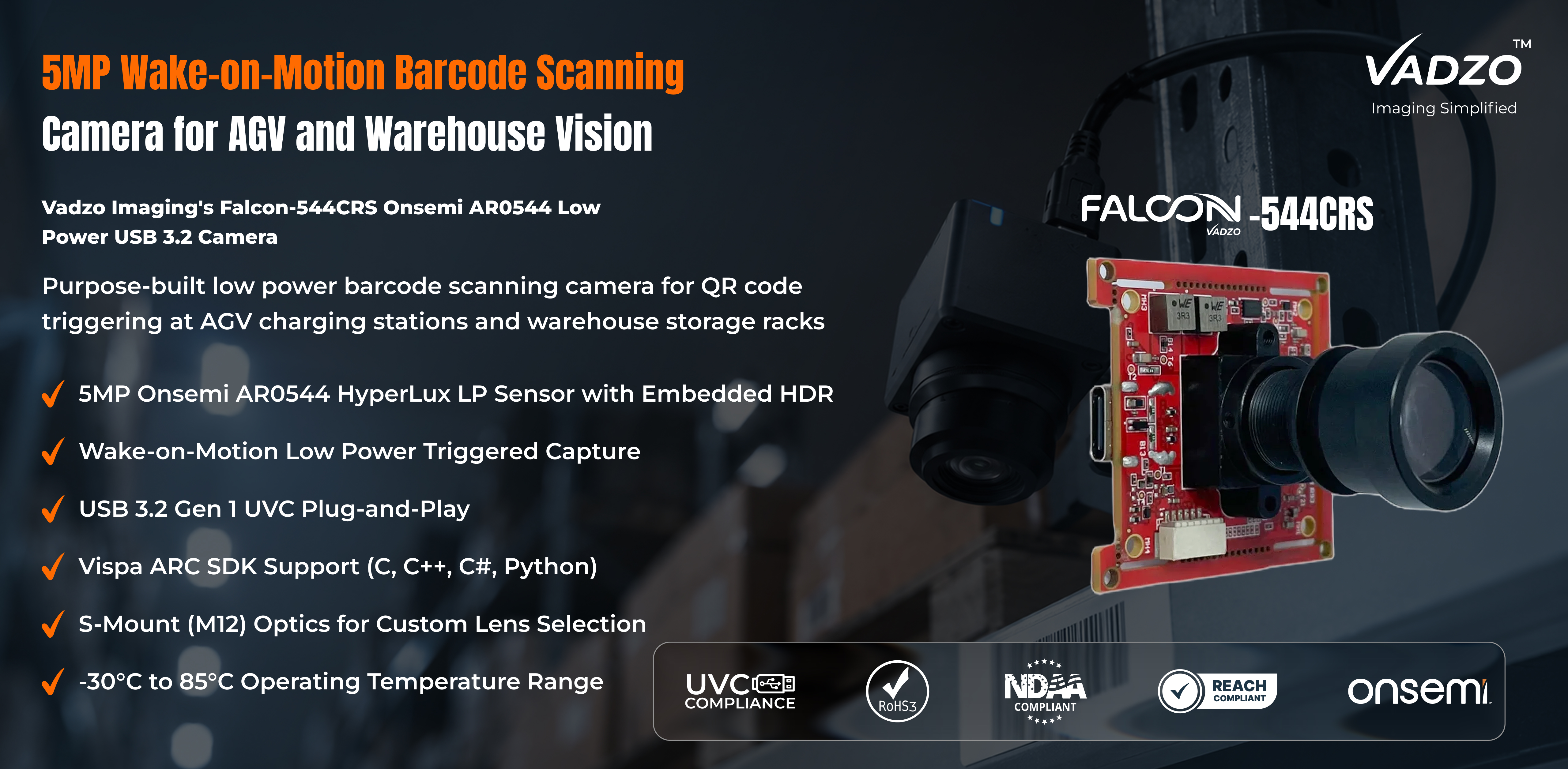
FORT WORTH, Texas, July 20, 2026 (Newswire.com) - Vadzo Imaging, a provider of embedded vision camera hardware for OEMs and system integrators, today introduces the Falcon-544CRS, a 5MP AR0544 barcode scanning camera built around Wake-on-Motion triggered acquisition for AGV navigation and warehouse automation deployments. Rather than streaming continuously at a fixed frame rate regardless of scene activity, the Falcon-544CRS holds its imaging core in standby and wakes to capture only when motion enters the field of view, a design suited to charging station docking bays, storage rack scan points, and other locations where a barcode or QR code needs to be read only when an AGV, tote, or pallet actually arrives.
Sensor and Camera Overview
The Onsemi AR0544 HyperLux LP is a HyperLux LP sensor built for embedded platforms where power budget and thermal headroom are as important as resolution. In a 1/4.2 inch optical format with 1.4 µm x 1.4 µm pixels, it resolves 5MP at 2592 by 1944 through a rolling shutter architecture and delivers embedded HDR processing on the sensor itself, extending usable dynamic range in scenes with mixed illumination without adding a merge step to the host processor. For a barcode scanning camera reading labels under warehouse lighting that ranges from overhead LED banks to shadowed rack aisles, this on-sensor HDR keeps both bright specular highlights on glossy label film and dim rack shadow regions inside a decodable contrast band in a single capture. Layered onto that sensor foundation, this Wake-on-Motion camera module places the imaging core into standby between events and triggers a full wake and frame capture only when motion is present, cutting the average power draw of an always-mounted AGV barcode camera to a fraction of what continuous streaming requires.
Key specs: 5MP (2592x1944) | Onsemi AR0544 HyperLux LP | 1/4.2 inch | 1.4 µm x 1.4 µm | Rolling Shutter | Embedded HDR | USB 3.2 Gen 1 Type-C | S-Mount (M12 Standard) | -30°C to 85°C | Wake-on-Motion
Wake-on-Motion Triggered Capture for Low Power Barcode Scanning at Charging Stations and Storage Racks: An always-powered barcode scanning camera mounted at a fixed AGV charging station or a storage rack scan point spends most of its operating life looking at an empty aisle or an unoccupied dock. Continuous streaming at full frame rate burns power and generates heat for scene content that never needs to be decoded, a real constraint in rack-mounted enclosures and charging infrastructure where thermal and power budgets are already allocated to battery management electronics. This Wake-on-Motion (WOM scan camera) design holds the AR0544's imaging core in a super low power standby mode and monitors the scene for motion using minimal circuitry, triggering a return to full imaging operation only when motion is detected in the field of view. The host system does not need to poll the camera or manage any power state transitions in software, because the wake decision happens on the sensor itself. For an AGV pulling into a charging bay, the arriving vehicle itself is the motion event that wakes the camera in time to read the dock identification code before the charge session begins. For a storage rack scan point, a picker or robotic arm entering the aisle triggers the same wake and capture sequence. This is the foundation of a true Wake-on-Motion barcode camera and smart trigger camera design, where the trigger condition is physical presence rather than a software polling loop.
Onsemi AR0544 HyperLux LP Sensor: 5MP Resolution and Embedded HDR for Mixed-Illumination Warehouse Scanning: Warehouse and AGV scanning environments rarely offer even lighting. Overhead LED fixtures create hot spots on reflective label stock while adjacent rack shelving throws a shadow across the same scan zone, and a standard dynamic range sensor forces a choice between blown highlights or crushed shadow detail. The Onsemi AR0544 HyperLux LP scan camera addresses this with embedded HDR processing built into the sensor pipeline, extending the usable dynamic range of a single capture so both the bright and shadowed regions of a scan zone remain inside a decodable contrast range. At 5MP, the AR0544 QR code camera resolves 2592 by 1944 pixels, delivering enough spatial resolution for 1D barcode and 2D QR code decoding across the working distances typical of AGV-mounted and rack-mounted installations without requiring a higher resolution sensor that would add cost and bandwidth the application does not need. The 1.4 µm x 1.4 µm pixel architecture improves photon collection relative to front-illuminated designs of comparable pitch, which matters directly for a low-power scan camera that is frequently reading labels under the dimmer portions of a warehouse lighting layout.
Ground Sample Distance and Optics Selection for AGV and Storage Rack QR Code Camera Deployments: Reliable decode performance in any 5MP QR code camera deployment comes down to ground sample distance, the real-world dimension each pixel resolves at a given working distance, and lens focal length. The governing relationship is GSD equals pixel pitch multiplied by working distance divided by focal length. For a 1D barcode, the narrowest bar needs to span at least two pixels. For a QR code or Data Matrix symbol, the narrowest module needs two to three pixels of coverage to leave the decode engine enough margin. Take a storage rack scan point where the AR0544 scanning camera sits 400mm from the rack face behind an 8mm lens. With the AR0544's 1.4 µm x 1.4 µm pixel pitch, GSD works out to 0.07mm per pixel. A rack label printed with a 0.4mm minimum module size maps to roughly 5.7 pixels per module at that distance, comfortably above the functional decode threshold. At a charging station scan point where the working distance drops to 150mm behind a 12mm lens, GSD tightens to about 0.0175mm per pixel, giving a 0.25mm barcode bar around 14 pixels of coverage and margin for off-angle capture during docking. OEM teams building AGV scanning camera or storage rack camera installations should run this calculation against their own mounting geometry, since working distance and angle vary between a floor-level charging bay and an elevated rack scan point, a lens selection question closely related to the tradeoffs covered in Vadzo's blog on optical zoom vs digital zoom.
USB 3.2 Gen 1 UVC Plug-and-Play Integration for AGV and Warehouse Vision Platforms: The Falcon-544CRS connects over USB 3.2 Gen 1 with full UVC compliance, meaning this USB 3.2 scanning camera registers as a standard video capture device on Windows, Linux, and Android without any custom driver installation. For OEM teams building embedded barcode camera nodes across a mixed fleet of AGV controllers, warehouse servers, and edge compute boxes, this removes driver development and compatibility testing from the integration scope entirely. A USB barcode camera module that streams immediately on connection also simplifies field replacement, since a technician swapping a unit at a storage rack scan point does not need to reinstall driver software before scanning resumes. The S-Mount M12 lens mount gives OEM developers the flexibility to select a lens matched to their own working distance and field of view, whether the deployment calls for a wide-angle lens covering multiple shelf positions or a narrower lens focused on a single charging station dock target.
GPIO and Trigger Synchronization for Event-Driven Barcode Camera Module Deployments: Beyond the sensor-level Wake-on-Motion trigger, the Falcon-544CRS exposes GPIO for hardware-level trigger input and strobe output, giving integrators a second layer of event control for barcode camera module deployments that need to synchronize capture with an external signal rather than relying on motion alone. An AGV controller can assert a hardware trigger the moment its docking sequence confirms alignment at a charging station, or a rack-mounted photo-eye can fire the strobe output the instant a tote passes a scan point, giving this triggered scan camera a deterministic capture window instead of a motion estimate. This matters where ambient light on the warehouse floor shifts across a production shift, since a synchronized strobe pulse overwhelms ambient contribution and keeps barcode to background contrast consistent, the hallmark of an edge trigger camera and event trigger camera design built for deterministic capture rather than free-running video.
Product Specifications
Parameter | Specification |
Sensor | Onsemi AR0544 HyperLux LP |
Sensor Format | 1/4.2" |
Max Resolution | 5MP (2592 x 1944) |
Pixel Size | 1.4 µm x 1.4 µm |
Shutter Type | Rolling Shutter |
HDR | Embedded HDR |
Low Power Feature | Wake-on-Motion (Super Low Power Standby, Motion-Triggered Wake) |
Interface | USB 3.2 Gen 1 Type-C Interface Backward Compatible to USB 2.0 |
Optics | S-Mount (M12 Standard) |
Operating Temperature | -30°C to 85°C |
Compliance | UVC, RoHS 3, REACH |
SDK | Vispa ARC SDK (C, C++, C#, Python | Windows, Linux, Android) |
"Most barcode camera deployments on the market today are built around continuous streaming, which is the wrong assumption for a huge share of AGV and warehouse scan points. A charging station or a storage rack does not need a camera watching an empty scene all day. It needs a camera that wakes up, reads the code, and goes back to sleep. That is exactly what we built into the Falcon-544CRS. The AR0544 gives OEM teams the resolution and the embedded HDR to handle real warehouse lighting, and Wake-on-Motion gives them the power budget to leave that camera running indefinitely at a battery-backed or thermally constrained install point without babysitting it." - Alwin Vincent, Product Manager, Vadzo Imaging.
Target Applications
AGV Charging Station Docking and Identification Verification: An AGV QR code camera mounted at a charging bay has one job during most of its operating life: confirm which dock the vehicle has arrived at and verify docking alignment before a charge session begins. The Falcon-544CRS charging station camera configuration uses Wake-on-Motion to stay in low-power standby until the arriving AGV triggers a wake, then captures and decodes the dock identification barcode or QR code printed at the charging point. This event-driven approach matters at scale, since a facility running dozens of charging bays around the clock cannot afford continuous streaming power draw multiplied across every dock, and a charging station camera that only wakes when a vehicle is present keeps the aggregate power budget of the charging infrastructure under control. The AR0544's embedded HDR also handles the lighting mismatch common at charging bays, where dock-mounted indicator LEDs and overhead fixtures create localized bright spots against an otherwise dim floor-level scan zone.
Storage Rack and Pick-Face Inventory Scanning: An industrial barcode camera reading pick face labels or bin location codes at a storage rack faces a related constraint: it needs to trigger reliably when a picker or automated shuttle arrives at a scan point that may go unused for long stretches between put-away and pick cycles. The Falcon-544CRS storage rack camera configuration applies the same Wake-on-Motion trigger logic to rack-level scanning, waking on approach rather than streaming continuously across a rack face that sits empty between fulfillment waves. At 5MP resolution, the AR0544 barcode camera resolves rack labels across the working distances typical of floor-level and elevated rack positions, and the S-Mount lens mount lets integrators select optics matched to a specific aisle geometry. For an inventory scanning camera program spanning thousands of rack locations, the power and thermal savings of an event-triggered camera module compound directly into lower infrastructure cost per scan point.
Warehouse Automation and Autonomous Navigation Camera Integration: Beyond fixed scan points, the same Falcon-544CRS platform serves as an AGV vision camera for onboard reading tasks, where an autonomous navigation camera mounted on the vehicle itself reads floor markers, rack face codes, or routing labels as the AGV moves through a facility. Warehouse automation camera deployments of this kind benefit from the same low power profile as the fixed installation case, since an onboard camera running on the AGV's own battery budget competes directly with drive and lift motor power draw, and every milliwatt saved extends operating time between charge cycles. The USB 3.2 UVC interface integrates directly with the onboard compute platforms common in warehouse automation camera fleets, useful for engineering teams evaluating a robot scanning camera for the first time.
Supply Chain, Logistics, and Inventory Tracking: At the facility level, a warehouse barcode camera and logistics barcode camera are deployed across dock doors, sortation lanes, and cross-dock scan points to support the broader inventory tracking camera and logistics tracking camera function that ties physical goods movement back to a warehouse management system. The Falcon-544CRS gives supply chain camera integrators a single sensor platform covering charging station identification, storage rack verification, and general-purpose fixed-mount scanning without switching sensor families across use cases, simplifying spare parts inventory and firmware maintenance for a smart warehouse camera rollout across multiple facility types.
Vispa ARC SDK: Programmatic Control for Trigger, ROI, and GPIO Configuration
The Falcon-544CRS is supported by Vadzo's Vispa ARC SDK, providing programmatic access to streaming parameters, exposure and gain control, region of interest configuration, GPIO trigger and strobe management, Wake-on-Motion sensitivity tuning, and firmware updates. The SDK supports C, C++, C#, and Python across Windows, Linux, and Android, letting OEM developers build a QR code scanning camera, an industrial QR scanner camera, or barcode camera module integration, write directly against a documented API rather than reverse engineering UVC extension controls. Region of interest configuration limits processing to the active scan zone, reducing bandwidth and decode engine load for a fixed mount barcode scanner deployment where label position is known in advance. For teams standardizing across Vadzo's broader Falcon camera series, the same Vispa ARC SDK governs sensor parameters consistently, reducing integration burden across multiple sensor families within a single warehouse automation software stack.
Frequently Asked Questions
Q: What is a Wake-on-Motion barcode camera, and how does it reduce power consumption in AGV deployments?
A: A Wake-on-Motion barcode camera holds its imaging core in a super low power standby state and monitors the scene for motion using minimal circuitry, triggering a return to full imaging operation only when motion enters the field of view rather than streaming continuously. This matters at AGV charging stations and storage rack scan points that sit unused for long stretches between arrivals. Vadzo Imaging's Falcon-544CRS implements this at the AR0544 sensor level, so the host never needs to poll the camera or manage power state software, the wake decision happens on the sensor itself. Across many install points, this motion-triggered camera design cuts the aggregate power draw of the vision layer to a fraction of a continuously streaming barcode scanning camera, extending the runway where the camera shares a power budget with charging electronics and reducing heat inside enclosed rack and dock hardware.
Q: How does a low-power USB barcode scanning camera work at AGV charging stations?
A: At an AGV charging station, a low-power barcode scanning camera needs to confirm dock identification and docking alignment only in the brief window when a vehicle is arriving, not across the hours a dock sits empty between charge sessions. Vadzo's Falcon-544CRS is built around this event-driven scanning pattern. The AR0544 sensor's Wake-on-Motion feature keeps the camera in standby until the arriving AGV triggers a wake, at which point it captures and decodes the charging station's identification code and passes the result to the host over its USB 3.2 Gen 1 connection. Because the interface is fully UVC compliant, the camera streams immediately once woken without any custom driver work, whether that host is a warehouse execution server, an edge compute box near the charging bay, or the AGV's own onboard controller. Embedded HDR in the AR0544 also compensates for the lighting mismatch typical at charging bays, where indicator LEDs and overhead fixtures create bright regions against a dim floor-level scan zone.
Q: What GSD is needed for a 5MP barcode camera to decode QR codes on warehouse storage racks reliably?
A: Reliable QR code decoding requires the narrowest module in the symbol to cover at least two to three pixels in the captured image, a threshold defined by ground sample distance, or GSD, which equals pixel pitch multiplied by working distance divided by lens focal length. For a 5MP scanning camera, also marketed as a 5MP code reader camera, built on the Onsemi AR0544 with its 1.4 µm x 1.4 µm pixel pitch, mounting the camera 400mm from a storage rack face behind an 8mm lens yields a GSD of approximately 0.07mm per pixel. A typical rack label printed with a 0.4mm minimum module size maps to roughly 5.7 pixels per module at that geometry, comfortably above the functional decode threshold with margin for label wear or minor mounting misalignment. Engineers evaluating a storage rack camera installation should calculate GSD against their own working distance and lens combination before finalizing optics, since rack heights and aisle widths vary across facilities.
Q: Does a USB 3.2 barcode scanning camera work plug-and-play on Windows, Linux, and Android without custom drivers?
A: Yes. A USB camera with full UVC compliance operates as a plug-and-play video capture device on Windows, Linux, and Android because all three include native UVC support in their standard driver stack, with Linux exposing this through V4L2. When a UVC-compliant barcode scanning camera connects, the host recognizes it as a standard video input, available to any application that can access a camera stream, without installing a vendor-specific driver first. Vadzo Imaging's Falcon-544CRS is a fully UVC-compliant USB 3.2 Gen 1 camera built on the Onsemi AR0544 sensor and streams immediately on connection across all three platforms. For control beyond the UVC baseline, including Wake-on-Motion sensitivity tuning, GPIO trigger and strobe configuration, and region of interest settings, the Vispa ARC SDK installs alongside the native driver and provides programmatic access in C, C++, C#, and Python without disrupting standard UVC streaming.
Q: What should OEM engineers evaluate in an embedded barcode camera module for warehouse automation?
A: OEM engineers building a warehouse automation deployment around an embedded barcode camera module should evaluate five things: sensor resolution relative to the smallest symbol module, dynamic range handling for mixed warehouse lighting, power architecture for install points that run continuously without a duty cycle break, interface compatibility across host platforms, and SDK access for parameters beyond basic plug-and-play streaming. Vadzo Imaging's Falcon-544CRS addresses all five in a single OEM barcode camera platform. The AR0544 sensor delivers 5MP resolution with embedded HDR for warehouse lighting variation, Wake-on-Motion solves the power question for always-mounted charging station and storage rack scan points, USB 3.2 Gen 1 with full UVC compliance covers host platform compatibility, and the Vispa ARC SDK exposes trigger, GPIO, region of interest, and Wake-on-Motion sensitivity settings for teams needing control beyond the UVC baseline. Evaluation units and OEM customization support are available directly through Onsemi HyperLux AR0544 USB camera channels at Vadzo Imaging.
Availability and Customization
The Falcon-544CRS 5MP AR0544 Wake-on-Motion USB 3.2 Barcode Scanning Camera is available now for OEM evaluation and production ordering directly from Vadzo Imaging. Evaluation kits ship with the camera module, a default S-Mount lens, and integration documentation covering Vispa ARC SDK setup, GPIO wiring, and Wake-on-Motion sensitivity configuration. Full OEM customization is available, including board redesigns, alternate lens holders and filter configurations, firmware modifications for custom trigger logic, and enclosure design for charging station and storage rack mounting environments. Volume pricing and applications engineering support are available on request. For inquiries, contact the Vadzo sales team at support@vadzoimaging.com
About Vadzo Imaging
Vadzo Imaging develops embedded and machine vision camera hardware for OEMs and system integrators building production-ready vision systems across industrial automation, robotics, AGV and warehouse platforms, smart surveillance, medical device imaging, and edge AI. The company's USB camera series, alongside MIPI, GigE, Wi-Fi, and SerDes interface camera products, supports the full range of embedded deployment architectures from onboard AGV payloads to fixed infrastructure scan points. Vadzo provides end-to-end imaging support, including sensor integration, ISP tuning, firmware development, and OEM camera customization services that accelerate development and deployment at scale. Visit vadzoimaging.com to explore the full embedded vision camera portfolio.
Media Contact
Alwin Vincent
Vadzo Imaging
Email: alwin@vadzoimaging.com
LinkedIn: Vadzo Imaging
YouTube: Vadzo Imaging
X: Vadzo Imaging
SOURCE: Vadzo Imaging
Source: Vadzo Imaging