AWEAR Review 2026: Best EEG Wearable for Stress & Focus Tracking?
Early-access wellness wearable brings brain-signal tracking, AI-powered insight features, iOS compatibility, beta pricing terms, and privacy considerations into the 2026 wearable technology conversation.
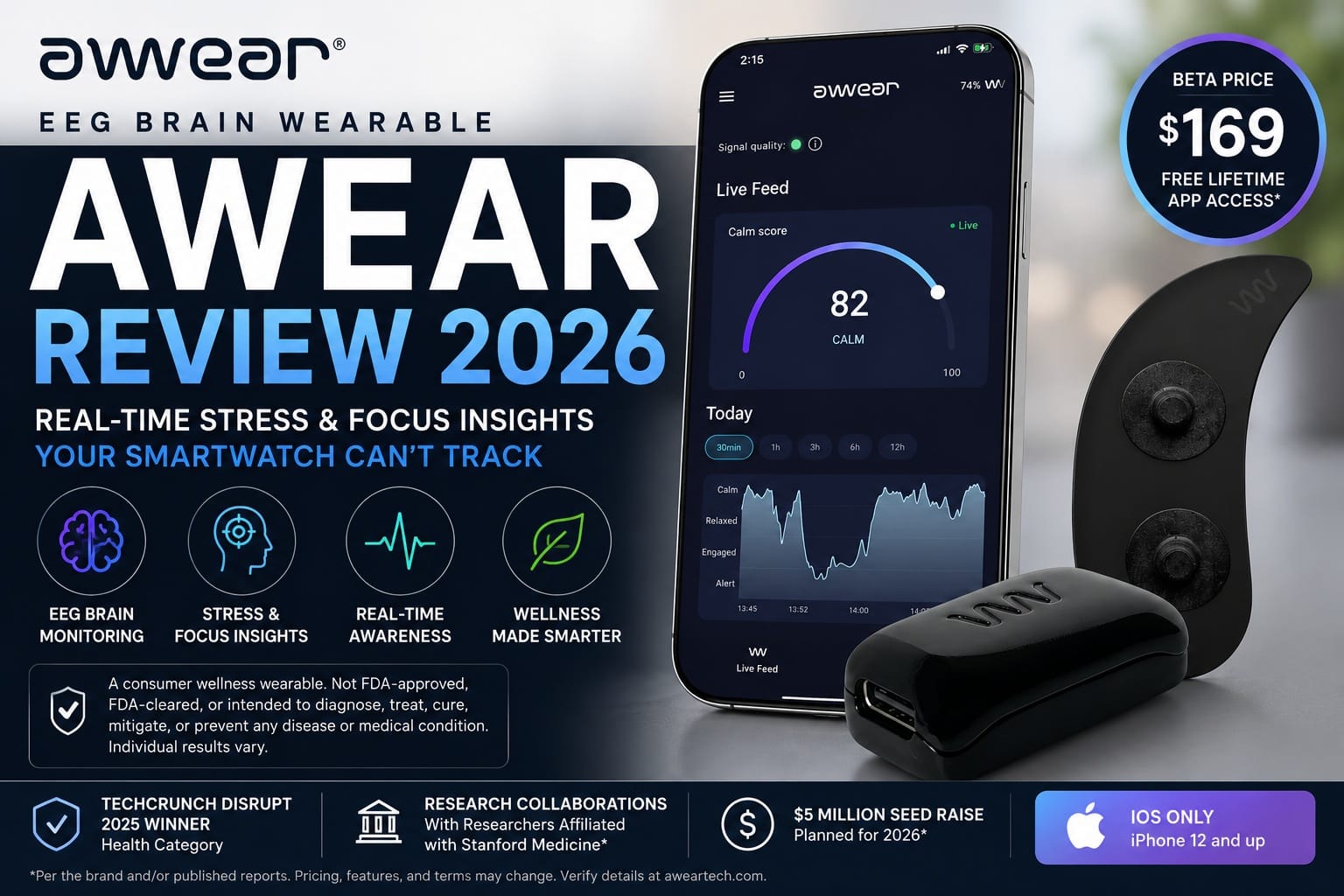
San Francisco, CA, May 26, 2026 (Newswire.com) - Disclaimers: This article contains affiliate links. A commission may be earned on qualifying purchases made through links in this content, at no additional cost to the reader. Affiliate relationships do not influence editorial content or the evaluation of products. Disclosure is provided in accordance with FTC 16 CFR Part 255. AWEAR is marketed by the brand as a consumer wellness wearable and is not FDA-approved, FDA-cleared, or intended to diagnose, treat, cure, mitigate, or prevent any disease or medical condition. Individual results and experiences vary. Consult a licensed healthcare professional before making decisions related to health devices or programs.
AWEAR Beta Wearable Highlights Consumer Ear-EEG Tracking for Stress Awareness, Focus, and Mental Load Insights
TL;DR - Bottom Line Up Front: AWEAR is a behind-the-ear EEG brain wearable that, according to the company, translates real-time brain signals into stress awareness, focus, and mental load insights via AI. Beta price: $169 with free lifetime app access - terms the brand ties explicitly to the Beta phase. iOS-only. Ships with five patches. Not a medical device. TechCrunch covered it in December 2025; the brand reports pilot research collaborations involving researchers affiliated with Stanford Medicine; a $5 million seed raise was reported as planned for 2026 per TechCrunch coverage published in December 2025. For anyone tracking physical metrics who wants the brain-signal layer their smartwatch cannot provide, the Beta-phase pricing and app-access terms are a meaningful consideration for buyers evaluating the device today.
Quick Verification Snapshot
Product: AWEAR® Beta - ear-EEG brain sensor
Current price: $169.00 - early-access Beta pricing, per the brand
App access: Free lifetime membership for early Beta testers specifically - per the brand, future access terms may vary
Patches included: 5 adhesive patches; approximately 7 days each, per the brand
Compatibility: iPhone 12 and up, iOS only - Android in development, not yet available
Estimated delivery: End of June per brand communications at time of writing
Return window: 15 days from receipt - item must be in original condition
Company: AWEAR Technologies Inc., San Francisco, CA
Support: contact@awear.us
Returns to: AWEAR Technologies Inc., 1900 Washington St., Apt. 501, San Francisco, CA 94109
Regulatory status: Consumer wellness wearable - not FDA-approved, FDA-cleared, or intended to diagnose, treat, cure, mitigate, or prevent any disease
Backing: Pre-seed round from Hustle Fund, Niremia Collective, Techstars, and The Pitch Fund, per TechCrunch reporting (December 2025)
Recognition: Winner, Health Category - TechCrunch Disrupt 2025 Startup Battlefield 200, per published coverage
Readers can verify current pricing, availability, app terms, and return policy directly at the official AWEAR website: https://aweartech.com/.
View current AWEAR Beta pricing and availability here
Disclosure: If you buy through this link, a commission may be earned at no extra cost to you.
Why the Timing of This Review Matters
Most AWEAR coverage online was written in December 2025 when TechCrunch first covered the device. Those articles are news stories, not buyer evaluations - and they were frozen in time the moment they were published. The SERP is full of them. None of them answers the question a buyer in 2026 actually has: is this available right now, what does it cost today, what has changed since the early coverage, and does the early-access window still apply?
Here is what is currently verified. AWEAR Beta is available for purchase at aweartech.com as of this writing. Per the brand, the current price is $169, which is specifically associated with early Beta tester pricing - a figure lower than the $195 reported in TechCrunch's December 2025 coverage of the first wave of early adopters. The brand states that early Beta testers receive free lifetime app access, with a note in the FAQ that future access terms may vary by product version and release stage.
That is the relevant urgency signal - and it is completely real. This is not a countdown timer. It is the straightforward fact that the device is in Beta, the pricing and app terms are explicitly tied to that Beta status, and neither is guaranteed to stay as-is once the product moves toward general availability. Buyers who want the current terms are evaluating a real window, not a marketing construct.
Beyond pricing: the category itself is moving fast. A 2026 systematic review in Frontiers in Human Neuroscience surveyed the entire ear-EEG research landscape from 2010 to 2025. The brand reports pilot research collaborations involving researchers affiliated with Stanford Medicine. Per reporting published by TechCrunch in December 2025, the company stated plans to raise a $5 million seed round. These developments suggest increasing commercial and research interest in ear-EEG wearables - and the early-access experience of a product like this is, by definition, specific to the phase the device is currently in.
The Gap Every High-Performer Eventually Hits
There is a moment most people who track their health eventually run into. They have the Apple Watch on their wrist, maybe an Oura ring on their finger. The recovery score looks solid. HRV is good. Eight hours logged. Everything on the dashboard says ready to go. They sit down at their desk - and spend the next six hours grinding through back-to-back meetings feeling mentally underwater, stress building in the background, and not a single device they own registers any of it.
That is the gap. Heart rate, steps, sleep staging, and blood oxygen - those are body signals. What happens in the brain during a high-pressure workday, a difficult conversation, or a creative session pushed past its limit - that is a different data type entirely. And until recently, capturing it in daily life required clinical equipment no one outside a research lab was wearing.
AWEAR is positioned, per the brand, as the consumer's answer to that gap. According to the company, it uses EEG technology worn behind the ear to track brain-signal patterns associated with stress, focus, and mental load - in real time, during everyday life. The brand's own site puts it directly: AWEAR tracks your mind. Everything else tracks your body.
That framing is accurate to what the device is designed to do. It is also worth being clear about what AWEAR is not. Per the official FAQ, AWEAR is not a medical device. It does not diagnose mental health conditions. It is a consumer wellness tool designed to support awareness and self-reflection, not to replace clinical evaluation or professional mental health support.
How Ear-EEG Technology Actually Works
EEG - electroencephalography - measures the tiny electrical signals produced when neurons fire. The technology is over a century old and thoroughly established in clinical neuroscience. What has changed recently is miniaturization and AI-driven signal processing, which now make it possible to capture useful EEG data from a small electrode set worn in or around the ear - rather than a full clinical cap with conductive gel.
A 2023 systematic review in the Journal of Neural Engineering analyzed 123 publications on ear-EEG technology and concluded that it represents the future of wearable EEG, noting real advantages over scalp-based methods for continuous daily wear. A 2026 systematic review in Frontiers in Human Neuroscience, following PRISMA guidelines and surveying peer-reviewed work from 2010 through 2025, documented expanding evidence for ear-centered EEG wearables across brain-state monitoring applications. Neither study is specific to AWEAR - they establish the scientific credibility of the approach AWEAR applies.
Per the brand, AWEAR's electrodes capture brain-signal patterns from around the ear. AI algorithms analyze those patterns for changes in mental states, including stress response and activation levels. The app translates the processed data into readable insights about focus, mental load, and balance as they shift through the day - no raw waveform charts, no interpretation required from the user.
On AWEAR's own validation: the brand states it has conducted internal testing and neuroscience validation and has worked with researchers affiliated with Stanford Medicine and UCSF through pilot research collaborations. These are brand-reported descriptions of ongoing validation work - not FDA clearance, not independent peer-reviewed publications on this specific hardware. The brand states this clearly and consistently, and that transparency earns more trust than overclaiming would.
Where AWEAR Sits in a Fast-Moving Neurotech Market
The consumer EEG space has gotten genuinely crowded heading into 2026. Muse S Athena combines EEG with fNIRS in a meditation headband. The FRENZ Brainband at $680 targets sleep and focus sessions. Sens.ai runs over $1,000 for a structured brain-training system. Neurosity targets developers. NextSense Smartbuds, which closed a $16 million Series A, launched clinically-focused in-ear EEG earbuds in early 2026.
AWEAR's positioning differs from most of these session-based devices by emphasizing continuous, passive, all-day wear in everyday life. Every one of the competing devices is designed for defined sessions - a 20-minute meditation, a sleep period, a focused work block. AWEAR's form factor - a small sensor worn behind the ear under an adhesive patch - is specifically built to be forgotten about while someone works, commutes, takes meetings, and goes about their day. The hypothesis is that persistent daily awareness, not session-based snapshots, is where the real insight about mental patterns lives.
Per the brand, AWEAR does not replace Apple Watch, Oura, or Fitbit. It is described as complementing them - filling in the brain-signal dimension that heart-rate and metabolic tracking cannot access. That positioning is honest and accurate to what the current wearable market actually offers.
On price: at $169 with free lifetime app access for current Beta testers, AWEAR sits well below the established EEG wearable alternatives. That gap is not just significant in dollar terms - it reflects that AWEAR is targeting a consumer audience that the clinical-adjacency and performance-biohacker market has largely priced out.
What AWEAR Tracks: Exactly What the Brand Says, Nothing More
Every claim below comes directly from brand-published materials. In a category where overclaiming is the norm, the distinction between what a device actually tracks and what a buyer assumes it tracks matters more than almost anywhere else.
Real-time mental-state awareness: According to the company, AWEAR continuously reads brain signals and shows when a user appears focused, overloaded, or experiencing elevated stress patterns - as it happens, not in a morning summary.
Activity correlation: Per the official website, AWEAR shows how specific activities - meetings, workouts, commutes - correlate with brain-signal patterns across the day.
AI-powered brain-signal insights: The company describes the app as delivering insights into how the user's brain responds to stress, focus, and recovery, building a pattern picture over time.
Wellness timeline: According to the brand, AWEAR tracks how habits and recovery shape brain-signal data across longer periods, enabling the pattern recognition that a single day cannot show.
Gentle nudges: Per the brand, when patterns suggest mental load has stayed elevated for an extended period, AWEAR delivers a subtle vibration to prompt a pause, breath, or step away before the stress response escalates.
What AWEAR does not do, per the company's own FAQ: it does not diagnose any medical or mental health condition, is not recommended for intense physical activity or sauna use, and the device itself is not water-resistant (though the adhesive patch is designed for sweat and water resistance during normal daily wear).
What Ships, and What It Costs to Own Over Time
Per the official AWEAR product page, the Beta box ships with the AWEAR EEG device (USB-C rechargeable), five adhesive ear patches, each rated for approximately 7 days of wear, and free lifetime app access for early Beta testers on iPhone 12 and up.
Battery life is described by the brand as typically up to approximately 14 hours per charge on current Beta hardware, with improvement possible through firmware updates. The device charges via USB-C. The brand states it is compatible with glasses and other ear-worn items for most users.
Ongoing patch cost: refills are $25 for 10, $45 for 25, or $80 for 50 per the official website. At the 50-pack rate, daily wear runs roughly $1.60 per week. At the 10-pack rate, roughly $2.50 per week. For consistent daily users, the true cost of ownership includes those ongoing patch costs - worth knowing upfront rather than discovering them later.
Per the FAQ, the device can be worn during sleep - many Beta testers report comfortable overnight wear - and during light daily activity. Not recommended for intense workouts or sauna conditions.
Check current AWEAR Beta availability and order details here
Should You Buy Now, or Wait?
This is the question that every honest review of an early-access product needs to answer directly. Here is the actual framework for making this call.
The case for buying now: The current $169 price and free lifetime app access are explicitly tied to Beta-tester status, per the brand. The FAQ notes that future access may vary depending on product version and release stage. Early-access pricing on a venture-backed consumer hardware product historically does not hold after general availability launches - and AWEAR has disclosed plans for a significant fundraise in 2026. Buying during the Beta phase is the only way to participate in the early-adopter terms the brand is currently offering. There is also the 15-day return window: if the device does not work for a particular buyer's life and workflow, returning it is the option. Waiting until general availability simply removes the current pricing and app terms without providing a risk-free alternative.
The case for waiting: Android support is not yet available. If an Android device is the primary phone, waiting is the right call - full stop. The 15-day return window is short; someone who cannot genuinely evaluate an unfamiliar consumer technology device in 15 days should not buy in this phase. Battery life at approximately 14 hours means daily charging is required - buyers who are not prepared to build that into their routine should be honest with themselves about whether they will actually use the device. And for anyone who needs independently published peer-reviewed clinical validation of this specific hardware before purchasing, that data does not exist publicly yet. Waiting for it is a legitimate choice.
The honest bottom line on timing: The terms available right now are, per the brand's own published materials, specifically tied to the Beta phase. They are not guaranteed afterward. That is a real and verifiable factor - not a countdown timer, not a manufactured push. Whether it changes the decision depends entirely on whether this buyer is the right fit for what AWEAR is right now.
Who This Device Is Actually Built For
AWEAR Beta in its current form is a strong match for someone who: already tracks physical metrics and wants a brain-signal layer alongside them; works in a high-cognitive-demand environment - founder, executive, clinician, knowledge worker - and wants awareness of mental load during their actual day rather than a post-hoc recovery score; is on an iPhone 12 or newer; is comfortable with early-access consumer hardware and understands what "Beta" means in practice; and has 15 days to give it a real evaluation.
It is not the right fit for someone who needs Android compatibility now, requires an FDA-cleared device, needs water-resistant or fully ruggedized hardware, or is not prepared for a product still being actively refined. For those buyers, waiting for a future version is the honest recommendation.
AWEAR Beta Pricing, Return Terms, and Everything You Need Before Buying
All figures sourced directly from aweartech.com at time of writing. Verify current details at https://aweartech.com/ before purchasing - pricing and terms are subject to change.
Device price: $169.00 - includes 5 patches and free lifetime app access for early Beta testers
Patch refills: $25 / 10 patches | $45 / 25 patches | $80 / 50 patches
Shipping: Free on orders above $50
Estimated delivery: End of June per brand communications at time of writing
Return window: 15 days from receipt - original condition, with packaging and proof of purchase required
Initiate returns at: contact@awear.us - do not ship without prior authorization
Return address: AWEAR Technologies Inc., 1900 Washington St., Apt. 501, San Francisco, CA 94109
Refund timeline: Within 10 business days of approved return, to original payment method
EU buyers: 14-day cooling-off period applies under EU consumer protection law
HSA/FSA: Not eligible - general wellness product, per the brand
Because AWEAR is an electronic wearable, buyers should also review current device labeling, wireless specifications, and product documentation directly from the brand before purchase.
View full AWEAR Beta pricing and place an order on the official site
Frequently Asked Questions About AWEAR
Is AWEAR still available to buy right now?
Yes, as of this writing AWEAR Beta is available for purchase at aweartech.com. The device is currently in early-access Beta, which means availability is not general-release and the current pricing and app terms are specifically associated with this Beta phase. The brand describes delivery for current orders as estimated for end of June. Readers should verify current availability directly at https://aweartech.com/ as stock and order windows for Beta products can change. There is no publicly confirmed general-availability date at the time this article was written.
What exactly does AWEAR measure, and how is it different from a smartwatch?
A smartwatch measures body signals - heart rate, steps, sleep stages, blood oxygen. According to the company, AWEAR measures something different: brain-signal patterns captured from electrodes around the ear using EEG technology. The AI processes those signals to surface insights about stress awareness, focus, and mental load as they change in real time during daily life. Per the brand, the two categories are complementary - one tracks the body, the other tracks the mind. AWEAR's outputs are wellness insights and do not constitute medical evaluation or clinical assessment of any kind.
Is the $169 price guaranteed, or will it go up?
The current $169 price is described by the brand as Beta-phase pricing. The brand's FAQ states that future app access may vary depending on the product version and release stage, and any changes will be communicated at the time of purchase or setup. TechCrunch's December 2025 coverage reported early-access pricing at $195, suggesting the brand has adjusted pricing as the Beta has progressed. The $169 price and free lifetime app access are not guaranteed to carry forward after the Beta phase ends, per the brand's own published language. Buyers should verify current pricing at aweartech.com before purchasing.
Is AWEAR a medical device? Is it FDA-approved?
No to both. Per the brand and the official FAQ, AWEAR is designed and sold as a consumer wellness wearable. It is not FDA-approved, FDA-cleared, or intended to diagnose, treat, cure, mitigate, or prevent any medical condition. The EEG technology it uses has established clinical applications in other devices, but AWEAR's specific application is consumer wellness awareness and self-reflection. Anyone experiencing symptoms of anxiety, chronic stress, depression, neurological concerns, or other health conditions should consult a licensed healthcare professional.
What iOS devices work with AWEAR? What about Android?
Per the brand, AWEAR currently works with iPhone 12 and newer running iOS. Android support is described by the company as in active development but is not available in the current Beta release. Android users should wait for confirmed compatibility before purchasing - there is no publicly announced timeline for Android availability at the time of this writing.
How do the patches work, and what does long-term ownership actually cost?
Each adhesive patch lasts approximately one week, per the brand. Five patches come with the device, covering about five weeks of daily wear. Refills cost $25 for 10, $45 for 25, or $80 for 50 per the official website. At the 50-pack price, ongoing daily use runs approximately $6.40 per month. At the 10-pack price, approximately $10 per month. People with sensitive or dry skin may experience adhesive irritation; the brand recommends discontinuing use and consulting a healthcare professional if irritation persists.
Can it be worn all day, overnight, and during exercise?
Per the brand's FAQ, AWEAR can be worn during sleep - the brand reports many Beta testers find it comfortable overnight - and during everyday activities and light movement. The company does not currently recommend use during intense workouts or physical activity, and the device should not be used in sauna conditions. The adhesive patch is sweat- and water-resistant for daily use; the device itself is not water-resistant.
What are the gentle nudges, and can notifications be turned off?
Per the brand, when brain-signal patterns suggest mental load has stayed elevated for an extended period, AWEAR delivers a subtle vibration to prompt the wearer to pause, breathe, or step away. The nudge signals that a pause may be useful - the app does not prescribe what to do next. Notifications can be managed or turned off entirely in the app settings at any time, per the FAQ.
What was the deal with Stanford Medicine and UCSF?
Per the brand's published FAQ, AWEAR states it has conducted internal testing and neuroscience validation and has worked with researchers affiliated with Stanford Medicine, UCSF, and other organizations through pilot research collaborations. The brand describes these as addressing specific use cases and gathering feedback. These are not independent peer-reviewed publications on the current AWEAR Beta hardware and are not regulatory endorsements or clinical certifications. They represent ongoing scientific validation work. The general EEG-for-stress-monitoring research base is well-established; AWEAR's specific outcomes data on its current device is not yet publicly available.
How does AWEAR compare to Muse, FRENZ Brainband, or other consumer EEG devices?
Most consumer EEG wearables are session-based - worn for a meditation, a sleep period, or a focus block, then removed. AWEAR's approach, per the brand, is continuous all-day wear during ordinary daily life, which requires a different form factor: behind the ear under a patch rather than a headband placed on the head. On price, AWEAR Beta at $169 is well below FRENZ ($680) and Sens.ai (over $1,000). Whether the behind-the-ear, continuous-monitoring approach captures what a specific buyer cares about is the core evaluation question - the form factor is the key differentiator, and it is worth evaluating honestly against how the buyer actually intends to use the device.
What happens if AWEAR does not work as expected?
Per the brand's published refund policy, buyers have 15 days from receipt to request a return. The item must be in original, unworn condition with tags, packaging, and proof of purchase. Contact contact@awear.us before returning anything - items sent without prior authorization will not be accepted. Once received and inspected, refunds process to the original payment method within 10 business days. EU buyers have a 14-day cooling-off period under applicable consumer protection law regardless of these terms.
Who is behind AWEAR - is this a credible company?
AWEAR was founded by Antonio Forenza, PhD - a former SVP of R&D at Rakuten Symphony with over 20 years in engineering and R&D - and co-founder Alejandra Guillén, per published company profiles. The company closed a pre-seed funding round backed by Hustle Fund, Niremia Collective, Techstars, and The Pitch Fund, per TechCrunch reporting in December 2025. AWEAR won the Health category pitch competition at TechCrunch Disrupt 2025 Startup Battlefield 200, per the same coverage. The team, per the brand, includes experts in neuroscience, computational neuroscience, and psychophysiology. This is a venture-backed neurotechnology startup with institutional backing and a founder with deep technical credentials - not a crowdfunding project.
The Bottom Line: A Straight Answer for the Right Reader at the Right Time
The wearable market has spent fifteen years getting better and better at tracking the body. Heart rate. Sleep. Activity. Recovery. The hardware is genuinely good and keeps improving. What it has not solved - and what AWEAR is one of the most credible early attempts to solve - is the brain side. What is actually happening in your mind during a hard Tuesday? When did you tip from productive into depleted? What patterns in your environment, schedule, and decisions seem to push your mental state in one direction or the other?
Those are not questions a heart rate monitor can answer. According to AWEAR, a behind-the-ear EEG sensor can at least begin to address them. The science underlying the approach is credible and well-documented. The company's validation work is more serious than most of the wellness device category. The pricing - $169 with free lifetime app access for current Beta testers - is meaningfully accessible for what the category usually charges. And the brand's own honesty about what the device is and is not - Beta hardware, consumer wellness tool, not a medical device, not a finished product - is the kind of straight talk that earns trust rather than manufacturing it.
The timing factor is real and worth naming plainly. The current pricing and app terms are specifically tied to the Beta phase, per the brand's published materials. The category is accelerating. The company is moving toward a seed raise. Early-access products do not stay early-access forever, and the terms attached to them do not always carry forward. Whether that changes the decision depends entirely on whether the right buyer is reading this at the right moment - and if that description fits, the 15-day return window is the honest way to find out.
Confirm AWEAR Beta availability and secure your order here
Contact Information
Company: AWEAR
Email: contact@awear.us
Product Return Address: AWEAR Technologies Inc., 1900 Washington St., Apt.501, San Francisco, CA, 94109 USA
Disclaimers
Regulatory and Medical Disclaimer: AWEAR is marketed by the brand as a consumer wellness wearable. It is not FDA-approved, FDA-cleared, or intended to diagnose, treat, cure, mitigate, or prevent any disease or medical condition. References to EEG, stress awareness, focus, mental load, neuroscience, AI insights, or brain-signal tracking in this article are provided solely for general wellness and informational purposes. Individuals experiencing anxiety, depression, chronic stress, neurological symptoms, sleep disorders, or any medical concern should consult a licensed healthcare professional.
Trademark Acknowledgment: AWEAR® is a trademark of AWEAR Technologies Inc. All other trademarks and brand names referenced in this article - including Apple Watch, Oura, Fitbit, FRENZ, Muse, Neurosity, Sens.ai, and NextSense - remain the property of their respective owners. References to competing or comparative brands are provided strictly for informational purposes and do not imply endorsement, sponsorship, or affiliation by those companies. All registered trademarks are acknowledged.
FTC Affiliate Disclosure: This article contains affiliate links. The publisher may earn a commission from qualifying purchases made through links in this content at no additional cost to the reader. Affiliate relationships do not influence product evaluation, editorial analysis, or factual presentation within this article. This disclosure is provided in accordance with FTC 16 CFR Part 255.
FDA and Wellness Device Notice: AWEAR is marketed by the brand as a consumer wellness wearable and is not FDA-approved or FDA-cleared. The device is not intended to diagnose, treat, cure, mitigate, or prevent any disease or medical condition. Information contained in this article is intended solely for informational and wellness-awareness purposes and should not be interpreted as medical advice. Individuals considering changes to health-related routines or experiencing symptoms should consult a licensed healthcare professional.
Testimonial and User Experience Notice: Testimonials, customer feedback, and user perspectives referenced in this article represent individual experiences only and are not guaranteed outcomes. Such statements should not be interpreted as medical claims, scientific evidence, or representations of typical consumer results. Material relationships and affiliate disclosures are provided in accordance with FTC endorsement guidelines.
Results Variability Disclaimer: Individual experiences with consumer wellness wearables vary significantly based on user biology, calibration accuracy, device placement, environmental conditions, usage patterns, and other variables. Brand-related claims attributed in this article reflect publicly available product descriptions and should not be interpreted as guarantees of specific results for any user.
Electronic Device Notice: Because AWEAR is an electronic wearable device, consumers should review all current product labeling, wireless specifications, FCC-related disclosures, technical documentation, and safety guidance directly through the brand prior to purchase. Information contained in this article reflects publicly available brand materials at the time of writing and may not reflect future updates or revisions.
Pricing and Availability Disclaimer: Pricing, product availability, shipping timelines, subscription or patch pricing, return policy terms, and technical specifications are subject to change without notice. Readers should verify all current details directly through aweartech.com before making any purchasing decision.
Publisher Independence Disclaimer: This content was produced independently and does not represent the views, editorial policies, or endorsements of Accesswire, Newswire.com, or any affiliated syndication platform. Inclusion of affiliate links does not imply endorsement of the product by the publisher or any distribution platform.
Geographic Jurisdiction and State Privacy Rights Disclaimer: This article is distributed through wire-service syndication and may be accessed by consumers across multiple U.S. jurisdictions. Privacy rights related to health data, biometric information, and neural data vary by state and applicable law. Nothing in this article modifies, waives, or limits consumer privacy rights available under federal or state law. Consumers should review the brand's current privacy policy at aweartech.com and direct any privacy-related inquiries to the brand directly.
Neural Data and Brain-Signal Privacy Notice: AWEAR collects data associated with brain and nervous system activity. Under California SB 1223, effective January 1, 2025, neural data is classified as sensitive personal information under the California Consumer Privacy Act (CCPA). Colorado HB 24-1058 classifies neural data as sensitive data under the Colorado Privacy Act, while Connecticut SB 1295, effective July 1, 2026, extends similar protections under the Connecticut Data Privacy Act. Montana has enacted related protections, and additional neural-data legislation has been introduced or advanced in states including Massachusetts, Minnesota, Illinois, Vermont, Virginia, Alabama, and New York. The FTC Health Breach Notification Rule, as amended in April 2024, may also apply to health-related wearable devices and apps. All compliance obligations under applicable privacy laws remain the responsibility of AWEAR Technologies Inc., not this publication. Consumers should review the current privacy policy at aweartech.com and direct privacy questions to contact@awear.us.
AI and Algorithmic Insights Disclaimer: References in this article to AI-powered analysis, stress awareness, mental-state interpretation, wellness scoring, or brain-signal insights describe brand-reported functionality only and should not be interpreted as medical analysis, diagnostic conclusions, or clinical evaluation. Algorithmic outputs generated by the AWEAR device may vary based on signal quality, device placement, user biology, environmental factors, and usage consistency. Brand-reported outcomes are not guaranteed for any individual user.
Beta Product Notice: AWEAR Beta is currently marketed as an early-access version of the device. Hardware functionality, software features, app access terms, performance characteristics, and overall product capabilities remain subject to ongoing development and refinement. Product specifications, support policies, and feature availability may change in future releases. Consumers should review all current specifications, terms, and return policies directly through aweartech.com at the time of purchase.
SOURCE: AWEAR
Source: AWEAR