65% of Hospital Nurses Polled Feel Watched by AI, 63% Report Added Work, Reports Black Book RN Survey
Hospital automation's hidden warning signs: Nearly half of nurses surveyed say they are likely to seek roles with less AI exposure, while one in three report less willingness to flag near misses or uncertainty.
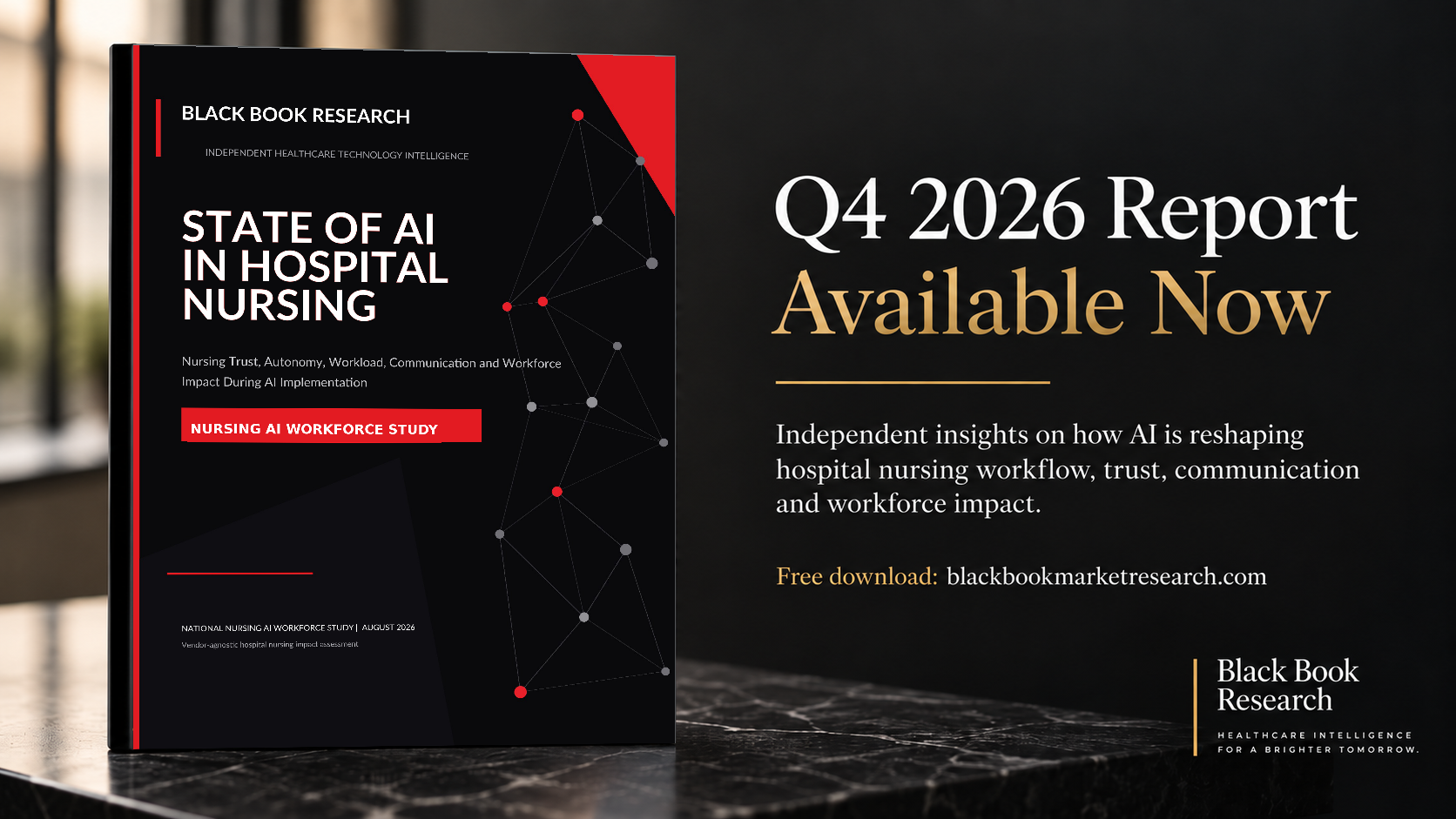
CHICAGO, September 23, 2026 (Newswire.com) - Black Book Research today announced findings from its State of AI in Hospital Nursing report, highlighting a disconnect between hospital automation's productivity promise and the experience of the nurses working alongside it. Among 202 hospital nursing professionals surveyed, 65% reported feeling individually watched or behaviorally tracked by at least one system, and 63% said AI introduced new tasks without removing previous work.
The warning extends beyond frustration with technology. Nearly half of respondents said they were likely to seek jobs or assignments with less AI exposure until systems become more reliable, transparent and clinically mature. One in three reported less willingness to report a near miss or uncertainty, a finding the report identifies as a warning about trust and openness, not evidence of a measured increase in patient harm.
"Hospitals can show a successful AI rollout on a dashboard while nurses experience a more complicated shift," said Doug Brown, Founder of Black Book Research. "The test is not whether a system generates more information or completes one task faster. It is whether nurses have less total work, clearer communication and more time for patients."
Added Work Undercuts the Productivity Promise
The report describes how time saved in one activity can be absorbed by new responsibilities elsewhere: reviewing automated outputs, correcting information, responding to alerts, explaining exceptions and reconciling conflicting instructions. Black Book's analysis calls for measuring the effect across an entire nursing shift rather than isolating the task a technology was designed to automate.
Fifty-eight percent of respondents reported additional time explaining exceptions, resolving conflicting outputs or communicating with managers, IT, quality or compliance teams. Fifty-two percent said they changed documentation timing or care sequencing to avoid negative flags or metrics. The findings raise a practical question for hospital leaders: Is the technology removing work, or creating new work that does not appear in the original business case?
The report also identifies nursing contributions that activity dashboards may overlook, including reassuring patients, explaining care to families, helping colleagues, locating equipment and adapting care when a patient does not fit a standardized pathway. These activities may appear as delays or missing activity when the system records tasks without the surrounding clinical circumstances.
More Monitoring Does Not Necessarily Mean More Visibility
A central concern is what happens when information collected for patient care or hospital operations becomes information used to evaluate employees.
Sixty-three percent of respondents said they had not been clearly informed about secondary workforce uses of AI-derived or algorithmic data, while 51% reported that AI-derived information was used for coaching or performance review.
Only 29% of hospital RNs surveyed said they could inspect information attributed to them, and 30% reported a defined correction or appeal pathway.
Black Book cautions that a digital record can be accurate without providing a complete account of nursing performance. A delayed entry may reflect an emergency, a deteriorating patient, missing equipment, family communication or assistance given to another nurse, not inattention or poor performance.
"A timestamp can show when something was recorded. It cannot, by itself, explain why a nurse changed priorities," Brown said. "A system that can flag a nurse should also support a fair way to review the circumstances, correct the information and challenge the conclusion."
One in Three Reports Less Willingness to Speak Up
The report's safety-culture findings move the discussion beyond whether nurses like a new technology.
Thirty-three percent of respondents said they were less willing to report a near miss or uncertainty, and only 38% said they felt safe overriding or disagreeing with AI. Separately, 49% reported using workarounds to reduce alerts or negative flags.
Black Book identifies these responses as reasons for hospitals to examine whether implementation conditions encourage clinical judgment and candid reporting or reward avoiding unfavorable metrics. The report distinguishes useful standardization from defensive behavior, such as additional documentation intended to prevent misinterpretation or changes in work sequence intended to avoid flags.
The study does not establish that AI caused patient injuries or that respondents stopped reporting safety concerns. It identifies self-reported changes in willingness and behavior that warrant attention alongside technical performance measures.
A Workforce Warning That Does Not Require Nurses to Quit
Ninety-six of the 202 respondents (approximately 48%) said they were likely or very likely to seek a job, transfer or clinical assignment with limited AI-enabled monitoring or decision support until the technology becomes more reliable, transparent and clinically mature. That is an expression of intent among the surveyed group, not a forecast that nearly half of American nurses will leave the profession.
The report notes that hospitals could experience workforce disruption even when nurses remain in nursing. Transfers to lower-exposure units, reduced hours, nonclinical assignments or moves to competing employers can affect staffing continuity and create additional recruitment, onboarding and overtime demands. These are potential operational consequences, not losses measured by the study.
The findings also expose a gap in frontline influence. Seventy-three percent of respondents said health system leaders emphasized return on investment, throughput and adoption over nursing impact, and 66% said frontline nurses were consulted after major design decisions. Black Book concludes that feedback channels lose credibility when concerns do not produce visible changes to workflows, configurations or deployment plans.
Nurses Support AI That Actually Gives Time Back
The report does not describe a blanket rejection of artificial intelligence. Respondents supported applications that remove existing work, identify clinically useful risks, preserve nursing judgment, explain limitations and protect the ability to override recommendations. The sharpest dissatisfaction was associated with monitoring-heavy and employment-related uses.
Black Book's 33-page report includes 18 nursing AI impact indicators, a hospital governance framework, a board dashboard and a 90-day corrective-action roadmap. Recommendations include giving direct-care nurses a meaningful role in deployment decisions, disclosing secondary uses of activity data, requiring human review before individual performance action, establishing correction and appeal processes, and measuring total workload and trust alongside financial and technical results.
"Their goal is not an AI-free hospital. It is a hospital where useful technology gives time back without taking professional judgment away," Brown said.
"Nurses should not have to choose between caring for the patient in front of them and satisfying a dashboard that cannot see the full situation."
The complete State of AI in Hospital Nursing report is available as a free download from Black Book Research, including detailed findings, the 18-indicator nursing AI impact framework and practical recommendations for hospital leaders at https://blackbookmarketresearch.com/uploads/pdf/Black_Book_State_of_AI_in_Hospital_Nursing_%20F%202.pdf
State of AI in Hospital Nursing: Nursing Trust, Autonomy, Workload, Communication and Workforce Impact During AI Implementation is an August 2026 vendor-agnostic assessment of 202 hospital nursing professionals with direct exposure to AI-enabled or algorithmic systems during the preceding 12 months. The cohort includes bedside nurses, charge nurses, managers, informatics professionals, utilization and case-management nurses, quality and safety personnel, administrators and advanced practice nurses.
The study evaluates implementation experience rather than technology brands. Findings describe the surveyed cohort; they are self-reported, subgroup comparisons are directional, and cross-sectional associations do not establish that AI alone caused dissatisfaction, workarounds or intentions to change roles.
About Black Book Research
Black Book Research provides independent healthcare technology intelligence based on verified client and user feedback. Its studies emphasize vendor-agnostic analysis, transparent methodology and decision-relevant performance measurement for global healthcare executives, clinical leaders, boards and technology buyers.
Media Contact: Caroline Brown, RN
For supporting research materials, contact research@blackbookmarketresearch.com 1.800.873.6590
SOURCE: Black Book Research
Source: Black Book Research