
Newswire Educational Resources
Explore Our Expert Advice, How-Tos and Guides
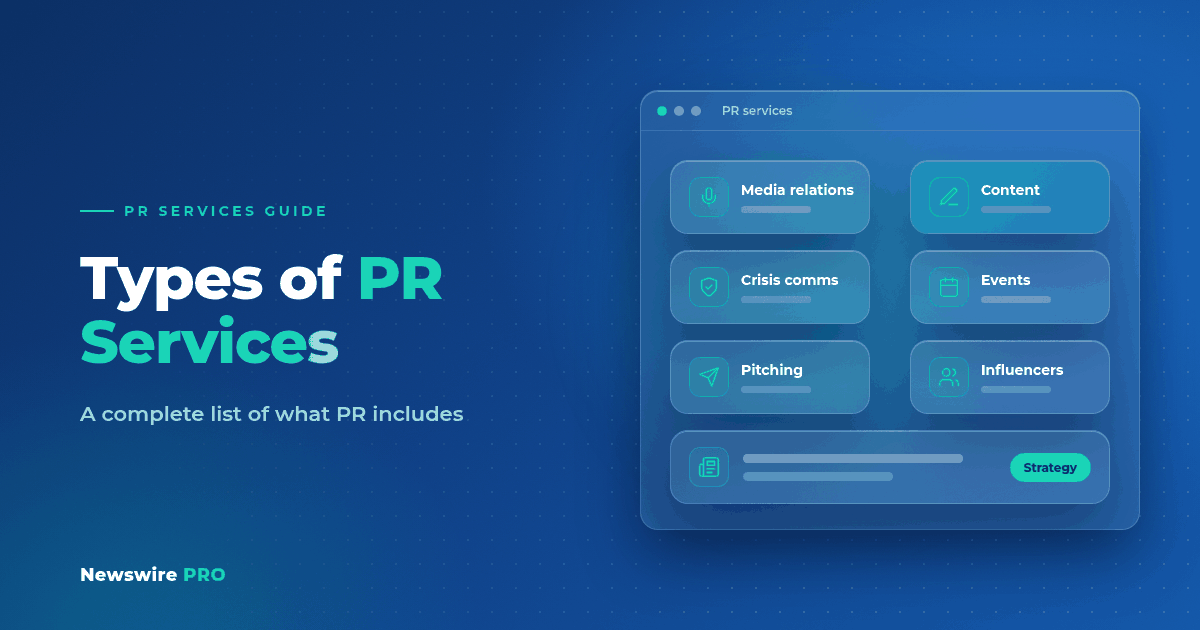
Types of PR Services: A Complete List of What PR Includes
PR services usually fall into six types of work: strategy and planning, content development, media relations and pitching, media monitoring, measurement and reporting, and specialized communications such as crisis or investor relations. Most companies buy a mix, based on what their own team can't cover.
What PR services are (and what they aren't)
The Public Relations Society of America (PRSA) defines public relations as "a strategic communication process that builds mutually beneficial relationships between organizations and their publics" ( PRSA). PR services are the work that turns that definition into results: planning what to say, writing it, getting it in front of journalists and tracking what happens next.
PR is not the same as buying ads. The U.S. Bureau of Labor Statistics notes that public relations specialists "get their stories covered by media instead of purchasing ad space in publications and on television" ( BLS). If you're weighing the two, see our guide to PR vs. advertising.
The main types of PR services
PRSA lists more than a dozen PR disciplines, from media relations and content creation to crisis communications and speechwriting ( PRSA). For a company buying help, they group into six types of work.
1. PR strategy and planning
Strategy is where a PR program decides what it is trying to achieve, who it needs to reach and which stories will get there. PRSA describes this work as "anticipating, analyzing and interpreting public opinion" and "setting objectives, planning, budgeting" for communications programs.
What to expect from a provider:
- Clear goals, such as awareness, credibility or search visibility
- A defined set of audiences and the outlets they follow
- Core messages and the proof points behind them
- A calendar of announcements, often called a press release calendar
2. Content development
Content is the raw material of PR. The BLS lists "write press releases and prepare information for the media" and "draft speeches" among the core duties of PR specialists. PRSA counts content creation, speechwriting and brand journalism as PR disciplines.
Typical content services include:
- Press release writing and editing
- Blog posts and articles that support your announcements
- Online media room or newsroom content: company facts, releases, images and contacts
- Search optimization so releases and posts can be found online
- Social posts that share your news
3. Media relations and pitching
Media relations is the work of matching your story with the journalists who cover it. It includes building targeted media lists, writing pitches, following up and setting up interviews. The BLS lists "respond to information requests from the media" and "arrange interviews for a client's top executives" among PR specialists' duties.
Pitching still matters to journalists. In Muck Rack's State of Journalism survey, 86% of journalists said at least some of their work began with a PR pitch. The same survey found that 62% prefer to be pitched in a one-to-one email and 69% prefer pitches under 200 words. Journalists valued clear relevance to their beat (70%), interview access to relevant sources (58%), original data or research (40%) and high-resolution images (37%) ( University of Minnesota summary of the Muck Rack survey).
That's why good media relations services start with targeting, not volume.
4. Media monitoring
Monitoring tracks where your company, competitors and topics show up in the news and online. The BLS notes that PR specialists "evaluate public opinion of clients through social media" and are usually in charge of monitoring and responding to social media questions. Monitoring tells you what coverage you earned, what people are saying and when a response is needed.
5. Measurement and reporting
PRSA describes PR as "researching, conducting and evaluating, on a continuing basis, programs of action and communications." In practice, reporting shows what was written, what was pitched, what coverage ran and what that coverage did for you, such as links or referral clicks to your site. Ask any provider what its reports include before you sign.
6. Specialized communications
Larger or more complex programs add specialist services. PRSA's list of PR disciplines includes:
- Crisis communications
- Executive communications
- Internal communications
- Investor relations communications
- Reputation management
- Events, social media and multimedia
- Corporate and marketing communications
Not every company needs these. You can add them when a specific need comes up, such as a crisis, an investor update or a leadership change.
Types of public relations by audience
Another way to sort the types of public relations is by who you're trying to reach. PRSA describes programs that include "marketing; financial; fundraising; employee, community or government relations," plus efforts to "influence or change public policy."
- Media relations: Main audience: Journalists, editors, producers. Common services: Press releases, pitching, interviews.
- Marketing communications: Main audience: Customers and prospects. Common services: Product news, content, social posts.
- Internal communications: Main audience: Employees. Common services: Announcements, leadership messages.
- Investor relations: Main audience: Shareholders and analysts. Common services: Financial news, disclosures.
- Community relations: Main audience: Local groups and residents. Common services: Events, local news, partnerships.
- Government relations and public affairs: Main audience: Policymakers and regulators. Common services: Position papers, public policy outreach.
What do PR services include? A checklist for comparing providers
Because packages vary from provider to provider, compare PR agency services by deliverables, not by name. Ask each provider:
- Strategy: Do you build a written plan and a press release calendar with us?
- Content: How many press releases, blog posts or other pieces are included, and who writes them?
- Search: Is content optimized for search?
- Media outreach: How do you choose target outlets and journalists? How many pitches are included?
- Tools: Do you use media databases and monitoring tools, and do we get access to the results?
- Reporting: What do your reports show, and how often do we get them?
- Turnaround: How long does a typical piece take from brief to draft?
- Pricing: What's included in the price, and what costs extra?
One more question is worth asking: is the coverage earned or paid? If a provider pays an outlet to run your story, that's advertising. The Federal Trade Commission says an ad shouldn't "suggest or imply to consumers that it's anything other than an ad" ( FTC).
Which types of PR services do you need?
Start with the gap you're trying to fill:
- You have news but no one to write it. You need content development: press releases, blogs and media room content.
- You have content but no media connections. You need media relations: targeting, pitching and monitoring.
- You have neither the time nor the team. You need strategy, content and media outreach handled together, which is what an outsourced PR team provides.
Whatever you choose, make sure reporting is included so you can see what the work delivers.
How Newswire PRO packages these services
Newswire PRO is a boutique PR team for companies that lack the resources, time or know-how to get media visibility. It covers the types of PR services above in three packages:
- CONTENT PRO: press release calendar, 12 written press releases, SEO optimization, 1 blog a month, an online media room and reporting. Social posting (1 post per press release) is an optional add-on.
- MEDIA PRO: custom media targeting, media pitching (up to 10 pitches per month), media monitoring, media databases and reporting.
- TOTAL PRO: both packages combined, an outsourced PR team at a fraction of the cost of a traditional agency.
Turnaround is approximately 3–5 days. Pricing depends on the package and scope, so contact us for pricing.
The CE Shop worked with Newswire PRO when, in the words of Liz Meitus, SVP of Corporate Communications, "We weren't at the stage to justify a full PR agency retainer, but we needed more structure and expertise than our internal team alone could provide." The CE Shop earned 34 high-value SEO backlinks through earned media, saw a 160% increase in PR-driven clicks and received inbound interest from journalists for the first time. PRO clients have earned 42+ media placements, including Forbes, PEOPLE and US News & World Report.
Compare Newswire PRO's press release writing and media pitching services, or explore the full range of PR services and how they help a business.
Frequently asked questions
What are the main types of PR services?
The main types are strategy and planning, content development, media relations and pitching, media monitoring, and measurement and reporting. Specialized services include crisis, executive, internal and investor relations communications.
What do PR agency services include?
It depends on the agency and package. PR agency services can combine planning, writing, media outreach, monitoring and reporting. Ask each provider for a written list of deliverables and what's included in the price.
Is PR the same as advertising?
No. Advertising buys space; PR earns coverage. The BLS notes that PR specialists get their stories covered by media "instead of purchasing ad space."
Do I need every type of PR service?
No. Start with the gap you can't fill in-house, such as writing or media outreach, and add services as your program grows.
Which PR services does Newswire PRO offer?
Newswire PRO offers content development, strategy and execution (CONTENT PRO), media outreach, targeting and pitching (MEDIA PRO), or both together (TOTAL PRO). Every package includes reporting.