
Newswire Educational Resources
Explore Our Expert Advice, How-Tos and Guides
PR vs. Advertising: Key Differences and When to Use Each
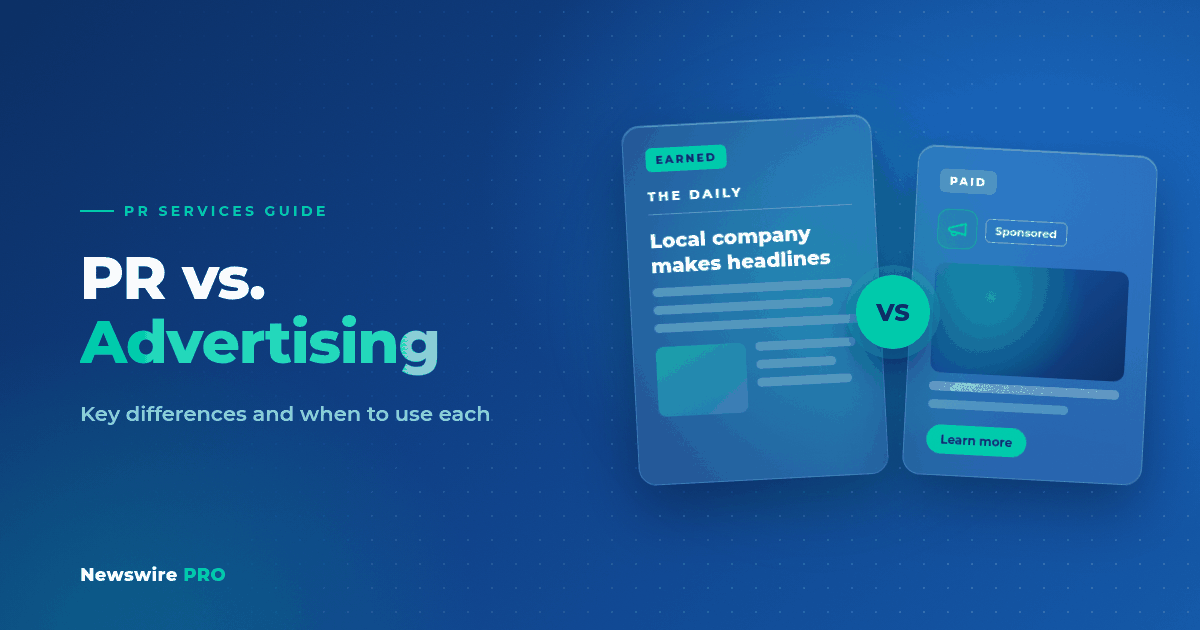
The key difference between PR and advertising is who decides what runs. With advertising, you pay for space and control the message. With PR, a journalist or editor decides whether your story is worth covering. Use advertising when you need guaranteed placement and timing, and PR when you need the credibility of independent coverage.
PR vs. advertising at a glance
The U.S. Bureau of Labor Statistics puts it simply: public relations specialists "get their stories covered by media instead of purchasing ad space in publications and on television" ( BLS). Here's how that plays out.
- What you pay for: Advertising: Ad space, airtime or clicks. Public relations: The work: strategy, writing, pitching and monitoring.
- Who controls the message: Advertising: You do. Public relations: The journalist or outlet does.
- Is placement guaranteed? Advertising: Yes, once the ad is bought and approved. Public relations: No, coverage has to be earned.
- How it's labeled: Advertising: As an ad or sponsored content. Public relations: As editorial content.
- How long it runs: Advertising: For as long as you pay. Public relations: As long as the outlet keeps the story up.
- Effect on Google rankings: Advertising: Buying Google ads doesn't change organic rankings. Public relations: Links from prominent sites can be a quality signal.
The last point comes straight from Google. It says the organic results "are not influenced by whether a business, individual, or organization buys ads," and that "one of the factors used to determine quality is understanding if other prominent websites link or refer to the content" ( Google).
How advertising works
Advertising is paid media. You buy a placement, such as a search ad, social ad, display banner, TV or radio spot, print ad or billboard, and the outlet runs your message as written. The U.S. Small Business Administration lists channels like "online advertising, radio ads, or billboards" as part of a marketing action plan ( SBA).
Search ads on Google are bought through an auction. In Google Ads, your budget "establishes a spending limit for an individual campaign," and your maximum cost-per-click bid "is the most you're willing to pay for a click on your ad." Google's auction uses both quality and bid to set your ad's position ( Google Ads Help).
What advertising does well:
- Control: You choose the words, images and offer.
- Timing: Your message runs when you need it, such as before a deadline or an event.
- Targeting: You can choose audiences, locations and placements.
- Direct measurement: Clicks, leads and sales can be tied to a specific campaign.
Its main limit is the label. The Federal Trade Commission (FTC) explains that "knowing that something is an ad likely will affect whether consumers choose to interact with it and the weight or credibility consumers give the information it conveys" ( FTC).
How PR works
PR earns attention instead of buying it. A PR program finds the news in your business, writes it up as press releases and other content, and pitches it to the journalists who cover your industry. If a journalist decides the story is relevant to their audience, they cover it in their own words.
PR is a real source of news. The BLS notes that "many radio or television special reports, newspaper stories, and magazine articles start at the desks of public relations specialists." In Muck Rack's State of Journalism survey, 86% of journalists said at least some of their work began with a PR pitch ( University of Minnesota summary).
It's also competitive. About half (47%) of journalists in the same survey said PR pitches are seldom or never relevant to their work, while 73% said PR professionals are at least moderately important to their success ( PR Daily). Relevance is what journalists want most: 70% said clear relevance to their beat was the most valuable part of a pitch ( University of Minnesota summary).
What PR does well:
- Credibility: Coverage comes from an independent outlet, not from you.
- Reach you can't buy: Editorial coverage can't be bought; it has to be earned.
- Search value: Google says links and references from other prominent websites are one of the factors it uses to judge quality.
- Lasting assets: Press releases, blog posts and your online media room stay on your site.
Its main limit is control. You can't guarantee that a story runs, when it runs or what it says.
The gray zone: sponsored content and paid placements
Some placements look like news but are paid for, such as advertorials, sponsored articles and "guaranteed" features. They can be useful, but they are advertising, and the rules for ads apply.
- Disclosure: The FTC says that if a disclosure is needed to prevent deception, it "must be clear and prominent." Terms such as "Ad," "Advertisement" or "Sponsored Advertising Content" are likely to be understood ( FTC).
- Links:
Google treats "advertorials or native advertising where payment is received for articles that include links that pass ranking credit" as link spam, and asks that paid links be marked
rel="sponsored"orrel="nofollow"( Google spam policies).
If a provider promises coverage in a named outlet for a fee, ask whether the placement is earned or paid. The answer tells you whether you're buying PR or advertising.
When to use advertising
Advertising can be the better fit when:
- You need people to see a message by a set date, such as a sale, a registration deadline or a launch day.
- You need to reach a narrow audience that news outlets don't cover.
- The exact wording matters, for example with a specific offer or legal language.
- You want to measure a direct response, such as sign-ups from a landing page.
When to use PR
PR can be the better fit when:
- You have real news: a launch, a partnership, a new hire, research or a milestone.
- You need third-party credibility with buyers, partners, investors or recruits.
- You want coverage and links that support your search visibility over time.
- You want to build relationships with the journalists who cover your industry.
How PR and advertising work together
You don't have to choose one forever. The two can support each other:
- Earn first, then amplify. When you earn coverage, you can promote it with paid media. The FTC notes that paying to distribute an independent article is a form of advertising, so you're responsible for making sure the claims it conveys about your product are "truthful, not misleading, and substantiated" ( FTC).
- Keep messages consistent. The BLS lists evaluating "advertising and promotion programs to determine whether they are compatible with their organization's public relations efforts" as a PR duty.
- Plan and budget both together. The SBA recommends a marketing plan that lists your channels, breaks down costs and compares "marketing and sales costs to the revenue it generates" to check your return on investment.
To map out an earned media plan, try Newswire's free PR and Earned Media Planner.
Get the PR side done for you
If advertising is covered but PR keeps slipping because no one has the time or know-how, that's the gap Newswire PRO fills. Our team plans your content, writes it and pitches your story:
- CONTENT PRO: press release calendar, 12 written press releases, SEO optimization, 1 blog a month, an online media room and reporting, with optional social posting (1 post per press release).
- MEDIA PRO: custom media targeting, media pitching (up to 10 pitches per month), media monitoring, media databases and reporting.
- TOTAL PRO: both together, an outsourced PR team at a fraction of the cost of a traditional agency.
Giant Le of CLS Health put the result this way: "We're creating a stronger brand message, and we've been able to get some earned media wins that give us credibility." PRO clients have earned 42+ media placements, including Forbes, PEOPLE and US News & World Report.
Turnaround is approximately 3–5 days. Contact us for pricing. See Newswire PRO's press release writing and media pitching services, or explore how PR services can help your business.
Frequently asked questions
What is the main difference between PR and advertising?
Advertising is paid space where you control the message. PR earns coverage that an independent journalist or outlet decides to publish.
Is PR cheaper than advertising?
They're priced differently, so compare them by goal. With advertising, you pay for the placement or the click. With PR, you pay for the work of planning, writing and pitching, and the coverage itself isn't bought.
Is PR part of marketing?
They overlap. PRSA lists marketing communications and integrated marketing communications among the disciplines within PR ( PRSA).
Can you pay for PR coverage?
You can pay for sponsored placements, but they're advertising and should be disclosed. Earned coverage can't be bought.
Which is better for a small business, PR or advertising?
It depends on your goal. Advertising gives you control and timing, and PR gives you credibility. See PR services for small business for a step-by-step starting plan.